


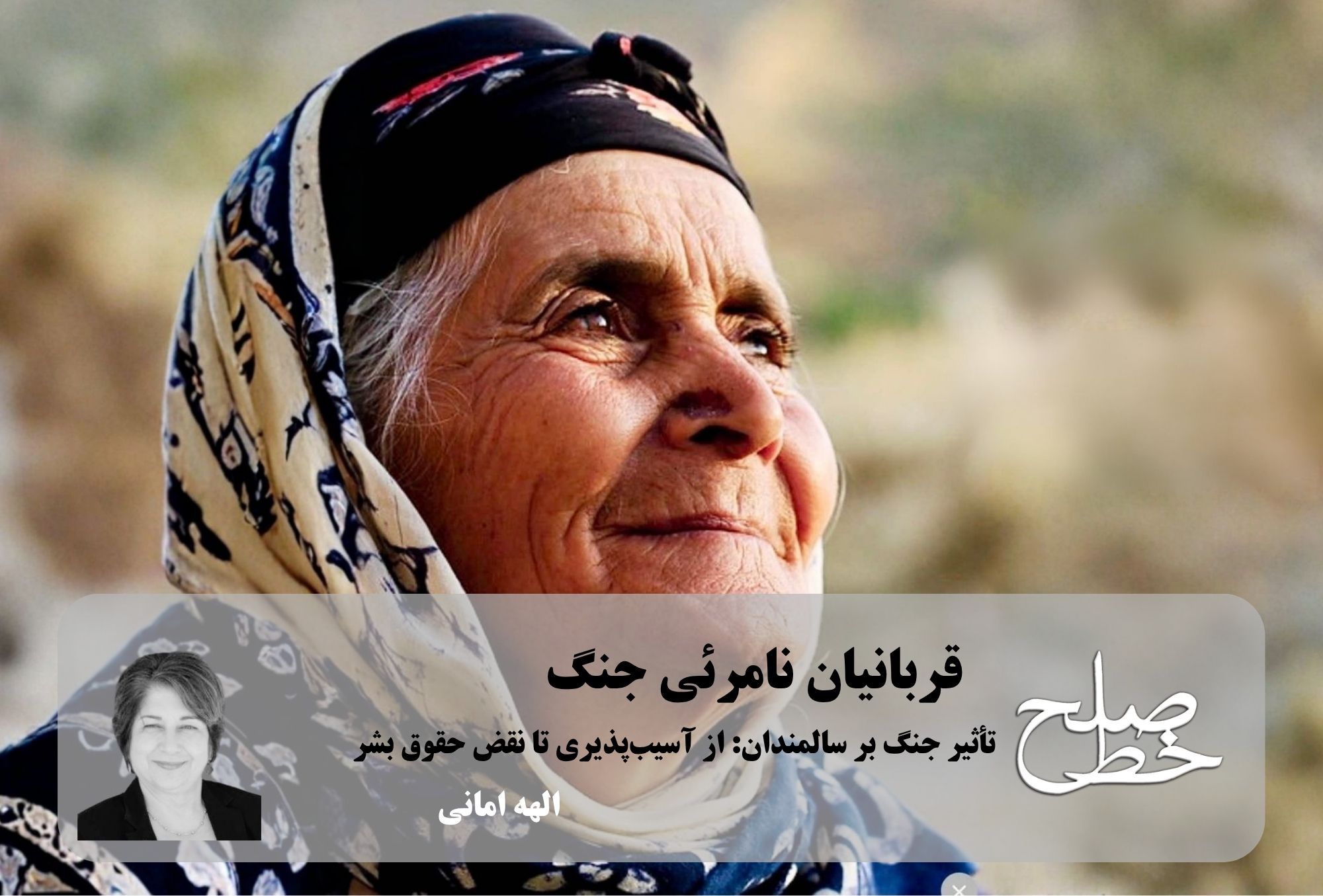
The Impact of War on the Elderly: From Vulnerability to Human Rights Violations/ Elahe Amani
Older persons in armed conflicts, much like children, face numerous and often overlooked forms of human rights violations; patterns in which age becomes a factor that intensifies vulnerability. Despite the extensive body of literature on the challenges faced by older persons, the 12-day war and its consequences, as well as the war that began on February 28, 2026 (9 Esfand 1404) and became known as the Forty-Day War, once again—following the eight-year Iran-Iraq War—demonstrated how the violence of war pulls the bodies and lives of older persons from the margins to the center of crisis and exposes them to structural neglect.
Under such circumstances, the lack of accountability and the structural inefficiency of the Islamic Republic of Iran have trapped thousands of older persons in a vicious cycle of poverty, aging, illness, insecurity, and war. Governments and those in power, based on their human rights obligations and the fundamental principles of governance, are responsible for guaranteeing security, health, access to food, housing, medical services, and social support for all citizens, particularly vulnerable groups, including children and older persons. Neglecting these responsibilities during wartime is not only a failure of public policy but also constitutes a violation of the right to life, human dignity, and the right of older persons to receive special protection.
This situation is not limited to Iran. In Ukraine, older persons bear the brunt of displacement, isolation, and lack of access to vital services, while in Gaza, people over the age of 60, amid the collapse of healthcare and humanitarian infrastructure, face a level of vulnerability that reduces the boundary between survival and death to the span of a single moment. In Iran as well, older persons, under the shadow of war and alongside sanctions and economic pressures, face a situation in which poverty, illness, and social insecurity are intertwined in an intersectional manner, eroding their daily lives.
Within this context, war is not merely a political or military event but a mechanism for intensifying structural inequalities; a mechanism that places the greatest burden on those who have the least ability to defend themselves, yet carry the greatest share of a society’s memory and history.
On October 9, 2025, Claudia Mahler, the United Nations Independent Expert on the enjoyment of all human rights by older persons, addressed the Seventieth Session of the Second Committee of the United Nations General Assembly (Social, Humanitarian and Cultural Affairs) in New York. (1) As in previous sessions, the committee examined issues related to human rights, including reports submitted by the special procedures of the Human Rights Council. In her remarks, she correctly noted that in today’s wars, civilians are no longer merely caught in the crossfire between opposing forces; they are increasingly placed at the center of the battlefield itself. Wars unfold in cities, villages, and residential areas and disrupt every aspect of citizens’ daily lives.
Among those who suffer the greatest harm, older persons occupy a special place. Not only are they often left behind during wartime evacuations, but they are also frequently excluded from emergency communications, despite needing support more than ever. Shelters are inaccessible to many of them. Healthcare services disappear due to the destruction of hospitals and care facilities, and family support networks collapse. Malnutrition and the spread of disease also severely threaten the lives of older persons.
Claudia Mahler further stated that many older persons remain in war-affected areas even when others flee because they have deep attachments to their homes and land, face physical limitations, or fear they may never be able to return home. The UN expert also referred to the painful phenomenon of “self-ageism,” which influences their decisions about whether to leave their place of residence. This group of older persons believes that they are no longer worth saving or capable of rebuilding their lives and that they would only become a burden on their families. Mahler also added that “information regarding evacuation and relief efforts is often disseminated only through digital platforms, which means that older persons without internet access or digital skills remain unaware of this vital information.”
It should be noted that older persons in wartime are not only exposed to direct violence like everyone else; forced displacement and the loss of access to resources that, despite pre-war shortcomings, had previously been available to them—including medication, access to medical centers, security, and even food security—make daily life significantly more challenging for them.
War and the Human Rights of Older Persons; A United Nations Convention on the Rights of Older Persons
At present, there is no specific United Nations convention dedicated to the human rights of older persons. However, over the past decades, the UN has recognized the rights of older persons through non-binding instruments (meaning official declarations or recommendations adopted by one of the UN bodies that carry moral and political significance but do not create legally binding obligations for states under international law) and is now moving toward drafting a binding international convention.
The most important existing document is the United Nations Principles for Older Persons, adopted by the General Assembly in 1991. In addition, in 2025, the United Nations Human Rights Council initiated an intergovernmental process to draft a treaty on the rights of older persons.
The United Nations Principles for Older Persons call on governments to guarantee the dignity, independence, participation, care, and security of older persons. These principles encompass issues such as access to healthcare services, adequate income, housing, education, social participation, and protection against abuse and discrimination based on age or other conditions.
Human rights and gender equality organizations argue that existing human rights treaties do not specifically and explicitly protect older persons against age discrimination, neglect, violence, and various forms of abuse. The adoption of a dedicated convention would make states’ obligations clearer and more enforceable in areas such as healthcare, social protection, employment, long-term care, and legal protections.
In April 2025, following years of discussion within the Open-ended Working Group on Ageing, the UN Human Rights Council launched the process of drafting an international treaty on the rights of older persons. According to a report by HelpAge International, the first organizational meeting of this working group was held in February 2026.
The Processes of War and Armed Conflict for Older Persons
During wars and armed conflicts, older persons suffer not only from direct attacks but also from indirect harms that violate their fundamental rights, including the right to security, human dignity, health, housing, and freedom from torture or cruel, inhuman, and degrading treatment. In practice, these violations may include arbitrary detention, sexual violence, abduction, destruction of homes, deprivation of humanitarian assistance, and disruption of the daily lives of older persons.
Because of reduced mobility, disability, caregiving responsibilities, fear of displacement, or emotional attachment to their homes and land, older persons are more likely to remain in conflict zones. This places them at greater risk and sometimes makes them easier targets for violence, particularly when they are unable to flee with younger family members.
Moreover, war disrupts family networks and caregiving systems, leaving many older persons isolated and dependent on humanitarian systems that are often unable to reach or effectively support them.
In June 2026, the Oxford Law Review published an article entitled “Protecting the Rights of Older Persons in Hazardous Situations and Humanitarian Emergencies Through the Proposed United Nations Convention on the Rights of Older Persons” by Doug Kyby and Natalie Baird. (2) This article is of particular importance in examining the situation of older persons in war and military conflicts.
The introduction emphasizes the reality that older persons in crisis situations—such as war, natural disasters, forced displacement, and humanitarian emergencies—are more vulnerable than other population groups. The authors refer to recent examples, including the devastating Valencia floods in Spain in 2024, in which a large proportion of victims were over the age of 70; the widespread Los Angeles wildfires in 2025, which created serious challenges for older persons living in care facilities in terms of evacuation, treatment, and care; as well as the war in Ukraine and the crisis in Gaza, where older persons experienced compounded harms due to interrupted healthcare services, shortages of medicine, lack of pensions, and difficulties with mobility.
A particularly important point raised in this legal article is that older persons should not simply be viewed as a “vulnerable group.” The authors remind readers that aging is not merely a biological phenomenon but a social construct, and that older persons can play effective roles in crisis management. The experience of earthquakes in New Zealand has demonstrated that the active participation of older persons in post-crisis planning and reconstruction can be a valuable asset to society. Likewise, the knowledge and experience of elders in Indigenous communities are of particular importance in confronting environmental crises and climate change. Therefore, older persons should be viewed as active agents and holders of experience, not merely recipients of aid and support.
The authors then argue that today’s world—with increasing armed conflicts, escalating impacts of climate change, and expanding humanitarian crises—needs effective legal frameworks to protect older persons more than ever before. They believe that older persons face a situation within international human rights law and humanitarian policy that may be described as one of “relative invisibility.” This concept refers to the neglect of the specific needs and rights of older persons, even though many simultaneously face age discrimination, poverty, disability, illness, or other forms of vulnerability.
The article further points to an important international development: the adoption of Human Rights Council Resolution 58/13 in April 2025, which initiated the drafting of a binding international treaty on the rights of older persons. The authors regard this decision as a historic turning point because, for the first time, the international community formally accepted the necessity of developing a dedicated convention for the protection of older persons’ rights. This development was the result of more than fifteen years of efforts by civil society organizations, experts, and UN mechanisms working in the field of aging.
The article also explains that the COVID-19 pandemic exposed serious weaknesses in legal systems and policymaking regarding the protection of older persons, as many governments ignored the needs and rights of older persons in their emergency plans, resulting in widespread suffering and mortality among them. This experience further underscored the necessity of creating an independent legal instrument for the protection of older persons.
Finally, the article—which examines in detail various aspects of the need for a convention on the rights of older persons—presents a legal argument for including a specific article on “hazardous situations and humanitarian emergencies” in the proposed UN Convention on the Rights of Older Persons. By examining existing international and regional instruments, the authors seek to offer a concrete proposal for the text of such an article so that protection of the rights of older persons during war, natural disasters, displacement, and other humanitarian crises becomes a clear and binding obligation under international law.
According to the authors, drafting an international convention on the rights of older persons presents a historic opportunity to address one of the major shortcomings of the international human rights system. Just as dedicated conventions on the rights of children, women, and persons with disabilities have succeeded in drawing global attention to the specific needs of those groups, a dedicated convention for older persons could likewise strengthen their legal protection.
The authors also emphasize that “this specific article should not only focus on protecting the lives, health, dignity, and access of older persons to essential services, but should also guarantee their participation in planning, decision-making, relief efforts, and post-crisis reconstruction.” In the authors’ view, “older persons are not merely recipients of assistance; their experience and knowledge can contribute to enhancing community resilience in the face of crises.”
A brief look at the effects of war on older persons in the two recent wars in Ukraine and Palestine demonstrates the extensive and catastrophic dimensions of these conflicts on the lives of older persons.
In the war in Ukraine, which began with Russia’s large-scale invasion on February 24, 2022, nearly one-quarter of the population consists of older persons, and one out of every four people affected by the war is over the age of 60. Furthermore, nearly half of civilian casualties are older persons. Although the United Nations has confirmed the deaths of more than 16,000 civilians, older persons have suffered disproportionately compared to others.
Although people over 60 constitute only about 25 percent of the population, in areas near the front lines they account for nearly half of civilian casualties. Many older persons have remained trapped in war zones because of physical limitations, inability to relocate, emotional attachment to their homes and communities, or lack of access to digital evacuation warnings before military attacks.
In the Israel-Hamas war, which many international bodies assess as constituting genocide and which began on October 7, 2023, more than 73,000 Palestinians in Gaza have lost their lives. During the first 19 days of the war in 2023, older persons accounted for 8.6 percent of the deaths while constituting only 5 percent of the total population. Although the Gaza Ministry of Health has not published separate statistics for people over the age of 60, demographic data indicate that women, children, and older persons together account for approximately half of all casualties. Palestinian older persons have been severely affected by the collapse of the healthcare system and the use of starvation as a weapon of war. During periods of intense conflict, older persons represented a significant proportion of those killed. They faced enormous difficulties in accessing safe shelters, escaping heavy bombardment, and obtaining essential medications for chronic illnesses.
A comprehensive report entitled “The Situation of Older Persons in Gaza; June 2025,” published by the United Nations Relief and Works Agency for Palestine Refugees in the Near East (UNRWA), (3) as well as a research article by Brown University entitled “The Human Costs of the Gaza War: Direct and Indirect Mortality from October 7, 2023 to October 3, 2025,” (4) both point to the challenges involved in gathering data and information concerning indirect war-related deaths in Gaza.
War in Iran
The older population in Iran experienced severe direct, indirect, and psychological consequences during both the 12-day war and the war that began on February 28, 2026, with the attack by the United States and Israel on Iran.
The catastrophic war imposed on the people of Iran displaced millions, deprived more than two million people of employment and livelihoods, and turned homes built through years of labor, savings, and hardship into piles of rubble. In this context, older persons, children, persons with disabilities, and low-income families were more exposed than others to poverty, homelessness, hunger, illness, and insecurity. War does not only take human lives; it also tears apart the economic, social, and cultural foundations of a country.
This war resulted in the destruction of more than 125,000 residential and public buildings, including 339 healthcare centers, 32 universities, and 857 schools. In addition, more than 20,000 industrial units were directly destroyed, while thousands of dependent businesses were forced either to close or reduce their operations, to the extent that approximately 20 percent of the country’s production capacity suffered direct damage.
Ports, transportation networks, and critical infrastructure essential for the transfer of basic goods and raw materials also sustained heavy damage. Some estimates indicate that damage to civilian infrastructure alone exceeded $300 billion—a staggering figure that reflects only reconstruction costs and does not account for the broader economic, social, and human consequences.
The impact of such widespread destruction cannot be reduced to statistics about demolished buildings or closed factories. It signifies the expansion of poverty, increased unemployment, worsening food insecurity, a housing crisis, and reduced access to healthcare and education. Under such circumstances, the most vulnerable segments of society, especially older persons, pay the highest price for war—a generation that, after a lifetime of work and effort, now faces insecurity, loss of assets, social isolation, health crises, and an uncertain future.
Official estimates by the Statistical Center of Iran indicate that the country’s older population reached approximately 10.2 million people by 1404 (2025–2026). Of these, about 67 percent—equivalent to 6.8 million people—are older persons living alone due to the death of a spouse, divorce, or never having married.
For many older persons, war does not simply mean hearing explosions, receiving alarming news, or feeling insecure; it also disrupts the familiar rhythm of daily life. According to recorded statistics, the total number of war-related deaths in Iran is estimated at between 3,600 and 6,000, of whom approximately 1,700 were civilians. However, no research or official statistics have yet been published regarding the number of older persons who died.
Nevertheless, many older persons faced problems similar to those experienced by older persons in other war-affected regions, including disruptions in access to healthcare services and medications for chronic illnesses; difficulties in evacuation and relocation due to physical limitations; greater dependence on caregivers and family members; vulnerability to power and water outages and disruptions in public services; increased anxiety, fear, and the revival of painful memories of the Iran-Iraq War among many older persons—particularly under circumstances in which, for many, the psychological resilience of youth (among those who experienced the difficult and anxiety-ridden days of the eight-year war with Iraq) has diminished.
There are also no precise statistics regarding the number of older persons whose children have emigrated. However, official estimates indicate that more than 60 percent of Iran’s population of over 10 million older persons—approximately 6 million people—live alone, and there is little doubt that, under the shadow of war and insecurity, loneliness can impose even greater psychological pressure on them.
The results of a limited national survey on “Assessing the Impact of War on the Health of Older Persons,” conducted with the participation of 2,175 older persons in Iran, indicate that war has had extensive effects on their health, livelihoods, and well-being. According to the study, 36 percent of older persons experienced a decline in physical health, 37 percent a deterioration in sleep quality, and 56 percent increased war-related anxiety, while feelings of security decreased among 27 percent of participants.
Economically, approximately 49 percent reported worsening financial conditions, and 60 percent reported increased living costs, with nearly one-third assessing their economic situation as having become significantly worse. In addition, 37 percent stated that carrying out daily activities had become more difficult than before.
In the area of healthcare services, one-quarter of older persons experienced difficulties accessing physicians and medications, citing treatment costs, drug shortages, and transportation difficulties as the primary reasons. The findings also indicate that low-income older persons and those living alone suffered the greatest harms in terms of physical health, access to services, and feelings of security. At the same time, increased communication with family members, feelings of social support, and the use of telephone-based medical services were among the positive outcomes observed during this period.
Internet shutdowns were also among the factors that had profoundly negative effects on the mental health of older persons in Iran. For many among the nearly five million Iranians living in the diaspora who have elderly relatives in Iran, the restriction and disruption of internet access during two major protest and military periods totaling 109 days created considerable concern.
According to the research article “The Culture of Nursing Care in Iranian Nursing Homes: An Ethnographic Study,” published in the Journal of Qualitative Research in Health Sciences, (5) only about 15,000 older persons in the country are housed in centers and care facilities supervised by the State Welfare Organization. There is little doubt that wartime conditions have also negatively affected the physical and mental health of these individuals.
Another profoundly catastrophic dimension of the war and the attacks by the United States and Israel on Iran is the interconnection of war, poverty, and aging—a situation that can also be analyzed through the lens of intersectionality. Nearly one-third of older persons in Iran live below the absolute poverty line, and approximately 16 percent live in severe poverty. This situation is even more alarming for older women; according to demographic reports, approximately 62 percent of older women living below the poverty line experience severe food insecurity.
For this vulnerable group, war is not merely a threat to life. Alongside the limitations associated with aging, poverty further disrupts the fragile cycle of their daily existence. Under such circumstances, the simultaneous presence of these three factors multiplies the risks and pushes the lives of many older persons to the brink of crisis and even death.
In conclusion, international research demonstrates that older persons are often the “invisible victims of war”—people who have neither the ability to escape battlefields, nor easy access to medical and humanitarian services, nor a proportionate place in humanitarian and support programs. Although they are more exposed than others to death, illness, hunger, displacement, and profound psychological harm, their voices are heard less often and their needs are more frequently ignored.
Yet aging is not merely a biological condition; it is to a large extent a social and contextual construct that acquires different meanings in every society and historical setting. Within this framework, older persons are not only bearers of experience and collective memory but, when appropriate conditions are provided, can also play effective, supportive, and strategic roles in confronting crises such as war and natural disasters. Ignoring these capacities means excluding a portion of society’s human and social capital.
Older persons are carriers of wisdom, guardians of forgotten narratives, and sturdy roots that make possible the connection between past and future. The lived history of a nation is inscribed upon their foreheads, and within their silence flows accumulated knowledge of living, resilience, and survival. They are not merely reminders of weakness; they are embodiments of experience.
From a human rights perspective, protecting older persons during wartime is not an act of charity or a matter of choice; it is a legal and ethical obligation aimed at safeguarding human dignity. The international community, governments, and humanitarian organizations must ensure that no person is deprived of the right to life, security, health, and access to humanitarian assistance simply because of old age. Age must not become a factor that renders human suffering invisible, for human dignity knows no boundaries and should never become a casualty of war.
Protecting older persons during wartime is not an act of charity or a matter of choice; it is a legal and ethical obligation aimed at safeguarding human dignity and implementing the fundamental principles of human rights. The primary responsibility for fulfilling this obligation rests with governments and those in power, who must be held accountable for the consequences of their decisions and policies. In light of the 14-point agreement between the United States and Iran and the release of financial resources to the Iranian government, it is expected that these resources will be used to rebuild destroyed homes, create safe conditions for the return of displaced persons to their places of residence, provide livelihood support to families until reconstruction is completed, address food insecurity, and guarantee universal access to healthcare and educational services—services that were severely disrupted for millions of people, especially older persons and other vulnerable groups, during the war.
Age should not become a factor that renders human suffering invisible, nor should human dignity become a casualty of war, neglect, or the lack of accountability of those in power. Rebuilding people’s lives, supporting those affected, and guaranteeing their fundamental rights are not only humanitarian necessities but also legal and ethical responsibilities that must be pursued with full transparency and accountability.
ّFootnotes:
Speech by Claudia Mahler, United Nations Independent Expert on the enjoyment of all human rights by older persons, Seventieth Session of the Second Committee of the United Nations General Assembly, New York, October 9, 2025.
Kyby, Doug, and Baird, Natalie. Protecting the Rights of Older Persons in Hazardous Situations and Humanitarian Emergencies Through the Proposed United Nations Convention on the Rights of Older Persons. Oxford Law Review, Vol. 26, No. 2, June 2026.
United Nations Relief and Works Agency for Palestine Refugees in the Near East (UNRWA). The Situation of Older Persons in Gaza. Advocacy Report, June 24, 2025.
Crawford, Neta. The Human Costs of the Gaza War: Direct and Indirect Mortality from October 7, 2023 to October 3, 2025. Costs of War Project, Brown University, October 7, 2025.
Pouraboli, Batool; Dehghan-Nayeri, Nahid; Sarkouhi, Zahra; and Khodabandeh Shahraki, Sedigheh. The Culture of Nursing Care in Iranian Nursing Homes: An Ethnographic Study. Journal of Qualitative Research in Health Sciences, Vol. 13, No. 2, 2024, pp. 65–70.
 Created By: Elahe Amani
 June 22, 2026
Tags
Elahe Amani Elderly Elderly rights Iran-US war peace line United Nations Human Rights Council