


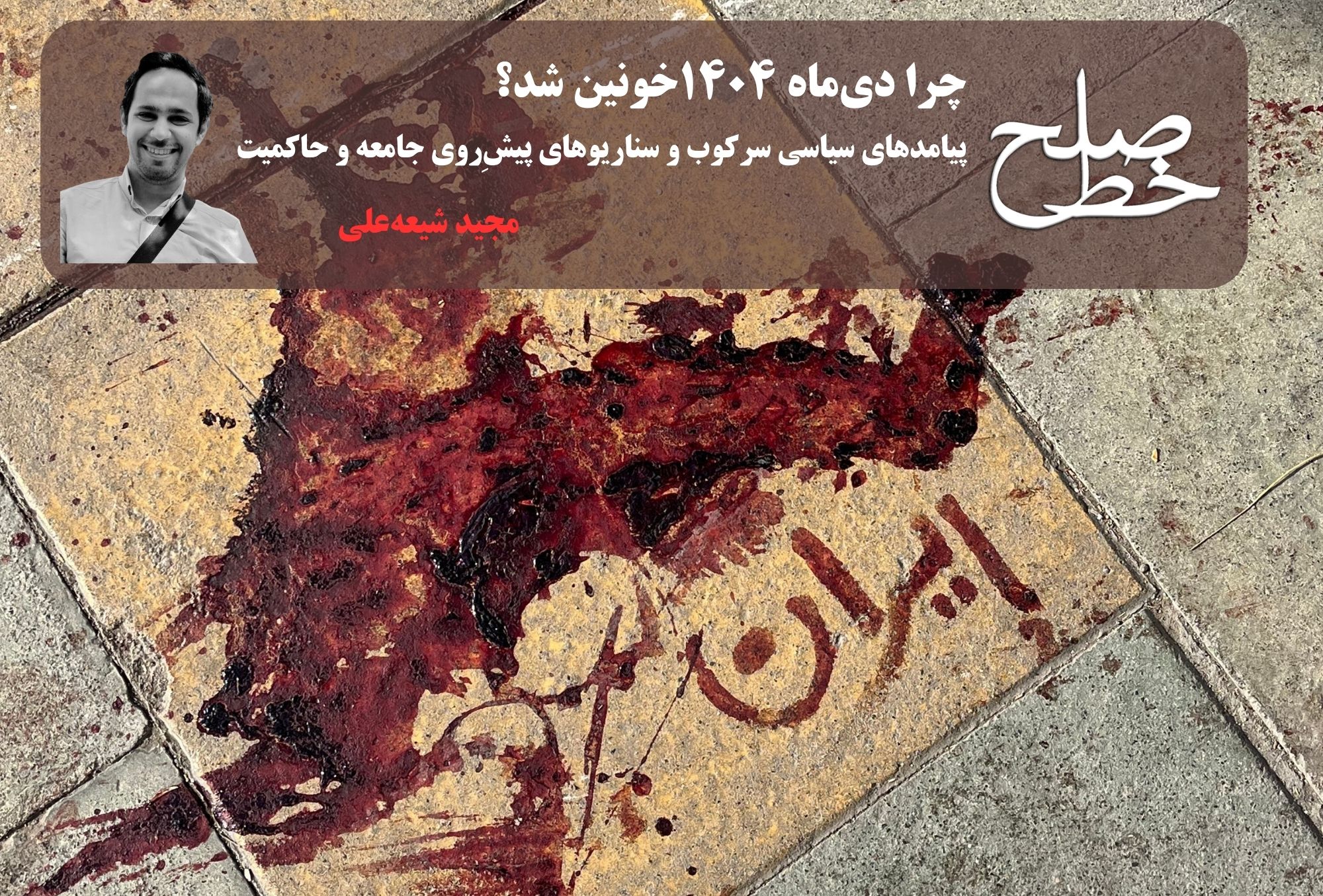
Why was January 1404 bloody?/ Majid Shia Ali
Throughout the contemporary history of the world, various governments have been responsible for the killing of a large portion of their citizens, from the crimes of the Khmer Rouge to the history of genocide in Bosnia, from the Nazi gas chambers to the famines resulting from the policies of the Stalin and Mao governments. Even the horrific repression of protesters such as Tiananmen in China or the entry of Soviet tanks into Prague are also present in the contemporary historical experience, but if we do not say that the experience of our people, who witnessed the loss of several thousand Iranian citizens protesting on the streets in two nights, is outstanding in the contemporary history of the world, at least it is unparalleled in the history of our country. This huge tragedy has made the numbers of those killed in various historical events meaningful for the people of Iran, and every number is compared to it. But why was such an experience created and what will be the results?
Many people limit themselves to the necessary condition to analyze why it occurs and present being a criminal as the only cause of the crime, while for such a major crime to occur, in addition to the necessary condition of the will to act, sufficient conditions such as the potential to commit it and the existence of necessity are also required. These two cases require examination. First, there must be protesters in the streets and the government must face a serious challenge from society to commit murder in the streets. Although the governments of Stalin and Hitler sent some citizens to labor camps simply for being born into a family, this is not the usual practice in non-democratic governments. Creating a widespread challenge from society requires several basic axes. First of all, governments need two basic foundations for governance. On the one hand, the rulers and the type of ruler must be the best possible in the minds of the majority of society, and on the other hand, the system must have such a level of efficiency that it does not lead to a high level of dissatisfaction.
These two axes are not two separate issues and affect each other. A government lacking legitimacy can provide itself with an efficient legitimacy by creating high economic growth and providing the necessities of life for citizens, and conversely, a government enjoying ideological legitimacy can prove the failure of that ideology in the field and lose its legitimacy by getting involved in numerous and diverse crises. Also, rulers who lack legitimacy have less chance of gaining the support and cooperation of citizens, and this situation may lead to the growth of crises and the inability of the regime to resolve them. During the sixties of the Islamic calendar in Iran, despite serious crises such as war, economic recession, and the like, we did not witness widespread expressions of citizen dissatisfaction because the ideology of governance and the charismatic leadership of Ayatollah Khomeini continued to provide legitimacy for a large part of society. In China over the past few decades or the Arab countries of the Persian Gulf, it can be considered that widespread dissatisfaction does not arise due to the experience of relatively continuous economic growth.
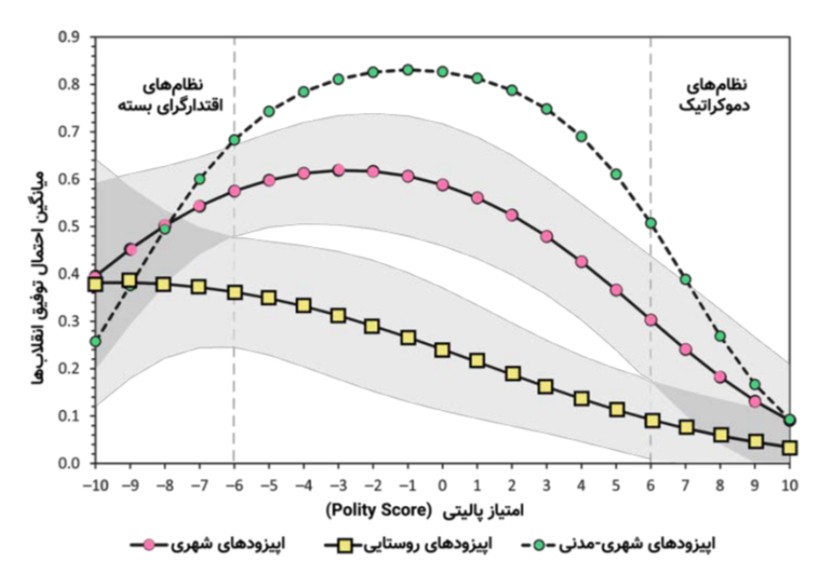
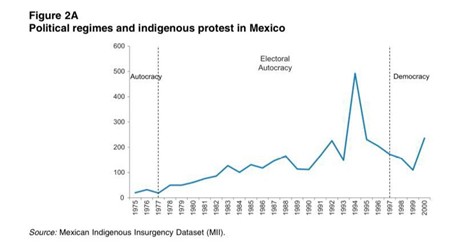
But in addition to these two axes, a third indicator is also raised. The political opportunity structure for protest is very serious. In the midst of the most critical possible conditions, such as the Great Famine in Mao’s China or the similar one in Stalin’s Ukraine, no protest is formed. In conditions where a high level of repression deprives citizens of the possibility of collective action, it becomes very difficult to form a protest. Various studies have shown that the most closed authoritarianisms of our time, i.e. structures that lack any competitive elections at the national level, such as Turkmenistan, Saudi Arabia, China, North Korea and many others, eliminate all opportunities for creating collective action for citizens. According to two different studies, in the first diagram we see that urban revolutions are less likely to occur in closed authoritarian structures, and in the second diagram we see that the rate of protest uprisings within a specific undemocratic government (e.g. Mexico) increases with the transformation from a closed authoritarianism to a competitive authoritarianism and decreases with democratization.
In addition to the type of governance affecting the extent to which opportunities for protest are created, the availability of resources within society is important for creating political mobilization. Theories about collective action that were put forward in the second half of the 20th century emphasized more on organizing to form protests. However, in the last two decades, with the spread of the Internet and its social media, the formation of protest actions has become easier, and for this reason we are faced with a higher number of street gatherings in the last decade than in the entire 20th century. It can be speculated that the level of access to the Internet and the degree to which governments control the Internet can affect the formation of protests.
Accordingly, given that, according to the National Survey of Iranian Values and Attitudes, more than 80% of the population in Mr. Raisi’s government agreed to separate the institution of religion from the institution of government. Given that the current government structure is based on the merger of these two institutions with the axis of Velayat-e-Faqih, the legitimacy of this government had reached about 10% in previous years. On the other hand, the economic recession of more than ten years and the lack of a promising perspective for its resolution have brought the system’s inefficiency to the highest level. In addition, the spread of the Internet and the consolidation of competitive elections and a level of civil society and minimal networking have provided the potential for widespread political mobilization. All of these have led to the formation of protests over the past eight years that have been growing like a snowball. In the latest episode of these protests in January of last year, their scope was much greater than previous times, and the government felt the need for bloody repression.
The third axis that creates such a massive massacre is the power and potential for it. Usually, authoritarian systems do not have the power to resist when faced with a large population of unarmed people, and the forces of repression are not willing to massacre them on a large scale, thus preventing the dictator from carrying out the repression. The lack of disobedience of the forces of repression and the implementation of this level of killing can be attributed to several factors.
First, rentier governments that rely on natural resource revenues for a significant portion of their budgets are more likely to maintain support for the repressive apparatus than others because of their financial independence from society. Second, this ability is enhanced if there are foreign military and paramilitary supporters who are prepared to enter the country and suppress. To examine this component, we should pay attention to the experience of the Eastern Bloc under the shadow of the Soviet Union and assess the impact of regional militias affiliated with the Iranian government. Third, governments that emerge from social revolutions usually have their own ideological military force that is more loyal. In these types of governments, the line between military and civilian is blurred, and therefore the likelihood of military disobedience is reduced. Fourth, the strategies of the opposition can create doubt in the heart of the repressive force or make them more determined in carrying out repression. When the radical faction takes the field and does not define a boundary with violence, the undemocratic government finds a good tool to legitimize any crime for its repressive force. Based on all the above reasons, it can be predicted that the government has a high capacity for repression and will apply it in calling for protests on January 8 and 9.
The more fundamental issue today is the impact that this horrific crime has had on the future. Several fundamental axes can be examined in this regard. First, according to historical experience, after the bloody suppression of a largely nonviolent protest campaign, the grounds for protest do not disappear, and three scenarios are likely to occur. In the first scenario, as the anger resulting from the suppression increases, subsequent protest episodes will be more violent and with different tactics. As was the case after September 7, 2014, the opposition turned to widespread strikes. In the second scenario, violent currents are strengthened due to frustration with nonviolent methods. As was the case after the repressions of 1941 and 1942, organizations with an armed approach were formed during the 1940s. In the third scenario, widespread despair is created by creating hopelessness about any change. As was the case after the coup of August 19, 2014. Meanwhile, the armed approach, which is not very feasible in our era, given the vastness of the Internet and the presence of a strong central government, can ultimately be achieved at the level of blind terror. But whether we witness the spread of despair or the restoration of nonviolent activism in society depends on the performance of all actors.
The second result: Society has become more polarized than ever. This polarization leads to increased levels of violence, the destruction of moderate forces and policies, and resistance to consensus-building. Also, the widespread use of violence itself reduces social capital and minimizes interpersonal trust. In such circumstances, the hope for democratization and development is less than in the past. In such circumstances, concerns outweigh hopes, and to offset its destructive effects on society, there is a need for greater effort, dynamism, and growth of civil society.
The third conclusion: The experience of widespread repression may lead to a decline in the social base of the government, and due to the presence of radical opposition forces, it may make the rulers more united and coherent. This component also depends on the subsequent behavior of the moderate forces and their chances of appearing in the main arena of political struggle so that they can create a rift within the government. If the internal cohesion of the government is strengthened, the existing undemocratic conditions will be able to maintain themselves in power.
As it turned out, this humanitarian disaster has not only led to the loss of many lives of our compatriots, but it could also have other undesirable consequences in the future. A change in the worrying outlook ahead can be achieved, above all, through the activism of moderate forces and the strengthening of civil society. A path that, although it seems very difficult, is not impossible.
 Created By: Majid Shia’ali
 February 20, 2026
Tags
Arrow of Fire Criminal Democracy Development and democracy Human rights Majid is a Shia follower of Ali. Majid Shia Ali Massacre 1404 peace line Peace Line 178 Protests Rentier rule Suppressing protesters Suppression The Di 1404 Uprising Uprising of 1404 ماهنامه خط صلح