


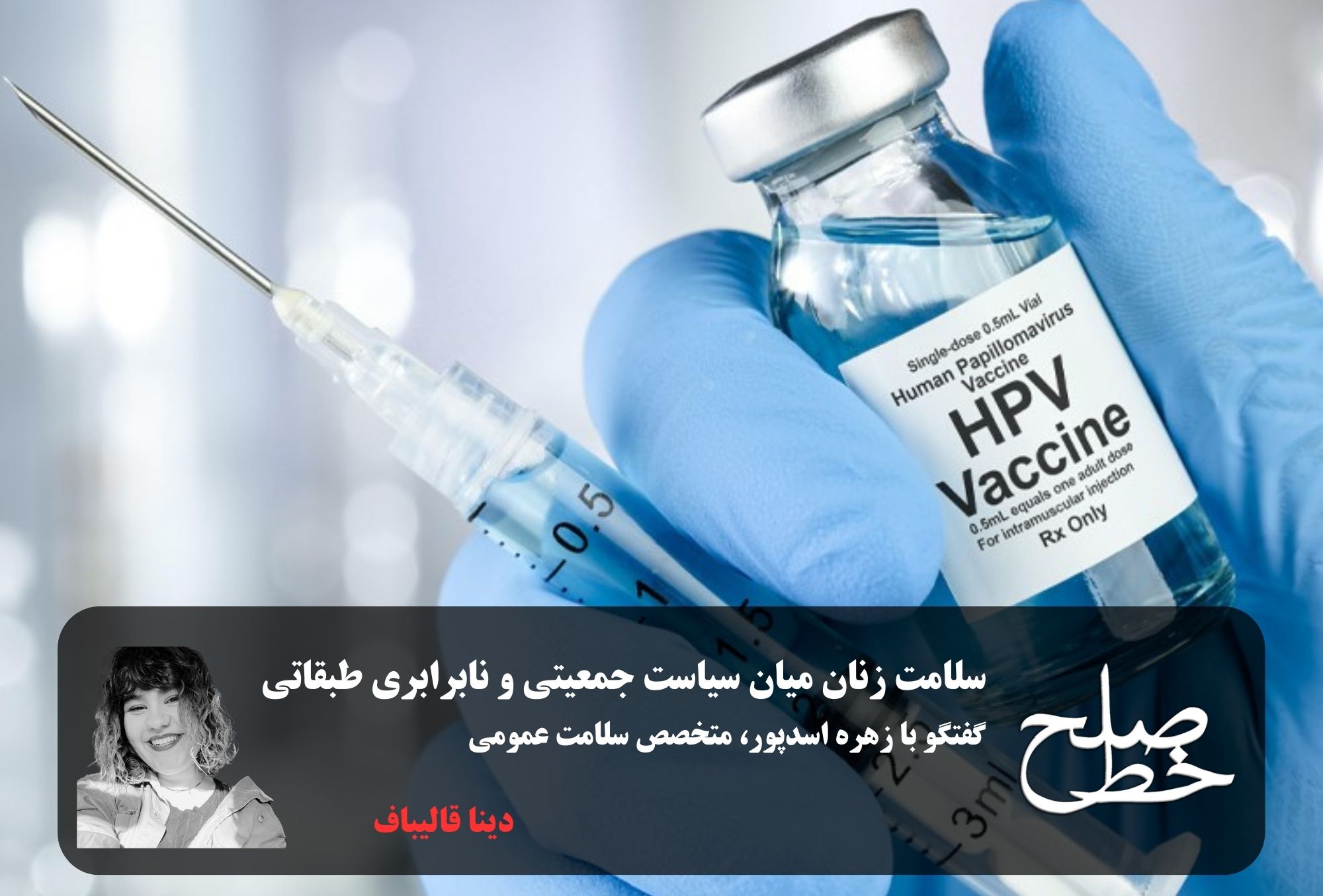
Women’s Health Between Population Policy and Class Inequality / Dina Ghalibaf
Following the sudden and quiet removal of the Iranian “Papilloguard” vaccine from pharmacies across the country, women who had been awaiting national vaccination to prevent infection with the human papillomavirus (HPV) have been forced to turn to foreign vaccines at prices several times higher—vaccines whose cost is incompatible with the economic circumstances of many women.
Under such conditions, in which access to the HPV vaccine has clearly become class-based, the “National Women’s Health Document” has been issued by the President of the Islamic Republic; a document that is intended to improve women’s physical, psychological, and social health indicators. However, the timing of this announcement, alongside the unequal access of women to basic health services, raises serious questions about justice in health.
Women’s Health; A Document with a Limited Definition of “Right”
The “National Women’s Health Document” was issued on 4 Dey 1404 (December 25, 2025) by Masoud Pezeshkian. The document covers all stages of women’s lives, from puberty to menopause. Government officials claim that women’s health indicators have improved over the past three decades and that this document has been drafted to further promote comprehensive women’s health.
Zohreh Asadpour, a women’s rights activist and public health specialist, offers a different interpretation in an interview with Khat-e Solh. She states: “Although the declared goal of the document is to promote comprehensive women’s health in its physical, psychological, and social dimensions, this comprehensive health is defined within a framework of family-centeredness, traditional gender roles, and population policies.”
According to her, sexual and reproductive health in this document is not presented as an independent right, but rather indirectly and conservatively: “Women’s sexual health is primarily viewed in relation to motherhood, marriage, and legitimate reproduction, not as a health right for all women at all stages of life.”
The Deliberate Absence of Sexual Health
Asadpour emphasizes that as a result of this approach, many key issues related to sexual health are either entirely absent from the document or addressed marginally and implicitly.
She explains: “Issues such as sexually transmitted infections including HPV, the sexual health of single women, independent contraception, or cancers related to sexual health are either not addressed in the document or are treated in an extremely marginal way.”
These omissions occur at a time when HPV, the most common sexually transmitted infection in the world, has become a serious concern for women’s health in Iran—a concern that carries not only physical dimensions but also wide-ranging psychological and social consequences.
Justice in Health; A Slogan Without Executive Policy
While the National Women’s Health Document refers to “justice in health” at the level of discourse, Asadpour believes that from a public health perspective it fails to respond to real inequalities.
She explains: “The document offers no specific executive mechanism to reduce class inequality, does not address differences in access based on income, geography, marital status, or cultural capital, and lacks measurable indicators to monitor health inequalities.”
According to this public health specialist, the result is that the document is “more of a normative-ideological text than an evidence-based policymaking tool.”
HPV; An Illness Beyond the Body
The qualitative study “HPV and Women’s Health; Psychological Dimensions and Social Care,” presented by Zohreh Rajabi, shows that HPV in Iran is not merely a physical issue but a psychological and social crisis for women.
This study, based on semi-structured interviews with four women diagnosed with HPV and an analysis of international studies, examines the decisive role of social stigma, lack of awareness, and gender pressures.
According to the findings, an HPV diagnosis is often accompanied by shock, fear of cancer, anxiety, and depression. Citing previous international research, Rajabi explains that in Iran, anxiety after an HPV diagnosis increases by about 30 percent and depression by about 25 percent—figures significantly higher than in countries such as England.
Social Stigma; A Barrier to Treatment
One of the central findings of this study is the role of social stigma in intensifying the psychological harm of HPV.
According to the data presented, 65 percent of Iranian women reported that social stigma prevented them from pursuing treatment, whereas this figure is only 20 percent in England.
In the qualitative narratives of the study, women diagnosed with HPV spoke of feelings of shame, self-blame, and fear of judgment by family and society—a fear that in many cases led to isolation, severed social relationships, and even abandonment of treatment.
Sexual Health; Dependent on Financial Means
Alongside social stigma, economic factors play a decisive role in the experiences of women diagnosed with HPV.
In her interview with Khat-e Solh, Asadpour states: “Women’s access to sexual health services in Iran is highly class-based and closely tied to place of residence, level of awareness, and cultural capital.”
One of the participants in Rajabi’s study recounts having paid several million tomans for a simple HPV test.
These experiences demonstrate that sexual health has effectively been removed from the sphere of public services and transformed into a commodity within the private medical market—a market whose entry requires substantial financial means.
The HPV Vaccine; A Prevention That Never Became Public
From a public health perspective, the HPV vaccine is one of the most effective tools for the primary prevention of cervical cancer. However, in Iran, this vaccine is neither included in the national immunization program nor covered by insurance.
Asadpour comments: “In practice, the responsibility for prevention has been shifted to the individual, and the state has retreated from its public health commitments.”
She also refers to the quiet discontinuation of the domestic Papilloguard vaccine, adding: “Even the domestic vaccine was halted without policy transparency, leaving women in a state of uncertainty.”
In her view, the combination of these factors demonstrates that sexual health in Iran has become a class privilege.
Asadpour states: “When the HPV vaccine is expensive, scarce, and not covered by insurance, prevention of cervical cancer effectively remains accessible to middle- and upper-class women, while for disadvantaged women it becomes a lost opportunity.”
According to her, the greatest harm falls on women who are marginalized both in policymaking and in the health system: marginalized women, women in deprived areas, migrant women, single women, and women with low incomes.
A Document Incapable of Addressing Inequality
In a context where access to the HPV vaccine and preventive services for cervical cancer depends on purchasing power, the issuance of the National Women’s Health Document alone cannot guarantee the equal right to health.
According to Zohreh Asadpour, until women’s sexual health is recognized as a public right, until HPV vaccination is incorporated into the national health program, and until psychological-social interventions to reduce social stigma are taken seriously, “prevention of cervical cancer will remain a class privilege rather than a universal right.”
 Created By: Dina Ghalibaf
 February 20, 2026
Tags
Dina Ghaleibaf Genital diseases HPV National Women's Health Document peace line Peace Line 178 Vaccine Violence Violence against women Women's body Women's health Women's rights ماهنامه خط صلح