


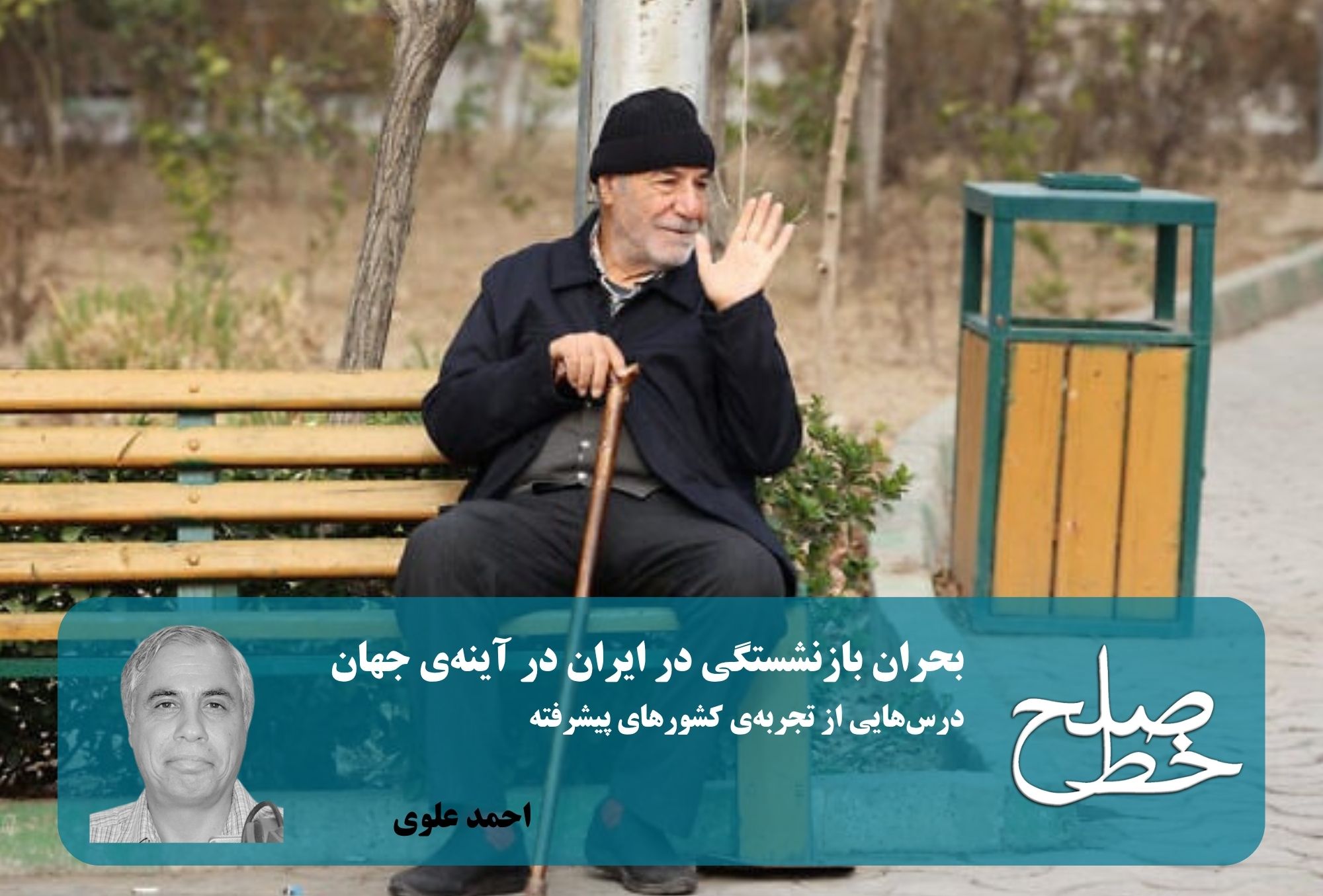
The Pension Crisis in Iran Through a Global Lens/ Ahmad Alavi
Pension funds, as the cornerstones of social security systems, play a key role in ensuring economic security, reducing poverty, and strengthening social cohesion. However, inefficiencies in these funds can lead to economic instability, increased inequality, and erosion of public trust. In Iran, pension funds such as the Civil Servants Pension Fund and the Social Security Organization face numerous crises and challenges, including high bankruptcy risk, financial deficits, delays in pension payments, and wage arrears. These issues stem from structural factors such as entrenched and systemic corruption, mismanagement, and macroeconomic instability. (1, 2) This report aims to analyze the root causes of the Iranian pension fund crisis and compare these funds with the experiences of developed countries.
A. Theoretical Framework
Institutional Economics and Vicious Cycles
This report draws on the institutional economics framework (3) and the concept of institutional vicious cycles (4) to analyze the inefficiency of Iran’s pension funds. Institutional economics emphasizes the role of institutions, laws, and norms in shaping economic behavior. In this framework, the inefficiency of Iran’s pension funds is the result of weak oversight institutions, lack of accountability among managers and government officials, absence of transparency, and the dominance of political motivations in economic decision-making. A vicious institutional cycle occurs when structural problems (such as corruption and mismanagement) and external factors (such as sanctions and inflation) reinforce one another, leading to systemic instability. In the case of Iranian pension funds, this cycle involves reduced financial inflows (due to wage arrears and unemployment), increased financial pressures (due to an aging population), and misuse of resources (due to corruption). This framework helps to identify root causes and propose structural solutions.
The Pension Sustainability Model
For comparative analysis, the Pension Sustainability Model (5) is employed, which considers three core components:
Financial Sustainability: The fund’s ability to secure long-term financing for pension payments.
Benefit Adequacy: Ensuring sufficient income to uphold the dignity and standard of living for retirees.
Equitable Coverage: Extending benefits to diverse groups, including informal workers and women.
This model serves as a benchmark to compare Iran’s pension system with those of developed countries.
B. Status of Pension Funds in Iran
Financial Deficits and Potential Bankruptcy
Iran’s pension funds are plagued by chronic financial deficits, resulting from a combination of factors:
Mismanagement and Institutional Corruption: Appointment of managers based on political motives rather than professional qualifications, lack of transparency in asset management, and financial abuse in subsidiary companies have weakened fund resources. (2)
Incomplete Premium Payments: The government and employers, due to budget deficits and liquidity issues, do not fully pay their insurance contributions. Over 90% of some funds’ costs are covered by the public budget, leading to severe dependency on the government. (1)
Population Aging and Ineffective Policies: The retiree-to-worker ratio (0.42) is rising due to declining fertility rates and increased life expectancy. Failure to reform the retirement age and workforce participation rates has intensified this pressure.
Inefficiency of Subsidiary Companies: Affiliated companies of the funds are often loss-making and their resources serve select groups instead of generating returns.
Wage Arrears and Their Impact on Workers
Wage arrears are a major challenge facing Iranian workers and exacerbate the vicious cycle affecting pension funds:
Inflation and Economic Instability: Chronic inflation (over 40% in recent years) and rising production costs have left employers cash-strapped, leading to months-long delays in wage payments.
Lack of Effective Oversight: Weak supervisory mechanisms and workers’ fear of dismissal hinder the pursuit of unpaid wages.
Crisis Scale: According to reports, in 2025 (1404), over 10 million workers faced wage arrears—including salaries, bonuses, and severance payments—reducing financial inflows to pension funds.
The Vicious Cycle Between Fund Crisis and Wage Arrears
The vicious cycle between pension fund crises and wage arrears unfolds as follows:
Reduced financial inflows to the funds (due to wage arrears and unemployment) lead to inability to pay pensions.
Delays in pension payments erode public trust in the pension system and reduce willingness to pay premiums.
Macroeconomic instability (inflation, sanctions, budget deficits) exacerbates the cycle, resulting in systemic unsustainability.
High Retiree-to-Worker Ratio
The increasing ratio of retirees to workers (0.42 in Iran compared to 0.30 in Sweden and 0.28 in the Netherlands) and high unemployment rate (11.8%) exert additional pressure on pension funds. The table below provides a comparison between Iran and developed countries:
Table 1: Retiree-to-Worker Ratio and Unemployment Rate
| Country | Retiree-to-Worker Ratio | Unemployment Rate (%) |
|---|---|---|
| Iran | 0.42 | 11.8 |
| Sweden | 0.30 | 6.1 |
| Netherlands | 0.28 | 4.2 |
| Canada | 0.32 | 5.5 |
This table shows that Iran’s high retiree ratio and structural unemployment have strained fund resources and increased the risk of bankruptcy.
Institutional Corruption and Managerial Inefficiency
Institutional corruption in Iran has weakened financial sustainability through illegal withdrawals from fund resources to cover government budget deficits and the transfer of loss-making enterprises to pension funds in lieu of debt repayment. (2) The absence of independent oversight and transparency has further enabled misuse.
C. Experiences of Developed Countries in Pension System Management
OECD member countries have adopted structural, long-term approaches to balance financial sustainability with benefit adequacy. The following table outlines key strategies used by these countries:
Table 2: Key Approaches in OECD Countries to Balance Financial Sustainability and Retiree Dignity
| Key Approach | Description | Countries | Impact |
|---|---|---|---|
| Raising Retirement Age | Gradual adjustment based on increased life expectancy | Sweden, Japan | Reduces financial pressure; ensures conditional benefits during transition periods |
| Mixed Public–Private Systems | Combining public funds with private individual accounts | Canada, Australia | Diversifies financial resources; achieves 60–70% of previous income |
| Reforms for Adequacy & Coverage | Ensuring minimum income and expanding coverage to informal workers and gender equality | Netherlands, Denmark | Reduces retiree poverty; long-term budgeting |
| Transparent Governance & Long-Term Forecasting | Independent oversight and modeling to prevent financial deficits | Germany | Maintains pension cost at ~10% of GDP; prevents disruptions in benefit payments |
| Encouraging Participation & Financial Literacy | Tax incentives and savings education to promote self-reliance | New Zealand | Increases financial inflows; boosts retiree independence |
Analysis of Approaches
Raising Retirement Age: In Sweden and Japan, gradual increases in retirement age tied to life expectancy have reduced retiree-to-worker ratios and enhanced financial sustainability.
Mixed Systems: Canada and Australia have distributed financial risk by integrating public and private systems, enabling retirees to receive 60–70% of pre-retirement income.
Transparent Governance: Germany’s independent oversight and long-term forecasting have kept pension spending around 10% of GDP and prevented financial shocks.
Promoting Participation: New Zealand has increased citizen participation in retirement saving through tax incentives and financial literacy programs, reducing dependency on public funds.
Role of Pension Funds in Economic Growth and Social Welfare
Pension funds contribute to economic growth and enhanced social welfare through investments in financial markets and infrastructure projects. The following table compares Iran with developed countries:
Table 3: Role of Pension Funds in Economic Growth and Social Welfare
| Country | International Investment (%) | Contribution to Economic Growth (%) | Retiree Welfare Index |
|---|---|---|---|
| Iran | Unknown | 1.2 | Low |
| Sweden | 60 | 3.5 | High |
| Netherlands | 55 | 3.2 | High |
| Canada | 50 | 3.0 | High |
International Investment: In developed countries, funds invest a significant portion (50–60%) of their assets in global markets, yielding higher returns than domestic investments.
Economic Growth: Pension fund contributions to economic growth in Iran stand at just 1.2%, compared to 3% or more in developed countries.
Retiree Welfare: Regular pension payments in developed countries have boosted retirees’ purchasing power, reduced poverty, and strengthened household consumption.
Postscript
Iran’s pension funds face deep challenges such as chronic financial deficits, wage arrears, and institutional inefficiencies, rooted in structural corruption, mismanagement, population aging, and macroeconomic instability. This study, using the frameworks of institutional economics and the pension sustainability model in OECD countries, demonstrates how these issues, through a vicious cycle, threaten the financial and social sustainability of pension funds. In contrast, developed nations such as Sweden, the Netherlands, and Canada have, through reforms like raising the retirement age, implementing mixed public–private systems, transparent and accountable governance, and encouraging financial participation, managed to strike a balance between fiscal sustainability and retiree dignity.
Footnotes:
World Bank. (2021). The pension system in Iran: Challenges and options. Washington, DC: World Bank.
International Monetary Fund (IMF). (2023). Islamic Republic of Iran: Selected issues. Washington, DC: IMF.
North, D. C. (1990). Institutions, institutional change and economic performance. Cambridge: Cambridge University Press.
Acemoglu, D., & Robinson, J. A. (2012). Why nations fail: The origins of power, prosperity, and poverty. New York: Crown Publishers.
Organisation for Economic Co-operation and Development (OECD). (2023). Pensions at a glance 2023. Paris: OECD Publishing.
(
 Created By: Ahmad Alavi
 October 23, 2025
Tags
Ahmad Alavi Development expensive Increase in retirement age Paragraph peace line Poverty and inequality Retirees ماهنامه خط صلح