


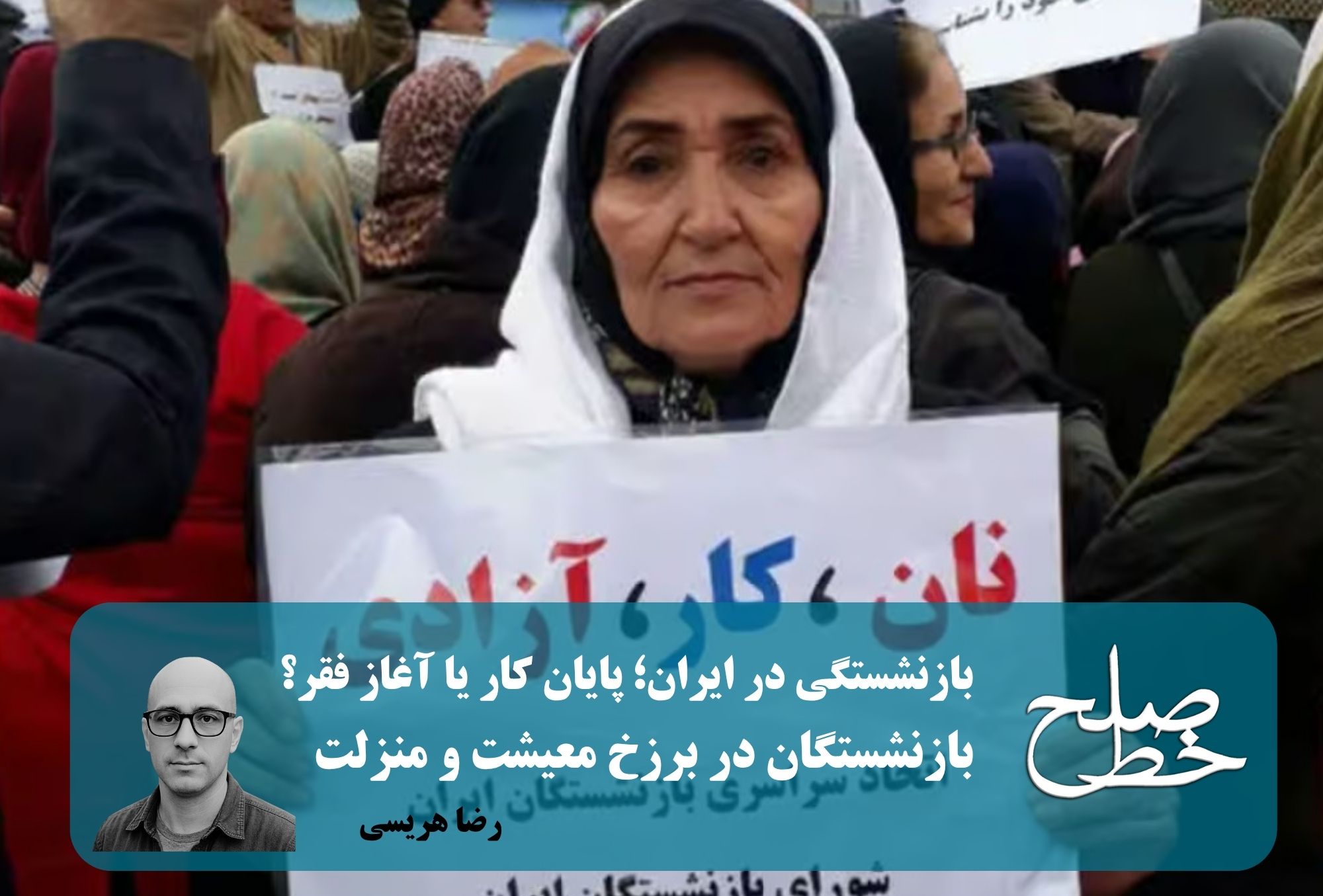
Retirement in Iran: End of Work or Onset of Poverty?/ Reza Herisi
In the lexicon of nations, retirement is synonymous with honor, comfort, and reaping the fruits of a lifetime of labor. It is not the end, but the beginning of a new chapter in life—a time when the retiree, free from the daily grind, devotes themselves to family, self, and personal interests. This concept represents an unwritten yet foundational social contract between the state, the people, and the individual. But in Iran today, this word has taken on a reversed meaning. To understand “retirement” in today’s Iran, one must look not to dictionaries, but to the streets: the image of thousands of elderly men and women who once powered the country’s economy, industry, and culture, now, in their seventies and eighties, standing in the streets—not in comfort and respect—but shouting for a piece of bread or a dose of medicine. This image is not a news headline, but a bitter norm and the raw face of a broken social contract. The word “retirement” in today’s Iran has been stripped of its global meaning—as security and the reward for a lifetime of work—and turned into a metaphor for “abandonment,” “poverty,” and “the struggle for survival”: an unequal battle against inflation that devours pensions, against crushing medical expenses, and against systemic injustice that tramples on human dignity. This article, focusing on the vital triad of “welfare, healthcare, and quality of life,” explores how a generation that gave its youth to build the future of this land has now been abandoned in a purgatory of poverty, illness, and humiliation. At the heart of this analysis is the destructive role of the state—a state that, instead of acting as a trustee, has taken control of the lifelines of pension funds and dragged intergenerational assets to the brink of ruin.
Welfare or the Struggle for Survival?
The first and most tangible aspect of any retiree’s life is their standard of living and purchasing power. In Iran, this aspect has become the primary source of crisis. The monthly pension, which was supposed to guarantee a dignified life, has become a meager stipend that grows more worthless each day against the monster of inflation. Iran’s ailing economy has been grappling with chronic double-digit inflation for decades, and more recently, hyperinflation. But for a retiree, this economic term is no abstraction—it manifests in a shrinking dinner table, the gradual disappearance of protein, dairy, and fruit from their shopping basket, and in the inability to meet even the most basic survival needs. Annual pension increases, often heralded with grand labels like “harmonization” or “equity adjustments,” are, at best, a temporary salve that never outpaces the uncontrolled growth of living costs and inflation. It’s an unequal race in which the retiree is doomed from the start. Official reports from the Iranian Statistical Center and the Central Bank corroborate this reality. When point-to-point inflation for food exceeds 50 or 60 percent, how can a trickle of a raise possibly bridge the gap? The result is the plummet of millions of retirees below the poverty line—a line whose definition is itself vague and politicized, but which for a retiree worrying about rent and medicine, is painfully real. (1) Even more bitter than poverty is the sense of injustice and being ignored by the law. Retirees—especially those under the Social Security Organization—are well aware that Article 96 of the Social Security Law (2) obligates the organization to raise pensions in line with the rising cost of living. This is not an audacious demand, but a deliberately neglected legal right. For decades, governments have dodged the full implementation of this article with baseless interpretations and excuses of insufficient resources. Civil service retirees face a similar struggle in the incomplete execution of the Civil Service Management Law (3), which mandates harmonizing retiree salaries with their employed counterparts. This blatant disregard for the law has eroded trust in the ruling system to its lowest point and reinforced the belief that retirees are second-class citizens whose legal rights are easily trampled.
Systematic Violation of Article 29 of the Constitution
As people age, access to healthcare is not a choice but a vital necessity. A functional retirement system is one in which retirees do not have to worry about exorbitant medical expenses. But for Iranian retirees, this sector too has become a nightmare. Basic insurance has become virtually ineffective, and supplementary insurance—intended to provide additional coverage—has become a major challenge itself. Insurance booklets, once symbolic of minimal financial security, are now widely rejected at medical centers, clinics, and pharmacies. Physicians and healthcare facilities, due to unrealistic tariffs and delays in receiving payments, are reluctant to work with insurance companies. Meanwhile, a retiree battling pain and illness must pay out-of-pocket and then endure a grueling process to reclaim a fraction of the cost from the supplementary insurer. The coverage limits for services like dentistry, eyeglasses, hearing aids, or specialized surgeries are laughably inadequate. The central slogan of protesting retirees—“Free healthcare is our inalienable right”—echoes this profound pain. They invoke Article 29 of the Constitution (4), which declares access to social security, retirement, unemployment, disability, and healthcare services as a “universal legal right.” But this “universal right” has effectively become a luxury accessible only to the wealthy. (5)
The Erosion of Social Dignity
Quality of life is a concept that extends beyond bank accounts and physical health. It is intertwined with feelings of satisfaction, dignity, hope, and social belonging. For retirees in Iran, this dimension of life has also been severely damaged. A person who spent thirty years in a respected, specialized position often sees their social status crumble alongside their income after retirement. Many retirees, to make ends meet, are forced into second and third jobs—from driving for ride-hailing apps to working as security guards or taxi drivers. This “employment out of desperation” not only accelerates physical decline, but is also psychologically degrading and destructive. The image of retirees in today’s Iranian society is not one of experienced, respected individuals, but of needy dependents. This erosion of dignity leads to isolation and depression. When retirees can no longer afford to participate in social activities, travel, leisure, or even visit relatives due to financial constraints, they are gradually excluded from the social fabric. This slow social death may be even more painful than physical death.
The Black Hole Called Government
Faced with this grim picture, the fundamental question is: how did we get here? The answer lies in a single word: government. The reality is that what we now call a “pension fund” is a hollow shell of a modern concept that has lost its meaning in the swamp of government bureaucracy. These institutions—particularly the Civil Servants Pension Fund—are no longer “funds” in the sense of independent insurance entities based on reserves and investments. Instead, as accurately described in expert reports, they have devolved into “redundant administrative mechanisms” and “pension disbursement offices” whose sole function is transferring money from the state treasury to retirees’ bank accounts. This degeneration is the result of a historical process of domination and expropriation. In Iran, governments have not acted as trustees of intergenerational assets but as unbridled owners. They have undermined the independence of these institutions by appointing political managers, raiding fund resources to cover budget deficits, and imposing laws without actuarial justification. This has created a destructive conflict of interest where policymakers are themselves the primary beneficiaries of unscientific decisions, sacrificing the future of millions for short-term political or factional gain. (6) This is a textbook case of the funds becoming the government’s private backyard. The disaster deepens when we realize this inefficient structure is itself a source of massive costs. Maintaining a bloated administrative apparatus to perform tasks that could be handled by a small financial unit within the government is nothing but a waste of public resources. The absurd spectacle of “a government body fining another government body using public funds” (6) epitomizes the futility of this system. This is not merely an economic crisis—it is the collapse of a social contract and the degradation of human dignity. The state, by reducing retirees from “rights-bearing citizens” with “professional identity” to “dependent pensioners,” has severely damaged their human dignity. The retirees’ protest movement in the streets is a cry against this trampled dignity—a cry not just for “bread,” but for the restoration of their lost “status and respect.” Therefore, any reform—whether raising the retirement age or changing the formula for pension calculation—is, at best, a placebo injected into a dying body. These measures delay the crisis but do not solve it. Salvation lies in a deep and radical surgery: complete disengagement of the state from the funds. This means returning true ownership of the funds to their rightful owners—the insured members—establishing independent and elected boards of trustees, and transforming the government from an “intervening self-entitled proprietor” to a “regulatory overseer” and, certainly, a “debtor institution.” In the case of bankrupt funds like the Civil Servants Pension Fund, even bolder options must be seriously considered, such as: “dismantling the current structure and merging its obligations into the public budget.” (6) Only through such a fundamental structural transformation can we hope to restore retirees’ dignity and ensure a sustainable future for the next generations. Otherwise, the streets will continue to reflect the full-scale crisis manufactured in closed policymaking rooms.
Footnotes:
1- Why is the law on annual pension increases not being implemented? ISNA, May 1, 2025 (11 Ordibehesht 1403).
2- Social Security Law, enacted June 24, 1975 (3 Tir 1354), Islamic Consultative Assembly Research Center.
3- Civil Service Management Law, enacted September 30, 2007 (8 Mehr 1386), Islamic Consultative Assembly Research Center.
4- Constitution of the Islamic Republic of Iran – Chapter III: Rights of the People, Articles 19 to 42, March 30, 1979 (10 Farvardin 1358), Islamic Consultative Assembly Research Center.
5- Social Security retirees cannot afford their medications, ILNA, October 2, 2021 (10 Mehr 1400).
6- Review of the Status of the Civil Servants Pension Fund (Challenges and Solutions), Islamic Consultative Assembly Research Center, March 3, 2025 (13 Esfand 1403).
 Created By: Reza Harisi
 October 23, 2025
Tags
expensive Health insurance Increase in retirement age Insurance National Pension Fund peace line Retirees Reza Harisi Social Security Organization ماهنامه خط صلح