


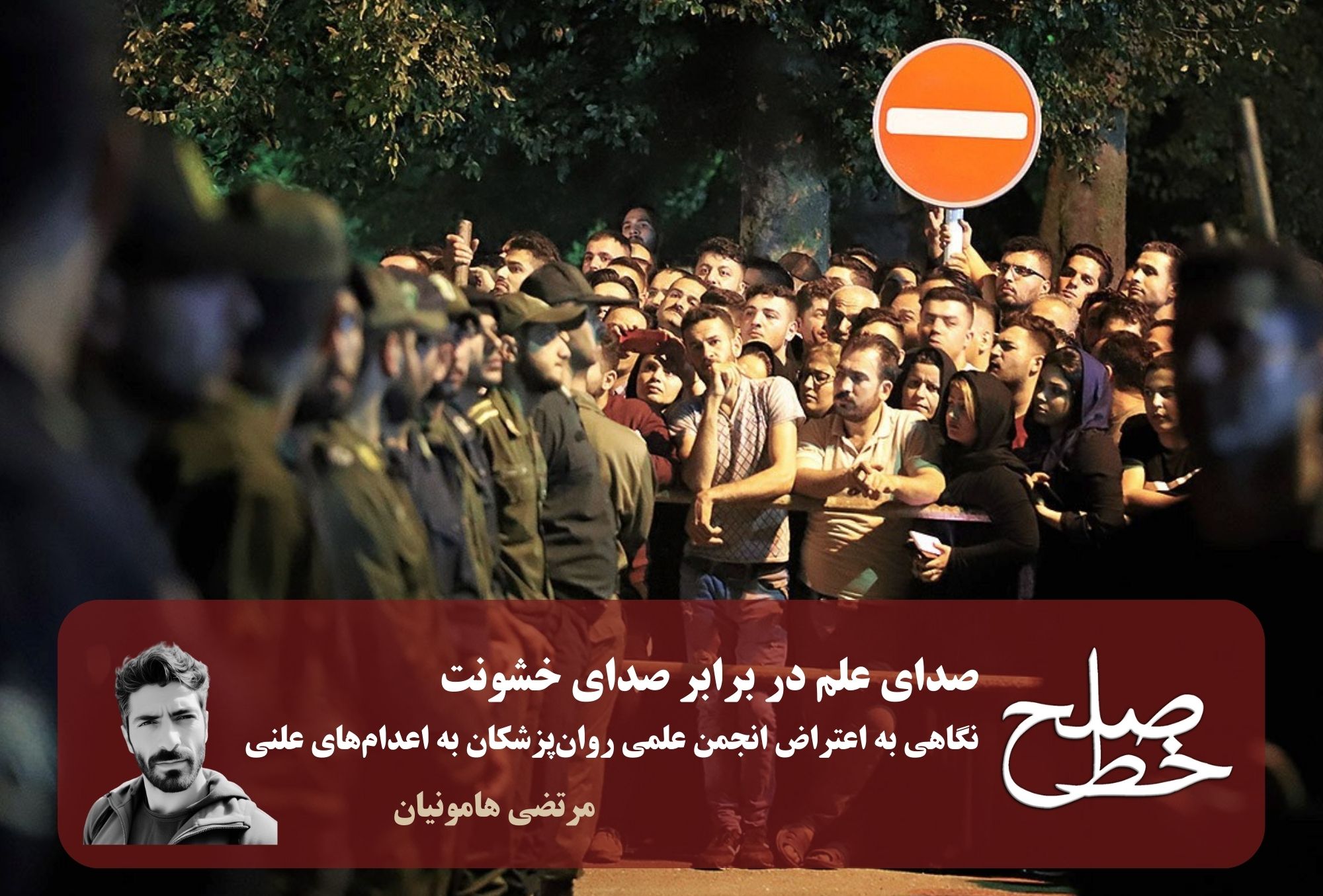
The Voice of Science Against the Voice of Violence/ Morteza Hamounian
The issue of capital punishment has always been a highly contentious matter in Iran. This punishment has been enforced by governments both before and after the February 1979 Revolution, and has consistently been the subject of criticism. At its core, the death penalty is a form of state-sanctioned killing—an act of violence inflicted upon the accused or convicted under the pretext of retribution for another act of violence. And all this assumes we are not even entering the complex realm of political executions, which is a different story altogether.
However, this state killing becomes even more horrifying when it leaves the confines of prison walls and is carried out on the streets, in front of the public eye. In such instances, the death penalty transforms into a political and social performance. Though on the surface it may appear as the implementation of a criminal sentence, in reality it is a public demonstration of state power—with thousands of spectators and a hanged human body as the lead actor. It is a performance where people gather to watch the death of a fellow human being. In cases of qisas (retribution), one group pleads with the victim’s family for forgiveness, while another insists on taking the life of someone just like themselves. The director of this macabre performance is the judicial-state apparatus, which places little to no value on the mental well-being of its citizens.
It was precisely because of such concerns that, on August 25, 2025 (3 Shahrivar 1404), the Iranian Psychiatric Association wrote an open letter to the head of the Judiciary of the Islamic Republic, expressing concern about the public executions carried out in the spring and summer of 2025 (1404). The letter stated that these actions are not only ineffective as deterrents but also result in broad psychological and social harm, particularly for children and for society at large. The association called on the head of the Judiciary to halt this practice. (1)
From Kordkuy to Larestan in Fars Province, from Damghan to Delfan and other parts of the country, the rise in public executions throughout 2025 sends a clear message: the ruling power claims exclusive control, and the offender is punished ruthlessly and in public to serve as a warning to others. However, the Iranian Psychiatric Association wrote in its letter that public executions have no proven or lasting effect on crime reduction, and instead cause negative psychological and social consequences for the community and its citizens. According to the association, one of these consequences is a potential increase in violence. (1) In fact, psychiatrists argue that witnessing the execution of a human being—their last moments atop the gallows—not only instills fear and dread but also gradually normalizes violence. Seeing a lifeless body amid a crowd blurs moral boundaries. People slowly grow desensitized to violence and indifferent to the suffering of others.
Public executions in the 1980s (1360s) were a demonstration of power for the Islamic Republic, then dealing with both a war and armed opposition groups within the country. The regime used public hangings as a tool to suppress dissent and create an atmosphere of terror. In the 1990s (1370s), this trend began to decline, and in the following decades, the number of public executions continued to decrease. This reduction was due not only to a shifting political and social atmosphere, but also to public pressure and international human rights advocacy—as well as concern that lift manufacturers and crane companies might impose sanctions on Iran for the use of their equipment in executions.
Nonetheless, public executions never fully disappeared from Iran’s penal system. In more recent years, this practice has been increasingly challenged by scientific research—especially from psychiatrists and psychologists. For example, in the summer of 2006 (1385), the second issue of Volume 12 of the Iranian Journal of Psychiatry and Clinical Psychology published a study titled “Post-Traumatic Stress Disorder in Elementary School Students Who Witnessed the Hanging of a Criminal.” Based on the findings, 52% of children aged 7 to 11 who had witnessed an execution in person exhibited symptoms of PTSD (Post-Traumatic Stress Disorder). The study, conducted in 2002 (1381), showed that the most common symptoms were intrusive memories and severe distress when recalling the event. (2) The research concluded that “witnessing a hanging can cause moderate to severe PTSD symptoms in children.” Notably, PTSD is commonly seen in war veterans or disaster survivors—not in elementary school children who were merely “spectators” of an event.
In the years that followed, as public executions became less frequent, responses from the psychiatric community also waned. One of the few exceptions was a statement by Dr. Mohammad Sanati, a psychoanalyst and psychiatrist affiliated with the Royal College of Psychiatrists in the UK, who addressed the issue in an interview with the Shargh newspaper’s annual publication in 2012 (1391). (3) Sanati, who at the time was an associate professor in the Department of Psychiatry at Roozbeh Hospital and Tehran University of Medical Sciences, emphasized the ineffectiveness of public (or even private) executions. In his view: “Executions have solved nothing; instead, they increase the desire for violence—especially when conducted in public.” (3)
Some other psychologists abroad, such as Reza Kazemzadeh, have also spoken out and given interviews on this topic. (4) However, it appears that with the recent rise in public executions in 2025 (1404), psychiatrists in Iran could no longer remain silent. In a turning point, the Iranian Psychiatric Association sent a formal letter to Gholam-Hossein Mohseni-Ejei, the head of the Judiciary, warning about the increasing number of public executions and calling for an end to them. In this letter, the association rejected any proven or lasting effect of such punishments on crime prevention and warned of their negative psychological and social impacts on society. The letter even stated that in the societies studied, murder rates temporarily increased after such punishments were carried out. It also highlighted the harmful impact on children. (1)
The letter further warned that these actions could seriously damage social cohesion. Moreover, the harm is not limited to those present at the scene—people who view recorded images of these events can also become victims of their destructive effects. (1) The letter marked a significant moment: a break in the long silence of Iran’s psychiatric community and a necessary reaction to actions that directly threaten public mental health. The letter received widespread media attention, both within and outside Iran, and also sparked conversation on social media. Some even wrote that this letter represents the voice of science against the voice of public execution and violence. Others expressed hope that more professional associations in Iran would begin to engage in public affairs and issue similar statements.
Vahid Shariat, president of the Iranian Psychiatric Association, explained the reasons behind the letter in an interview with ECO Iran: “We thought that, based on previous discussions, it had been concluded that this practice should no longer be carried out in public—that it should take place in prison, for example. But the repetition of these events was cause for concern.” (5)
In addition to the association’s letter signed by Dr. Vahid Shariat, some individual psychiatrists have also spoken out. For instance, Amirhossein Jalali, a member of the association, told the media that public executions project a dark and unsafe image of society, subconsciously instilling anxiety in the public and causing psychological harm. He added: “Sometimes it’s said that discussing certain social issues is painting a bleak picture—but these very actions are a form of practical bleakness, signaling that society is unsafe.” (6)
The Iranian Psychiatric Association’s letter may be the first clear initiative by a professional, official, and state-affiliated body to oppose public executions in particular, and the death penalty in general, in Iran. Though delayed, it is a welcome development, signaling that members of the academic and professional establishment with historical ties to the government are beginning to engage socially and raise issues in various domains. At long last, the voices of some experts are rising in protest against the regime’s public displays of violence that target the psyche of the society. One can only hope that this engagement by the scientific community will grow, and that we will see more such statements and positions in the future. It is also to be hoped that within the circles of power, there will be ears willing to listen—and that, heeding this scientific insight, they will not worsen an already precarious situation. The alarm bells have been ringing for a long time. What is needed now are ears that can hear.
References:
Request by the Iranian Psychiatric Association to the Head of the Judiciary Regarding the Halt of Public Executions, Shargh Network, August 26, 2025 (5 Shahrivar 1404).
Attari, A., Dashti, S., & Mahmoudi, M. (2006). Post-Traumatic Stress Disorder in Elementary School Students Who Witnessed the Hanging of a Criminal, Iranian Journal of Psychiatry and Clinical Psychology, Volume 12, Issue 2 (No. 45, Summer 2006). Magiran.
Sanati, M. (2012). Here, Violence Is a Value, Shargh Newspaper Annual Publication, 1391 [2012]. SedaNet.
Kazemzadeh, R. (2013, December 5). The Normalization of Violence: Interview with Reza Kazemzadeh, by Zahra Bagheri-Shad, Radio Zamaneh.
The Iranian Psychiatric Association’s Account of the Consequences of Public Executions, ECO Iran, August 26, 2025 (5 Shahrivar 1404).
Concern Over Naked Punishment: A Review of the Iranian Psychiatric Association’s Warning About Public Executions, Ham-Mihan, August 26, 2025 (5 Shahrivar 1404).
 Created By: Morteza Hamounian
 September 23, 2025
Tags
Execution Execution in Malaam Judiciary peace line Peace Line 173 Promotion of violence Psychiatrists Association PTSD Public execution Punishment Violence کن Avoid violence ماهنامه خط صلح