


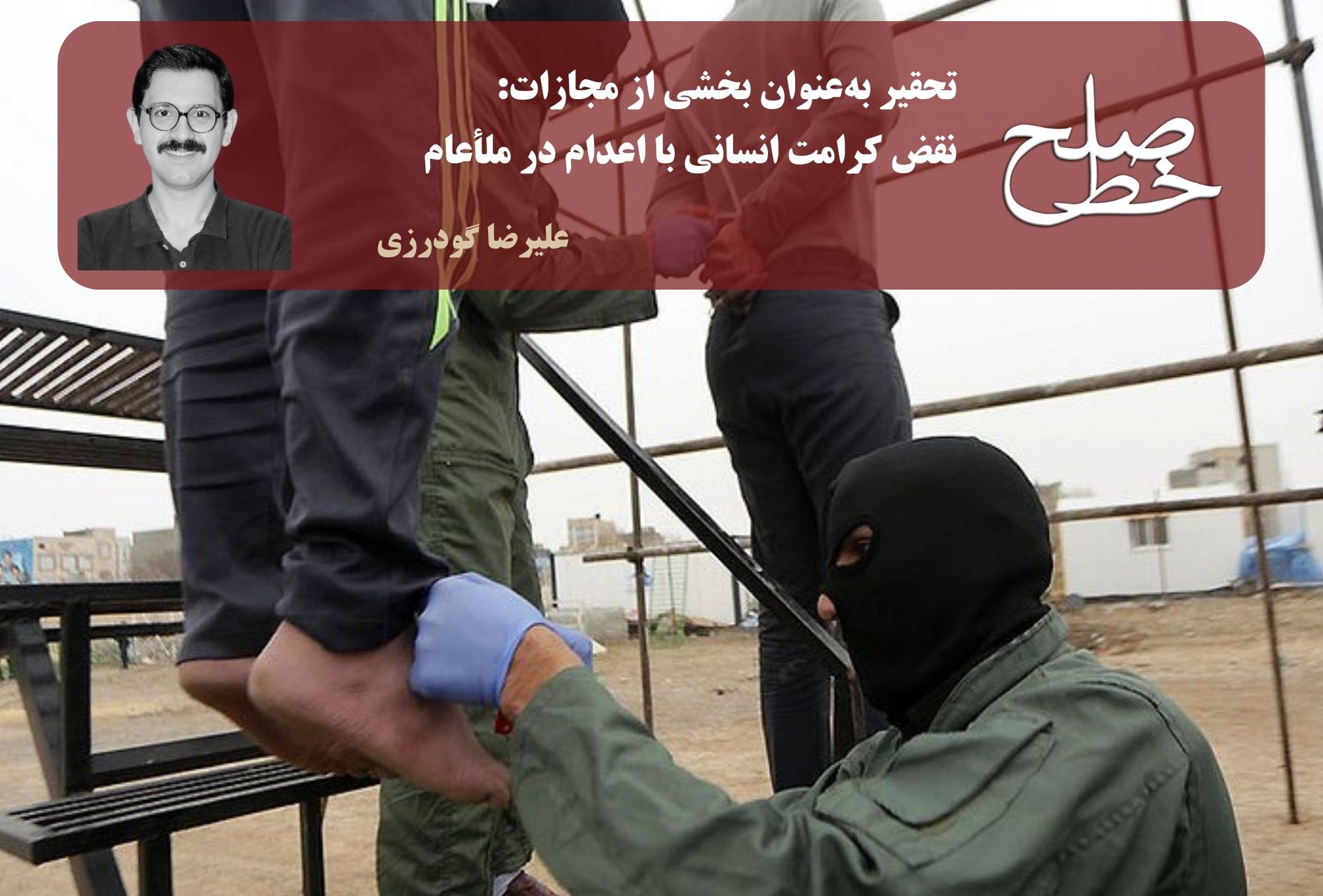
Humiliation as Part of Punishment: The Violation of Human Dignity Through Public Executions/ Alireza Goodarzi
Let us begin by distinguishing between a criminal, a suspect, and anyone else outside these categories. A person living in society may come under legal suspicion of having committed a crime. From that moment on, this individual is referred to as a “suspect.” Once the accusation is proven in a competent court, with all legal safeguards and rights for the accused upheld, the individual is then considered a “criminal.” Therefore, the difference between an innocent person, a suspect, and a criminal lies solely in the suspicion of a crime and the legal proof of it. Beyond that, they differ no more than any two individuals in society might differ in general.
Naturally, a suspect or a criminal may possess any other attributes or characteristics: race, skin color, language, gender, level of education, or social class. A murderer, for instance, may be American or not, white, Black, Asian, or a person of color, English-speaking or otherwise, male or female, literate or illiterate, rich, poor, or from the middle class. What sets them apart from others is only their criminal act.
Committing a crime—or being suspected of it—entails certain legal consequences. If someone is accused of a crime and there is strong evidence to support the accusation, they may be subjected to temporary restrictions until guilt or innocence is proven. These can include providing explanations, temporary suspension from certain activities, travel bans (sometimes across wide areas, such as between cities or international borders), or even pre-trial detention.
Once the crime is proven and confirmed by a higher court, the individual must receive a sentence that is predetermined for such a crime. The purpose of this punishment is to discipline the offender, remove them from society to allow for rehabilitation, or deter others from committing crimes. Accordingly, the individual, during their sentence, is still entitled to the same rights as others—unless the law, for one of the purposes mentioned, restricts those rights. In essence, aside from their criminal status and the need for punishment, a criminal does not fundamentally differ from other citizens.
Let us now consider this issue from the perspective of human rights and human dignity. Can the violation of a suspect or criminal’s dignity help achieve any of the above-mentioned purposes? The answer is no. A person paraded through their neighborhood with a water container hung around their neck might lose whatever shame they felt for themselves or their family, and thereafter may be treated as a more hardened criminal—closing the door to rehabilitation. Can this bring about deterrence? Many studies say no. That is, if you strip a suspect or criminal of their dignity in front of others, it does not instill fear in society that prevents future crimes.
(At this point, it’s worth addressing a commonly repeated but baseless notion: that humiliating suspects upon arrest boosts the authority of the police. This assertion is neither scientific nor legal. It cannot be counted among the justifications for punishment and serves no legitimate purpose—it’s simply the abuse of power by an armed officer in a dominant position over a vulnerable person.)
Insulting a suspect is illegal, and logic rejects it. If, for any reason—lack of evidence, extenuating circumstances, or legal justification for the act—the person is acquitted in court, their reputation should remain intact. Why should the safety and dignity of an individual be harmed by someone who is paid—by society, even by that individual themselves—to protect that very safety?
The same applies to criminals. If a person has committed a crime, they must be punished so that society can pursue the goals of justice. But what does humiliating someone and destroying their social standing accomplish for society? What is the aim of such acts?
Let me ask this question specifically in the context of public executions: what exactly is the goal of such an act? What criminological or sociological research supports it? Is it not the case that we are normalizing the act of killing (even when carried out under the law—a law which itself allows for the death penalty only in the most extreme cases, and which many countries no longer enforce)? By executing a person in public view, we grant a formal, public stage to the very violence for which the person is being punished. And in doing so, we replicate that violence in society at an unimaginable scale.
What purpose does humiliating a person serve—especially the weakest person, the one entirely under the control of the state, whose supposed goal is to reform them or deter others? Who exactly is being reformed or deterred by this act? A death behind closed doors is more mysterious, and if someone is going to fear it, this spectacle might actually reduce that fear. Death becomes mundane. Violence is replicated. Human dignity is shattered. And the only effect on society is the deepening of revenge and bloodlust.
Even if we accept the necessity of the death penalty, where did this additional, unnecessary violence come from? What is the justification for it?
The individual sentenced to death, to use human rights terminology, has been condemned to deprivation of life and violation of the right to it. Such a person is not sentenced to torture, humiliation, or the violation of their human dignity or other fundamental rights. Capital punishment is already the harshest penalty possible. There is no need to inflict further suffering. The only distinction between them and us is the criminal status—not human worth. If we inflict harm on someone beyond what their sentence entails (justified or not), we normalize unjustified cruelty in society—because such humiliation is not a part of their punishment.
The public display of violence leads to the spread of violence. So, as someone who cares for this society, I ask you—end this primitive spectacle. Please.
 Created By: Alireza Goodarzi
 September 23, 2025
Tags
Alireza Goodarzi Criminal Execution Execution in Malaam Forensics Human dignity peace line Peace Line 173 Public execution Punishment Reproduction of violence Right to life Violence به زندان Sentenced to prison ماهنامه خط صلح