


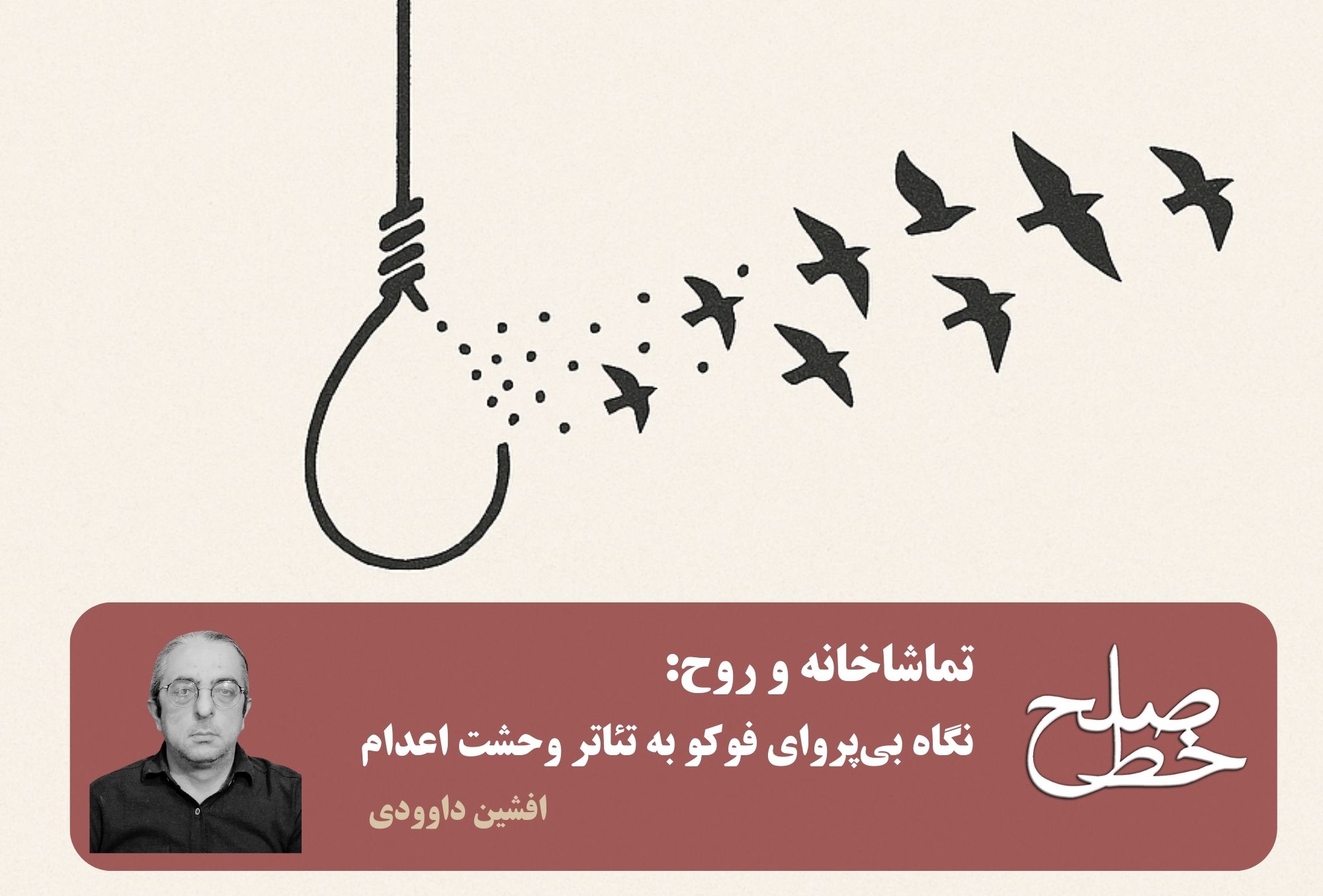
The Theater and the Soul: Foucault’s Unflinching Gaze at the Spectacle of Execution/ Afshin Davoudi
Speaking of public executions evokes a primal image: a crowd gathered in a square, a platform bathed in sunlight or shadow, and the haunting silhouette of the condemned. A scene that feels both ancient and profoundly disturbing. Most modern objections to this practice are based on human rights principles, empathy, and a deep revulsion triggered by state-sanctioned death. But Michel Foucault, the French philosopher, offers us a different—and far more painful—perspective. In his seminal work Discipline and Punish: The Birth of the Prison (1), Foucault does not ask us to merely pity the victim. Instead, with the cold precision of a surgeon and the lyricism of a poet, he anatomizes public execution to expose its rotting core.
Foucault argues that public execution is not about justice but about power—a grotesque, exaggerated, and ultimately failed spectacle designed to inscribe sovereign authority onto the bodies of the people. At the beginning of his book, he forces us to bear witness, in excruciating detail, to the 1757 execution of Robert-François Damiens (who attempted to assassinate the French king). His prose is clinical, factual, but terror bleeds through every line: the flesh torn by pincers, the boiling oil and molten lead poured into wounds, the horses straining to dismember a living body. This isn’t gratuitous violence—it’s a philosophical argument. Foucault uses this harrowing description to demonstrate that punishment was, first and foremost, a direct assault on the body—a ritual in which the sovereign, wounded by the criminal’s defiance, reasserts his power through physical vengeance. The screams of the condemned are not incidental—they are the soundtrack of the theater of horror, bearing witness to the audacity of absolute power. The body becomes a canvas, and pain the ink, to inscribe a lesson in obedience.
It is here that Foucault’s analysis transcends history and becomes a chilling interpretation of the nature of power itself. Public execution is not a chaotic outbreak of violence—it is a meticulously choreographed ritual. Every element—from the procession of the condemned through the streets to the reading of the sentence and the executioner’s role—is part of a performance meant to give visible form to the otherwise abstract and invisible concept of sovereign authority. Power, having been challenged by a rebellious act, manifests itself in the brutalized body of the condemned to reclaim its stability and dominance. The crowd is not merely a witness—it plays an essential role in the drama. They are summoned to bear witness to the ruler’s wrath and learn the ultimate price of defiance. This is a political performance, disguised as legal procedure. The execution stage is where the shaken foundations of authority are visibly reinforced. Public execution, Foucault says, is not about justice or deterrence—it is a reminder to the spectators of who holds the monopoly on violence and punishment.
And yet, in one of his most brilliant insights, Foucault exposes the fatal flaw in this bloody logic: “The spectacle often fails.” The stage may be carefully set, but one element never aligns completely with the intention—the audience. The image of horror can backfire. The crowd, rather than being subdued, may be stirred to revolt. They may admire the condemned’s courage and dying dignity. They may see in him a martyr, a hero resisting to the last breath. They may storm the guards, fighting to free the condemned or to claim his body as sacred relic. The executioner—the king’s agent—may become the object of public hatred and contempt. The very ritual meant to assert power can instead expose its fragility and become a stage for rebellion and collective solidarity against the sovereign. The grand finale of state supremacy can, in a moment, reveal its absence.
Foucault argues that this failure is key to understanding one of the most profound transformations in Western history: the disappearance of public torture and the emergence of the prison. In the late 18th and early 19th centuries, the spectacle came to be seen as too dangerous, too unpredictable, and ultimately too ineffective. The old sovereign power, exercised through theatrical outbursts of brutal violence, was replaced by a new and insidious form of power: disciplinary power. This new regime did not aim to shatter the body in a moment of public terror but to tame the soul over a lifetime. Power moved from the public square to the hidden cell, the barracks, the school, and the hospital. Its tools were no longer axes and scaffolds, but the guard’s gaze, the psychologist’s report, the warden’s routine.
Foucault’s famous description of the Panopticon—a prison design proposed by Jeremy Bentham in which a single guard can observe all inmates without being seen—becomes the perfect metaphor. (2) The new fear is not of a public death, but of constant surveillance. The goal is no longer the destruction of the body, but the capture of the soul and the shaping of a “docile” and productive individual. In a haunting and unforgettable line, Foucault writes: “The soul becomes the prison of the body.” Under invisible and perpetual scrutiny, the individual internalizes power’s gaze and begins to monitor themselves. They become their own guard.
This is the emotional and philosophical power of Foucault’s work: he does not allow us the comforting illusion that we have simply become more humane. We abolished public executions not out of pure moral enlightenment, but because we found a more effective way to exercise control. One system of power was replaced with another—arguably a far more pervasive one. The execution scaffold was dismantled not because of its horrific violence, but because of its political inefficiency.
Foucault warns us that modern systems of justice and rehabilitation are no less mechanisms of power—they are simply subtler, more psychological, and more effective. The public theater of blood may be closed, but the project of human control has merely grown more complex. The screams in the square may fade, but the machinery of power, redesigned and refined, hums on with tireless precision. Long-term prison sentences, in-absentia trials, and sentence extensions behind bars are part of the same strategy. The high suicide rates among young prisoners (political and non-political alike) are a stark indicator of the state’s determination to break any undesirable will and mold obedient citizens. Silent death in custody follows the same logic. Leaving someone who has challenged authority to rot in pain and illness, constantly reminded they’ve been forgotten, places them at a crossroads between death and surrender.
Foucault’s reading of public execution is thus a stripping away of comforting illusions. He compels us to see the scaffold not as a leftover relic of a savage past but as a brutally honest display of how power operates. If public execution, according to Foucault, is a spectacle to enforce sovereign power over the collective body, we must then ask: when this spectacle vanishes from the public eye, where does it go? The answer, perhaps, lies in the darkest and most intimate corners of our lives: the home.
Domestic homicide is, terrifyingly, a reflection of the same logic of power that Foucault identifies in the execution scaffold—only now, it is carried out not by the sovereign but by an individual acting as the mini-sovereign of a private domain. Here, there is no crowd to learn a lesson, or only a few who are themselves overwhelmed by violence. At least public executions, for all their horror, are carried out by a state with (at least theoretically) some mechanisms of accountability. But domestic murder is an execution without trial, without verdict, and without spectators. There is a killer—and all others are victims. It is execution in silence, where power reaches its purest and most destructive form: the power of one human being to decide the life or death of another, unchecked and unobserved.
These two phenomena—public execution and domestic violence—grow from the same root: the belief that a body can be a territory for domination. In the town square, the sovereign proves his rule by destroying the body of the condemned. In the home, the individual asserts absolute rule over their family by destroying the body of a spouse, child, or relative. Both acts represent the ultimate alienation from the other’s body, and the total denial of their human dignity.
The tragic insight Foucault offers is this: the abolition of public execution, its retreat into the prison or transformation into a slow death behind bars, does not mean that the will to dominate the bodies of others has vanished. It has simply shifted shape and space. Even as society recoils from state brutality, it often closes its eyes to the hidden violence of the home—operating on the unconscious belief that the private sphere is exempt from the laws of humanity.
Thus, the fight against execution, whether public or private, is not only a legal or political struggle—it is a philosophical and moral battle to reclaim the right to bodily integrity and human dignity from all forms of absolute power, whether wielded by the state or by the patriarch. In essence, the resistance to execution and domestic violence is a fight against the very idea that any person or institution can claim the right to decide the life and death of another. It matters not where the stage of this horror is set—in a public square, behind prison walls, or behind the closed doors of a home. Until the belief that “your body is mine” is challenged at every level—from state to household—violence will only change form, while continuing to serve the same function: maintaining absolute control.
This fight against the mechanisms of execution, whether on the scaffold or in solitary confinement, is urgent and essential. It is not simply opposition to one form of punishment—it is a confrontation with the core of domination itself: the notion that, by law, tradition, or ownership, someone has the right to govern another’s body or soul. The necessity of this struggle becomes clear when we see how the same logic unfolds across arenas: the silent disciplinary order of the prison, the quiet murder within the home, and the public spectacle of state violence all stem from the same root. Breaking this cycle demands a dual-front effort: the public reclaiming of the body from institutional power, and the private dismantling of oppressive structures within the smallest social units. Only then can we move toward a society where human dignity is preserved not through spectacles of death or silent submission—but through freedom and equality.
References:
Discipline and Punish: The Birth of the Prison, Michel Foucault, translated into Persian by Niko Sarkhosh and Afshin Jahandideh, Ney Publishing, 2007.
Panopticon: Originally a prison design proposed by Jeremy Bentham, British philosopher and jurist. In this model, a central guard tower allows for the observation of all prisoners without them knowing whether they are being watched. Foucault uses the Panopticon as a metaphor for the mechanisms of power in modern society, where institutions such as schools, military bases, public spaces, and workplaces create a state of internalized surveillance and self-censorship. A striking example of this can be seen in the unconscious self-monitoring behavior of Iranian women, especially in the 1980s, in their obsessive policing of their own hijab.
 Created By: Afshin Davoudi
 September 23, 2025
Tags
Afshin Davoodi Execution Execution in Malaam Michel Foucault Panopticon peace line Peace Line 173 Prison Prisoners Public execution Punishment Right to life ت Wisdom ماهنامه خط صلح