


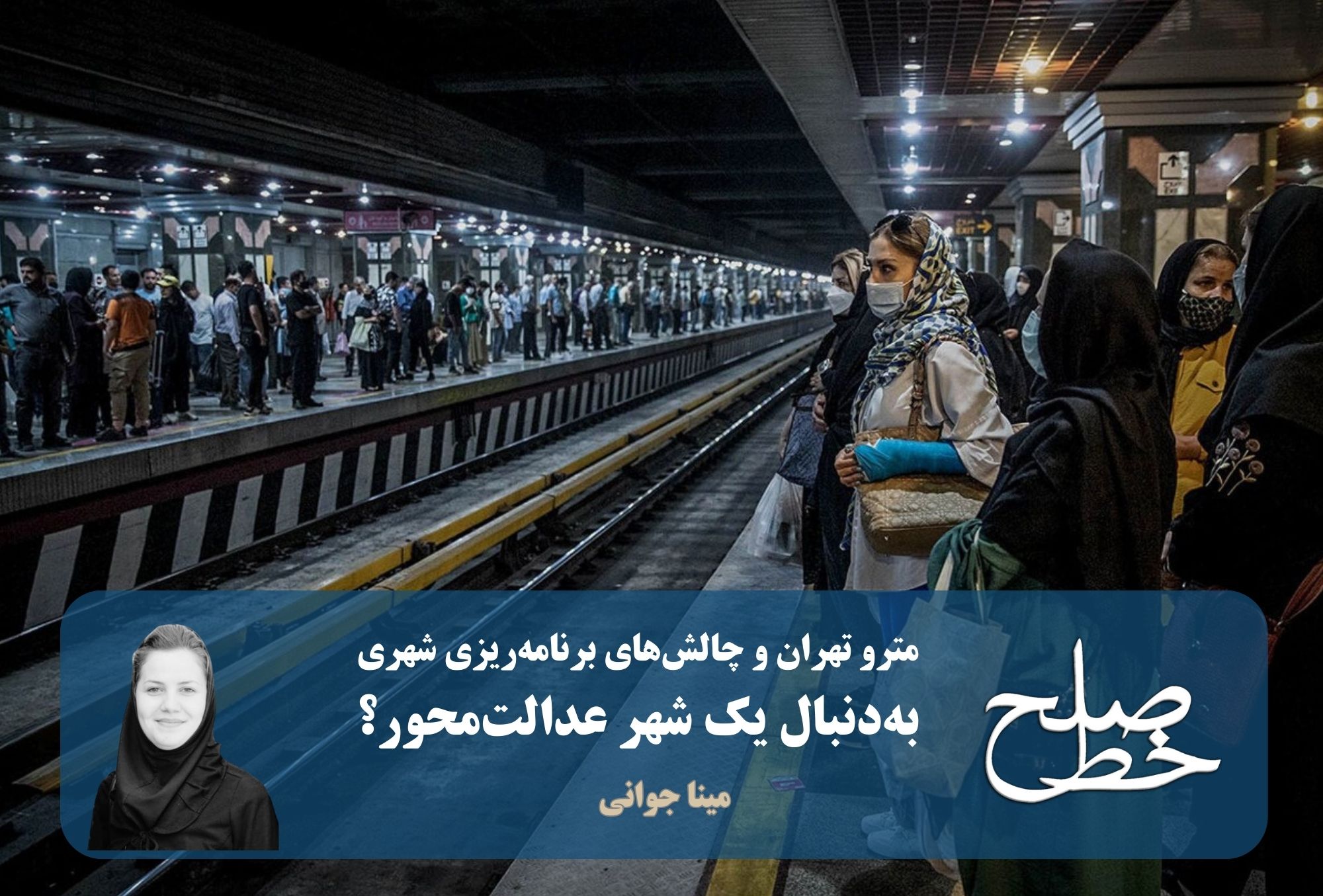
Looking for a justice-centered city?/ Mina Javani
The Tehran metro is no longer just a means of public transportation, but has turned into a battleground where tension, struggle, and survival take place in every corner. Every day, thousands of passengers search for a chance to catch their breath amidst the overcrowding and pressure at stations that cannot accommodate such a large population. Trains that arrive late, platforms that have no room for standing, and people who are exhausted and desperate, with their only hope being that the next train might have space for them. While officials speak of the normal flow of train traffic, the reality at stations like “Dowlat Gate”, “City Theater”, and “Shademan” paints a different picture: a crowd gathering on platforms, blocked exit routes, and passengers with their eyes fixed on a train in a world full of hope and despair, unsure if it will arrive or not.
This is not just a simple technical or traffic problem, but a critical crisis that is growing day by day and casting a shadow of ambiguity over the future of urban transportation. This situation not only reflects infrastructure deficiencies, but also has a direct connection with concepts of social justice. The metro, which was supposed to be a means of facilitating transportation, has now become a site for social and economic conflicts; a place where the need for reevaluating urban transportation policies and creating more equitable access for all citizens is felt.
Public transportation crisis, from infrastructure to management.
The Tehran Metro, which was initially designed as a solution to reduce traffic and improve public transportation, has faced major challenges due to population growth and increasing demand. While this system has been in place for over three decades and is considered one of the largest metros in the Middle East in terms of length of lines, its infrastructure falls short of efficient and sustainable metro standards. One of the biggest problems is the mismatch between the number of passengers and the metro’s capacity. During many hours of the day, especially at busy stations such as Darvazeh Dowlat, City Theater, and Sadeghiyeh, trains are overcrowded and passengers are forced to travel in undesirable conditions. The shortage of new trains and the aging of existing fleet have increased pressure and caused frequent delays in service. While the standard capacity for a train is a maximum of 1200 passengers, some reports show that during peak hours, this number reaches over 2000 passengers per train.
Another problem is the uneven development of the metro network. While some areas of Tehran, such as the north and center of the city, have good access to the metro, southern areas and outskirts still face shortages of lines and stations. This not only reproduces unfair distribution of urban facilities, but also leads to increased demand on main lines and puts more pressure on the system. Additionally, many stations suffer from serious deficiencies in design, emergency exits, ventilation, and amenities, making the travel experience more difficult for passengers.
Inefficient management is one of the most important factors that has exacerbated the crisis of the Tehran metro. Budget problems, poor decision-making, and lack of sufficient oversight have caused the metro system to not be able to properly deal with the existing challenges. One of the most prominent examples of this management weakness is the delay in the development and completion of metro projects. While the initial plan for the Tehran metro included a rapid and balanced expansion of the network, many projects have been delayed or left incomplete due to budget shortages, conflicts between responsible institutions, and mismanagement. For example, lines 6 and 7, which were designed to reduce pressure on other lines, have not been able to operate at full capacity due to technical problems and lack of equipment. On the other hand, ticket pricing policies are also a serious challenge in metro management. In recent years, ticket price increases to cover operational costs have put more pressure on low-income passengers. While the government has provided subsidies to compensate for these costs, these
The Tehran Metro crisis is not limited to technical and managerial issues, but is also reflected in the daily experiences of thousands of passengers. For many citizens, the metro is not just a means of transportation, but a daily battlefield for survival. Overcrowding, long delays, psychological pressure due to inadequate travel conditions, and lack of sufficient facilities have made it difficult for many individuals – especially women, elderly, and people with disabilities – to use the metro comfortably. One of the biggest problems is the lack of security in some stations and trains. Verbal and physical harassment, theft, and violent confrontations between passengers, especially during peak hours, have made the travel experience unpleasant for many. Another issue is the inadequate quality of services at stations. Many metro stations lack facilities such as elevators and suitable escalators for the elderly and people with disabilities. Additionally, inadequate ventilation in some stations and trains, especially during hot seasons, makes the situation even more difficult for passengers.
The crisis of the Tehran metro cannot be simply considered as a transportation problem. This crisis is a reflection of structural weaknesses in urban planning, mismanagement, and social inequalities that are clearly visible in the public space of the city. The Tehran metro, which was supposed to provide equal access to urban services, has now become a scene for class conflicts, public protests, and the failure of policymakers to respond to the needs of citizens. This situation requires a serious reconsideration of transportation policies, infrastructure improvements, and management reforms in order for the metro to once again fulfill its role as an efficient and equitable tool in the city.
Equal access or hidden discrimination?
The metro, as the backbone of the public transportation system in Tehran, can be a tool for achieving urban justice, but in practice, do all citizens benefit equally from it? At first glance, the metro is a space accessible to all segments of society, but in the underlying layers, there are visible gaps in how different groups access this system. These gaps, mainly caused by geographical, class, and gender differences, raise a fundamental question: Is Tehran’s metro truly serving urban justice, or is it secretly reproducing inequalities?
One of the main challenges of the Tehran metro is the unequal distribution of lines and stations. While central and northern areas of the city have a higher density in the metro network, southern and peripheral areas – which are mostly inhabited by lower-income groups – have limited access to this system. This causes residents of these areas to spend more time and money on transportation, despite having a greater need for public transportation. In such conditions, the metro becomes a factor in perpetuating spatial and economic disparities instead of reducing them. Although all passengers may seem to have equal access to facilities, the quality of services at different stations and lines is not the same. Some of the busiest stations, such as City Theater or Imam Khomeini, suffer from overcrowding, inadequate ventilation, and lack of sufficient amenities. On the other hand, newer stations in less dense areas are equipped with more modern facilities. These differences indicate a kind of inequality in the allocation of resources and managerial attention to different parts of the city.
One of the important aspects of urban justice is the issue of women’s safety in public transportation. The allocation of special women-only train cars was a positive step, but it is not enough. The experience of many women shows that they are forced to choose between designated cars – which are often crowded and limited – and mixed cars – where they sometimes feel unsafe. This situation shows that current policies not only fail to ensure justice, but may also lead to new limitations for certain groups. Despite the emphasis of urban laws on creating suitable facilities for people with disabilities, many metro stations lack elevators or standard ramps. This has made the metro, which was supposed to facilitate transportation, a serious obstacle for some citizens. Insufficient attention to the needs of this group is an example of hidden discrimination that has been overlooked in urban design and management.
Although the Tehran metro is supposed to serve all citizens as a public transportation system, in reality, spatial, economic, and social differences have caused various groups to have unequal experiences with it. Therefore, if the ultimate goal is to create a more just city, policymakers must pay attention to these hidden gaps and plan for equal access.
How can we have a fairer subway?
In order for the Tehran metro to become a real tool for urban justice, we must go beyond just developing the lines and increasing the number of trains. Achieving fair public transportation requires changes in infrastructure, policy-making, and urban management. In this section, some key solutions that can help achieve this goal are presented and discussed.
1- Balanced distribution of infrastructure and expansion of the metro to underprivileged areas: One of the first steps towards creating urban justice in the metro is to develop lines in areas that have been deprived of these services so far. The outskirts and southern areas of Tehran, which are mainly inhabited by low-income groups, have a greater need for public transportation. Planning for the construction of new stations in these areas and creating complementary transportation routes (such as bus lines coordinated with the metro) can be an effective step towards reducing spatial inequality.
2- Improving the quality of services and fair distribution of resources: Investing in improving facilities at busy and old stations, such as upgrading ventilation systems, increasing the number of escalators and elevators, and continuous cleaning, plays an important role in enhancing the experience of passengers. However, fair allocation of resources between stations and preventing the concentration of amenities in more affluent areas can help reduce the class gap in using the metro.
3- Facilitating access for people with disabilities: The metro should not be a barrier for people with disabilities, but rather should act as a means to increase their social mobility. For this purpose, the following actions are necessary:
Installation and repair of elevators at all stations.
Installation of standard ramps at entrances and exits.
Designing suitable wagons for people using wheelchairs.
4- Increasing transparency and citizen participation in metro management: Decisions about the metro should not only be in the hands of city managers, but citizen participation through public surveys and advisory councils can help identify problems and provide real solutions. Additionally, public dissemination of data related to metro performance, including train delays, financial status, and development plans, can increase accountability and transparency.
Notes:
Sen, A. (2006). What do we want from a theory of justice?
The Journal of Philosophy, 103.
(5), 215-238.
Dryzek, J. S. (1990).
Democracy based on discussion and debate: Government, decision-making, and the study of politics.
نشریات دانشگاه کمبریج
Cambridge University Press
Healey, P. (1995). Discourses of integration: Making frameworks for democratic urban planning. In P. Healey (Ed.),
This text is the title and author information for an article or book chapter written by Patsy Healey in 1995. The title of the article or chapter is “Discourses of Integration: Making Frameworks for Democratic Urban Planning” and it is included in a larger work edited by Patsy Healey.
مدیریت شهرها: محیط شهری جدید
Managing cities: The new urban context.
Pages 251-272. Taylor & Francis.
 By: Mina Javani
 March 21, 2025
Tags
Bus Injustice Metro Mina Youth peace line Peace Treaty 167 Public transportation Social stratification Tehran Metro Train Urban justice Water, electricity, and free bus. ماهنامه خط صلح