


A brief overview of the status of sexual minorities in Iran today / Nadia Riyazati
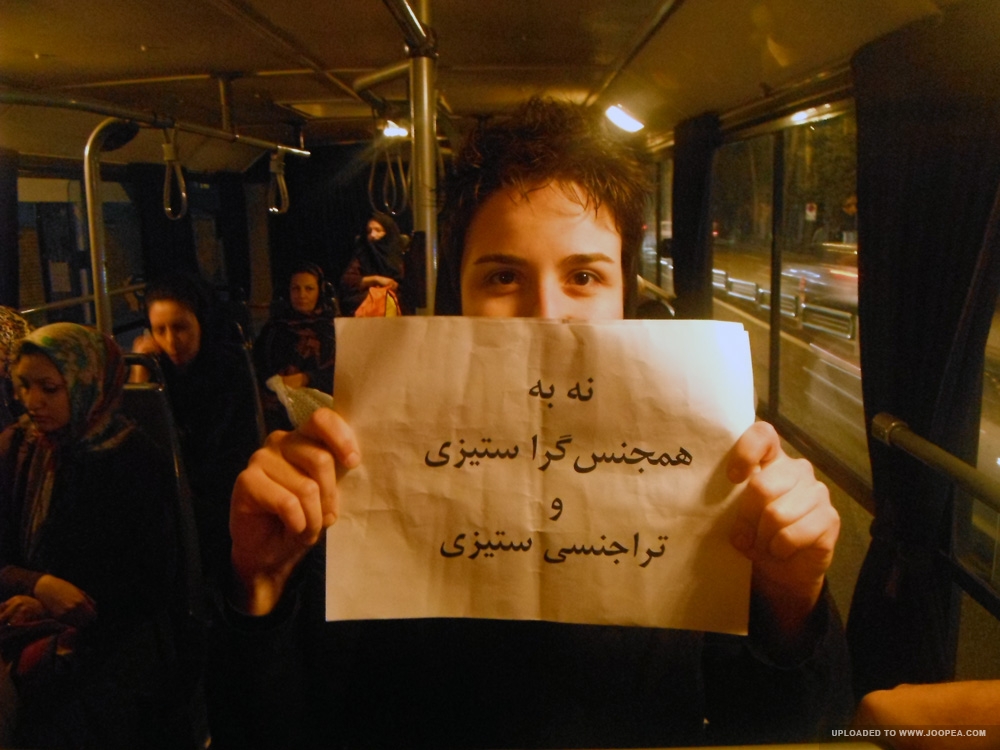
The film “Facing Mirrors” directed by Ms. Negar Azarbayjani and produced by Ms. Farshad Ta’irpour was made in Iran in 2009. In this film, Adineh, a transgender Iranian girl (someone who physically appears to have a different gender than their gender identity, and therefore feels the need to undergo a physical gender change), comes from a wealthy family who insists on a male identity and is therefore trying to find a way to change her gender. Adineh’s father, who sees her situation as an unsolvable problem, tries to solve it by forcing her to marry one of his acquaintances. Faced with this situation, Adineh runs away from home and meets Rana on the way. Rana is a young woman from a traditional and religious working-class family who works as a taxi driver to help her family’s financial problems. Rana takes Adineh in her car and during their conversation, she discovers Ad
What is the reason for behaviors such as the behavior of Adineh’s peers towards sexual minorities, such as Adineh, in society?
Field research shows that sexual minorities (homosexuals, bisexuals, and transgender individuals) in Iran are subjected to various forms of humiliation and condemnation by their families, society, and humiliating interrogations, torture, and heavy punishments by judicial authorities. Living behind the walls of traditional customs that reject any lifestyle other than the prescribed one, and also breathing in an atmosphere where the preaching of religious intolerance has been promoted for decades, has created a foundation for considering and carrying out humiliating and physically attacking behaviors towards one of the marginalized minorities in Iran, namely sexual minorities.
Through reviewing the statements of these individuals, their accusations can be categorized into three groups based on their nature and then examined and analyzed.
1- Accusations that directly target the sexual behaviors of homosexuals. As a result of these accusations, the sexual behaviors of homosexuals are considered a crime and are subject to severe punishments (as determined by the interpretation of Shia law). Accusations such as committing sodomy are examples that can lead to the death penalty if proven.
2- These accusations do not directly target sexual behaviors. Some of these accusations are related to security crimes (national security), such as “propaganda against the system”, “disrupting public order”, and “participating in illegal groups”. These crimes, which are considered first-degree crimes and carry severe punishments, are very vaguely defined, lacking a precise and clear definition, and in some cases, such as “corruption on earth”, carry the death penalty.
3- Another category is the accusation of committing immoral behaviors. These accusations do not directly and explicitly target and aim at sexual behaviors of homosexuals, but research shows that it can be said that almost all sexual homosexuals who are often targeted, arrested and detained by security forces in public and private spaces, are faced with charges such as committing “sexual crimes” with accusations like committing anti-social behaviors or behaviors against religious sanctities. Therefore, the sentences issued for them are also based on these accusations. “Disturbing public order and purity” and “insulting sanctities” are examples of accusations with vague definitions that, in most cases, according to their statements, have been imposed on homosexuals without providing a specific example in courts.

Furthermore, many sexual minorities have reported experiencing mistreatment from their families, classmates, and close acquaintances. They are not only unsafe in public and at a larger scale in the hands of security authorities (police, Basij, and Sepah), but also suffer from discrimination, humiliation, and violation of their rights by private actors such as family and close relatives. Interviews with these individuals often reveal a common pattern of humiliation, physical abuse, and violation of rights by these parties. In contrast, due to the indifference or attacks of their families, sexual minorities have difficulty receiving necessary support under Iranian laws, despite the fact that any non-heterosexual behavior is considered a crime. The government avoids dealing with, prosecuting, and punishing private actors who commit violence against sexual minorities. The sexual behavior of these individuals in their private lives is equated with rape, perversion, and immorality in relation to society, and is considered a factor in disrupting social order. In fact, the identity of sexual
The film “Facing Mirrors” shows that even religious believers can come to believe that inflicting suffering on a young transgender person is shameful and should be prevented. Despite the negligence of many religious leaders and the limited freedom of expression in Iran today, the collective conscience of awakened Iranians can use art and other means of communication to put an end to the oppressive and inhumane treatment of transgender individuals. This important issue can eventually gain enough strength to mobilize public opinion to abolish and prevent the enforcement of many current laws against transgender individuals.
In a healthy society, everyone should be able to have equal respect and civil rights. Sexual minorities are one of the groups in Iranian society and, like other Iranians, they are human beings who deserve to have all the rights and privileges of citizenship.
 Created By: Nadia Riyazati
 October 24, 2014
Tags
Monthly Magazine Number 42