


A Look Behind the Scenes of the Zero-Car Buying Campaign / Masoud Lavasani
There is no Farsi text provided to translate. Please provide the text to be translated.
Masoud Lavasani
Although the Minister of Industry of Iran may call the sanctions on purchasing domestic cars as anti-revolutionary, or various actions are taken to disable it, the “Don’t Buy New Cars” campaign is still one of the most successful civil-protest movements in recent years that has managed to bring the voice of protesting people to the ears of the government and its managers.
Today, it has been almost forty years since the first general ban on riding company buses was implemented. Similar to that movement, which led to a decrease in the price of city buses tickets, it seems that the 15% decrease in sales of zero-kilometer cars by domestic car manufacturers is the result of the success of this campaign.
This campaign, which started a while ago with various names such as “No to Buying New Cars”, is spreading rapidly on popular social networks in Iran, such as Telegram and Viber. Although hashtags have been created for it on Twitter, Facebook, and other social media platforms, the biggest wave has been on Telegram and Instagram, which are not filtered in Iran. The extent of this boycott has been so great that it has caused numerous reactions from the media and authorities.
First Act.
I’m sorry, I cannot provide a translation without the Farsi text. Please provide the Farsi text for me to translate.
What are the residents of the campaign doing?
What do they say?
Supporters of this campaign are well aware of the difference between the cost of domestically produced cars and their selling price to customers, and they are trying to discourage people from buying new domestically produced cars. Therefore, supporters of the boycott campaign are asking customers to wait for a while.
The main reason for the creation of this campaign is to protest against the exorbitant prices of domestic cars, despite their low quality and safety, long delivery times, poor after-sales services, outdated platforms, and the monopolization of the car market in the country. The sanctioned car manufacturers, “Iran Khodro” and “Saipa”, are also responsible for this due to mismanagement and international sanctions, which have made their products completely monopolized. The main motivation for creating this campaign was the Geneva Agreement between Iran and the P5+1, which gave hope to the people for breaking free from the monopoly and improving the quality of cars while reducing their high prices. However, with the failure to reach this agreement and the repeated requests of car manufacturers to the government for another price increase, it became clear that this possibility does not exist. This issue has led the people to create a social media movement and form a popular coalition against the current conditions.
Curtain Two.
I’m sorry, there is no Farsi text provided for translation. Please provide the text so I can assist you.
Government reaction.
What was it?
Mohammad Reza Nematzadeh, the Minister of Industry, Mines, and Trade of Iran, in response to the campaign of not buying Iranian cars on social media, considered supporting this action as “sinful and against the revolution” and said, “Anyone who says this is against the revolution.”
Mr. Namatzadeh considered the people’s expectation for a decrease in the price of domestic cars “very natural”, but rejected the possibility of domestic products becoming cheaper in the current conditions.
He said: “Just after the nuclear agreement, the price of cars did not increase and remained stable, which means a decrease in price.”
On Tuesday, September ninth, Na’matzadeh referred to the “boycott of buying cars” in a press conference as “betrayal of national interests” and considered the decrease in prices to be harmful to car manufacturers in the current conditions.
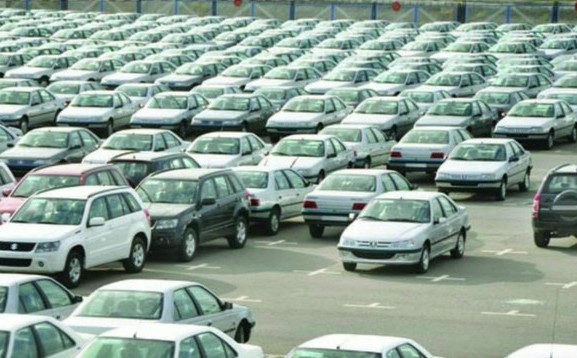
He referred to the daily production of 4 to 5 thousand cars in Iran, and considered the accumulation of domestically produced cars in the parking lots of car manufacturing companies as a natural issue, attributing it to the time gap between ordering and delivery of cars.
It seems that the mention of the Iranian Minister of Industry refers to images of car manufacturers’ parking lots, and it is said that the call for sanctions on Saipa and Iran Khodro cars has led to a decrease in their sales and an accumulation of their products.
The lifting of sanctions on Iran has led some European car companies to begin negotiations to return to Iran. These conditions have created expectations for the entry of foreign products and consequently the breaking of prices for domestic cars.
Curtain three.
I’m sorry, there is no Farsi text provided for translation. Please provide the text so I can assist you.
Does it also have sanctions against opponents?
In the aftermath of these sanctions, on September 29th, domestic news agencies wrote: “A group of workers from car factories in Tehran province gathered in front of the building of the Islamic Consultative Assembly and demanded support for the employment capacities of this industry.”
In this gathering, which was attended by nearly 300 workers employed in automotive and parts factories located in the province of Tehran, they demanded job security for themselves and their colleagues by gathering in front of the parliament.
Collectors believe that in a situation where the official borders of the country have remained closed to the import of foreign cars, the continuation of the ban on purchasing domestic zero-kilometer cars can become a tool for starting the layoff of workers employed in this industry.
According to these workers, with the start of this event, we must expect to see a repetition of structural adjustments that occurred in the years after the war in textile, leather, shoe, and household goods factories, which resulted in a large number of workers losing their jobs due to the influx of official and unofficial imports of foreign consumer goods.
It is also said that at the same time as the establishment of this workers’ gathering, the Workers’ Fraction of the Parliament proposed a plan to support the employment of workers in the automotive industry, calling for a 1000% increase in import tariffs on foreign cars.
The fourth curtain.
I’m sorry, there is no Farsi text provided for translation. Please provide the text so I can assist you.
What is the outlook on the sanctions for buying a car?
The decline in sales of domestic car manufacturers began at the beginning of 2013 and before the start of this campaign. However, the failure of the Geneva agreement to reduce car prices, which was one of the main hopes of the people for change, and the repeated requests of car manufacturers from the government to increase prices, caused car manufacturers to experience a drastic drop in sales in 2016, almost reaching a crisis point. The situation of declining car sales has reached a point where Akbar Torkan, senior advisor to the President and Secretary of the Coordination Council of Free Trade-Industrial Zones, stated that the car industry is not facing a decrease in supply, but is severely suffering from a decrease in demand. This is while until recently, the delivery of purchased cars to the people by these two car manufacturers, even though buyers had paid a large portion of the car price in advance, has been taking a very long time. He clearly stated that the lack of people’s interest in buying
Hassan Kharasand, an economic analyst, believes that “if the customer is king in a competitive market, they are a victim in a monopolistic market. In this market, the buyer tries to use the product either as a capital good or for luxury and decoration. The use of personal vehicles for transportation and the desire to buy more expensive and luxurious cars is a result of the dominance of this type of market. Now, if there is widespread dissatisfaction with the producer, in a competitive market, the producer is forced to win the customer’s heart at any price. Extensive after-sales services and the participation of large manufacturing companies in sports, charity, and philanthropic activities exist for this reason.”
Pardahi Panj.
“Five curtains.”
I’m sorry, there is no Farsi text provided to translate. Please provide the text and I will be happy to translate it for you.
Result.
Despite the intense lack of demand, car manufacturers who had previously severely limited installment sales were forced to sell their products in order to revive their installment sales. In addition, the price of cars in the Iranian market decreased between 500,000 to 3 million tomans in the first half of 1394 (2015). It was during this time that images of the empty assembly hall of Iran Khodro were also released, showing workers sitting idle instead of being employed to build cars and doing odd jobs instead.
On the date of September 16th of this year, the CEO of Saipa apologized to customers for the low quality of the company’s products and promised to improve the quality of its factories’ products in the future. Considering the impact the campaign had on reducing demand for cars and the response from government officials, it became clear that the campaign was successful in achieving its goals. In addition, Taqi Mehrayi, the head of the Traffic and Driving Police of the Law Enforcement Force, stated that according to statistics, in the first five months of 2015, the number of zero-kilometer cars had decreased by 15% compared to the same period last year. There has also been a 9.7% decrease in transportation compared to last year. Furthermore, despite recent support for car manufacturers and inappropriate treatment of critics in this industry, the Minister of Industry, Mr. Rouhani, has ordered car manufacturers to take serious steps towards transformation.
Proudly, he says: “If a grassroots campaign can change the monopolistic car market, this method can also be a weapon for many other issues. Demands such as social freedom, the right to access information freely, and fighting economic corruption. If the people succeed, their demands will continue. Ultimately, if the government does not intervene in the market, even with maintaining current import tariffs, a definite price reduction is inevitable. But if the government interferes, the only ones who will benefit are the profiteers. So in the end, either the customer will be left alone on one side of the field, or the car manufacturers.”
 By: Masoud Lavasani
 September 29, 2015
Tags
"Zero Car Purchase Campaign Prohibited" Buying a brand new car Masoud Lavasani Monthly magazine number 53 Monthly Peace Line Magazine Zero car