


Escape from the experience of execution cancellers of drug-related suspects/ Ali Kalaei
This is a caption.
Ali Kalai
“There is no place for punishment without hope. A punishment that lacks the element of hope is in itself a torture and not a punishment.” (1) These words were spoken by the leader of the Catholic world at the 6th World Congress Against the Death Penalty in Oslo, in a video conference. The statement acknowledges that because the death penalty is a punishment without hope and irreversibly ends the life of the accused and convicted, it is in fact a torture and an inhumane act, not a punishment.
Drugs. They are a scourge that devastate families and in Iran, for years, the punishment for many related offenders has been death. Execution by hanging. A punishment that many countries around the world have stood firmly against. In two-thirds of the world, including European and American countries, based on international treaties, the use of the death penalty has been limited to “the most serious crimes” and signing countries must consider them part of their domestic laws and be committed to them, essentially prohibiting or stopping the use of the death penalty for any crime, let alone drugs. (2).
Based on a report published in October 2015, while 75% of countries in the world have abolished the death penalty both in law and in practice for all crimes, there are still 33 countries where it is possible to execute individuals for drug-related offenses. Between 2010 and 2015, 13 countries among these have carried out such executions. These countries are mostly located in Southeast Asia, Oceania, and the Middle East. (3).
This action is not limited to only these countries. The death penalty still exists in 31 out of 50 states in America. In these states, it is argued that the death penalty serves as a deterrent for drug-related charges. This is despite official and international organizations connected to the United Nations stating that drug use in countries with the death penalty remains constant and unchanged, meaning that this punishment has not had an impact on drug use in these countries.
These institutions also acknowledge that this issue jeopardizes social and mental health, as authorities justify killing citizens and essentially turn violence into a daily occurrence for people.
Furthermore, according to Amnesty International, in many countries where the death penalty exists for drug-related offenses, cases such as lack of access to a lawyer or coerced confessions have led to unfair trials and ultimately, the execution of suspects due to lack of legal defense or even forced false confessions. In countries like Malaysia, according to the Bangkok Post, small-scale drug traffickers are arrested and punished, while the real traffickers, or the “big fish,” never get caught.
The existence and increase of substances that are referred to as drugs has become an issue that has imposed itself on the world today. In the final statement of the 6th World Congress Against the Death Penalty in Oslo in 2016, it was mentioned that member countries of the United Nations have reached a breaking point in the face of such substances and it is necessary for them to adopt new policies against them. They also stated that financial assistance should be provided to countries that have abolished the death penalty in order to combat drugs.
Here we are faced with two experiences. The experience of countries that have taken the harshest punishments against drugs and, based on experience and what has been said above, their struggles have had no impact on the root of the problem and have only led to an increase in violence. And the experience of countries that have abolished the death penalty altogether, including for drug-related charges, and have adopted other approaches. Here we take a brief look at the experience of several countries among the abolitionists to see what impact the abolition of this punishment has had on those countries? Has it had any impact and is the issue of the death penalty for drugs, even as countries around the world are seeking to change their policies towards these substances, a public concern for the people of those countries or not? In fact, if public attention is turned to the return of the death penalty today, is it because of this global war on drugs or for another reason?
The translation is: “A Persian cat with green eyes.”
Richard Sedilot
France is at the heart of Europe. A country where its great revolution marked the beginning of a global transformation. It is one of the most culturally rich countries in Europe. The death penalty was abolished in this country in 1981. Richard Sedillot, a prominent French lawyer, a member of the French Bar Association and the Council of Europe, in response to a question about the issue of the death penalty and drugs in France, says that at the time of the abolition of the death penalty in this country, the issue of drugs was not at all a concern for activists or opponents of the death penalty, and it was not an important issue in the space of those who were for or against the death penalty. This French lawyer also emphasizes that today the issue of drugs is more important and prominent since 1981, and this issue has no connection with the abolition of the death penalty. Sedillot says, “The more important issue of drugs today is the result of the increase of drugs
This human rights and anti-death penalty activist from France continues to say that if there is to be a discussion about the return of the death penalty to France, it should be in relation to terrorism and not the issue of drugs.
Let’s go back to Asia. Southeast Asia. Cambodia is located next to the Golden Triangle of drugs in Southeast Asia, which includes Laos, Burma, and Thailand. Cambodia abolished the death penalty in 1989. Cambodia has taken preventive and educational measures against the issue of drugs. In November 2010, the Cambodian government and the United Nations Office on Drugs and Crime held the first training seminar in Cambodia to build capacity in local communities for providing drug abuse treatment services, including HIV/AIDS prevention. (4).
These educational policies are implemented in a country where, for example, the use of marijuana is a part of its cultural fabric. However, in this country, drug trafficking is accompanied by severe punishments such as life imprisonment. In fact, in Cambodia, where the use of marijuana is considered acceptable in its cultural fabric, and in the context of the Golden Triangle of Southeast Asia, the country has taken action against drug use through education programs supported by the United Nations. (5).
Let’s compare statistics regarding this country. Cambodia, in comparison to Malaysia, a country that has the death penalty for even small amounts of drug trafficking in its laws and occasionally carries it out. According to statistics, the rate of crime and violence in Cambodia is lower than Malaysia. In the field of drugs, there are also similar percentages that show that the death penalty has had no impact on reducing or increasing crimes related to the drug issue in the region. (6).
This is a caption for an image.
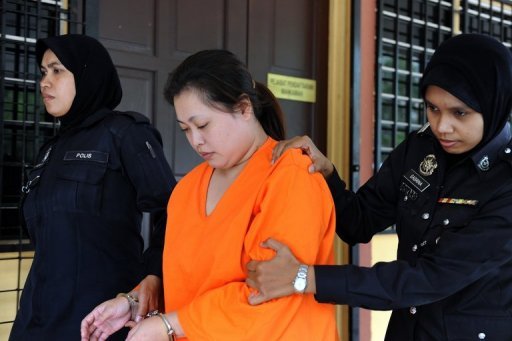
A Japanese woman sentenced to death in Malaysia – Photo from Japan Times
The interesting point here is that the death penalty is generally established for drug-related charges in all three countries of the Golden Triangle, namely Laos, Burma, and Thailand, but this punishment has not been able to prevent this issue. Even with the cultural issue present in Cambodia, the drug situation in Cambodia is much better than a country like Thailand (a member of the Golden Triangle). (7).
“We are returning to Europe. Germany. The industrial and driving force of united Europe. Germany, after the fall of the Berlin Wall, has never seen the death penalty imposed on itself. Khalil Rostamkhani, a journalist, translator, and human rights activist, in relation to the abolition of the death penalty in Germany, says that “West Germany was one of the first European countries to abolish the death penalty in 1949, except for West Berlin. Just a few days before the adoption of the new law in Germany, a man was executed on charges of murder and theft. In West Berlin, the death penalty was also banned after about two years in 1951.” This human rights activist also mentioned that “at least in recent history, the death penalty has never been established for drug offenses in Germany” and said that considering this issue, “its impact on reducing or increasing drug use cannot be estimated.”
However, statistics show a gradual but upward growth of those who have sought treatment and relief from the scourge of drugs in Germany. This can, of course, be attributed to the increase of drugs in the market in recent years, particularly in Southeast Asia and the Middle East (countries that have the death penalty for various crimes, including drugs, in their laws). (8).
Italy is another European country. This country abolished the death penalty in 1889 AD. Except for the period of fascist rule in Italy, there have been no executions in Italy. Ahmad Rafat, an Iranian-Italian journalist, talks about peace in relation to Italy, saying that even when the death penalty existed in Italy, it was not an issue for drugs. This well-known journalist also says that in Italy, drug use and possession for personal use have not been considered a crime for years; only selling and trafficking are considered crimes and are punished accordingly.
According to statistics, Italy is also suffering from a slow increase in drug treatment seekers for the drug problem, similar to Germany. This growth is also attributed to the drug market, like Germany and France. (9).
In October 2015, the thirteenth annual global event for the International Day Against the Death Penalty was celebrated. In one of the published texts from this event, comparisons were made between the United Kingdom and Wales as countries where the death penalty has been abolished, the United States as a country with varying policies towards this type of punishment in different states, and China as a country with a strong emphasis on the death penalty for drug-related crimes. This comparison shows that from 2003 to 2012, drug use in the UK and Wales has been decreasing. In the US, there have been consistent numbers recorded, while in China, despite the high number of executions in all areas, drug use has been steadily increasing.
Sweden. Another European country where the death penalty has not been implemented since 1910 and is prohibited in this country. Only a few statistics show that in this country, where the death penalty has been abolished for years, the rate of criminals in various fields is also decreasing. From 2004 to 2014, the number of prisoners in Sweden has decreased from 5722 to 4500. In 2013, 4 prisons in this country were closed due to lack of prisoners and Swedish authorities are looking for alternative solutions for rehabilitating criminals other than prison. (10).
The statistics of different countries that have abolished the death penalty are clear and show that the death penalty has no impact on reducing the scourge of drugs in these countries. In some cases, this violence and confrontation with society itself leads to the growth of drugs in society. When the death penalty jeopardizes the mental health of a society, on the other hand, this sick society is driven towards drugs to alleviate itself. In fact, the death penalty as a tool of violence can even be a factor in increasing social recourse to drugs.
The death penalty is a hopeless punishment. The death penalty is a punishment that only endangers the mental health of society, but has no effect on the level of crime, drug use, and statistics related to the same issues that those who are sentenced to death are guilty of. The death penalty is a tragedy for human society. And the world, based on experience, data, statistics, analysis, and reasoning, is moving towards complete and total abolition of it. People who wish for a time when there is no longer any need for a day against the death penalty, because there is no longer any death penalty.
“We come from Iran. It ranks second in the world for the highest number of executions, most of which are related to drug offenses. In Iran, the death penalty is issued for possession of 30 grams of heroin or other mentioned substances under Article 8 of the Anti-Narcotics Law. In Malaysia, with a history of tragedies in dealing with the drug problem, rampant police corruption, and horrific prison conditions, the threshold for possession is 50 grams. (11) In fact, in this field as well, we have taken the lead with significant gaps from the rest of the world.”
Where is the path of the global society and where is our path; as Hafez says, see the difference in the journey from where it begins to where it ends.
Resources
Summary report of the 6th World Congress Against the Death Penalty in Oslo, Herana News Agency, 3 July 2016.
2- The status of the death penalty for drugs in Iran and other countries around the world, Salamat News, February 7, 2016.
3- The 13th anniversary of the World Day Against the Death Penalty, the English-language website for the death penalty.
4- Reform or improvement of laws against illegal drugs in Asia, the website of the Anti-Drug Headquarters.
5- Akino, Michael, harsh penalties for drug use in Southeast Asia, English-language website about (aboul), January 19, 2016.
6- Comparison of crime and violence between Malaysia and Cambodia, English language website Numbeo.
7- Comparison of crime and criminality between Cambodia and Thailand, on the English website IndexMundi.
8- An overview of drug-related behaviors in Germany, the website of the European Monitoring Centre for Drugs and Drug Addiction.
9- An overview of drug-related behaviors in Italy, the same.
10- James, Irwin, prison is not a punishment in Sweden, The Guardian, November 26, 2014.
Two other Iranians sentenced to execution in Malaysia, IRNA news agency, July 2013.
 By: Ali Kalaei
 September 25, 2016
Tags
Abolition of the death penalty Ali Kala'i Drug offenses Drug trafficking Execution Execution in Cambodia Execution in Malaysia Magazine number 65 Monthly Peace Line Magazine Narcotics peace line Richard Sadilot The 6th World Congress Against Execution