


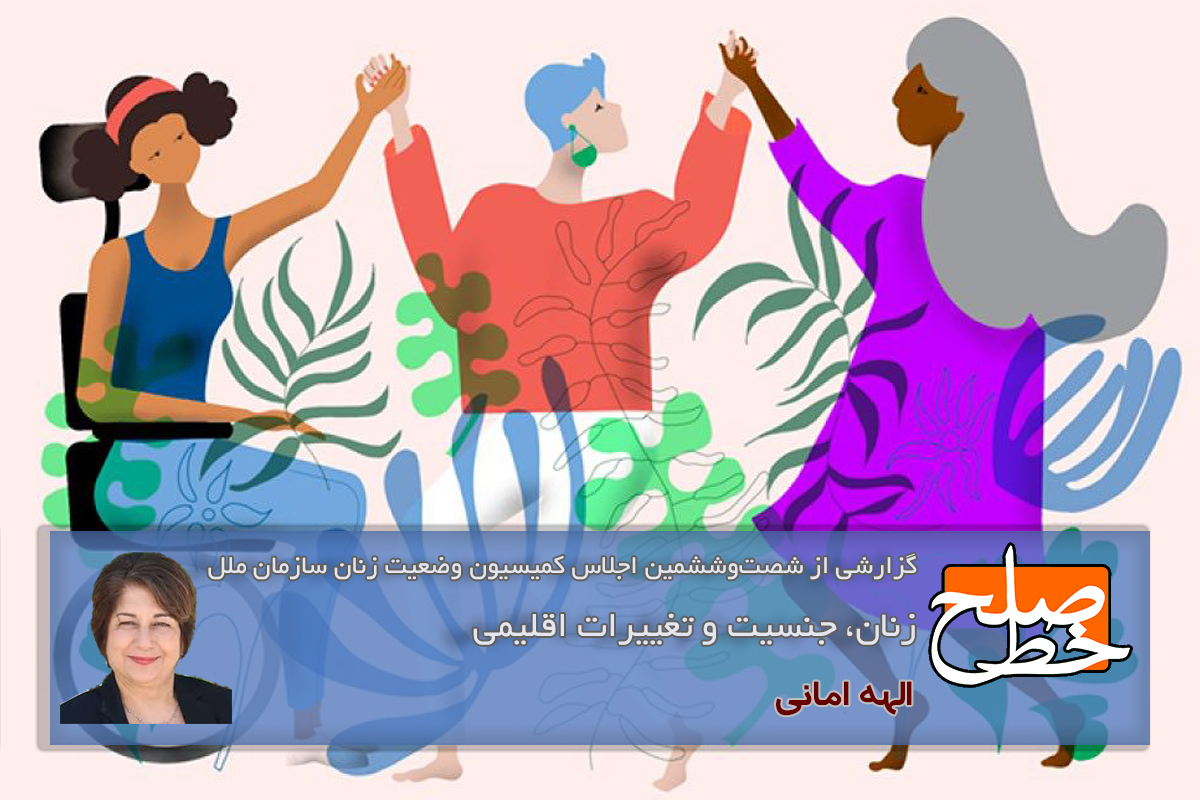
Women, Gender, and Climate Change: A Report from the 66th Session of the United Nations Commission on the Status of Women / Elaheh Amani
The 66th session of the United Nations Commission on the Status of Women (CSW) was held in March 2022, both in person and virtually. Government delegations were present in person, but most activities from government women’s organizations, feminists, women’s rights activists, and other civil society organizations were held online. Women’s rights defenders and feminist organizations discussed women’s perspectives on climate change, gender justice, economic empowerment, sexual justice, and fertility, among other topics. While conservative, right-wing governments with a strategy of rolling back women’s rights were unable to fully advance their policies, hopes for opening up UN negotiations for greater civil society participation were not successful, and the next session of the UN Commission on the Status of Women will have to be postponed.
The United Nations Commission on the Status of Women is the most important global conference on women’s rights and one of the largest UN commissions. It is held every year in March at the United Nations headquarters in New York. After the 2020 session was cancelled (due to the COVID-19 pandemic in the US), the 2021 session was held virtually. The 66th session of the UN Commission on the Status of Women was originally planned to be a hybrid event, allowing for both in-person and virtual participation from civil society organizations. However, in practice, the majority of civil society and non-governmental organizations participated online, while a minority of participants were able to attend in person in New York and faced numerous challenges.
After two weeks of activity, the United Nations Commission on the Status of Women finally emerged on March 25th with the agreed-upon conclusions of the governments’ representatives in the final official session of this commission. The document, which was released as the official outcome of the 2022 session of the UN Commission on the Status of Women, includes recommendations for governments, international organizations, civil society, and other key stakeholders. However, even as the excitement of the closing ceremony echoed, women’s organizations in non-governmental forums were considering how to carry out their challenging task of monitoring the implementation of the final document and holding governments accountable, and how to learn from their past failures in order to pursue it in another opportunity.
Women, Gender, and Climate Change.
I’m sorry, there is no Farsi text provided. Please provide the text for translation.
Although it can be said that this issue has a history as long as the United Nations itself, it was in the mid-1990s, after the historic Beijing Conference in 1995, that the UN Commission on the Status of Women became a key axis for evaluating progress and social, economic, and political gaps in different societies with a gender perspective. The theme of the current year, “Achieving Gender Equality and Empowering All Women and Girls in the Context of Climate Change, Policies and Programs for Reducing Environmental Risks and Natural Disasters,” was a historic opportunity and the first time that the United Nations addressed the intersectionality of women’s rights and status, climate change, environmental degradation, and the devastating impacts of this crisis on women, and deepening gender gaps, in an assembly.
This historic opportunity led to the attraction of a large number of civil society organizations that were working on climate change, and not necessarily part of the regular participants of the UN Commission on the Status of Women. This summit, in addition to highlighting the impact of climate change on women and girls, had the potential to highlight the creativity and practical and effective environmental solutions of women to combat climate change. Non-governmental organizations hoped that the main causes and consequences of climate change on women and their resulting increase in inequalities and violation of women’s human rights would be highlighted and that governments and the private sector would be held accountable. It was hoped that the UN Commission on the Status of Women would support a financial mechanism to address the damages caused by environmental crises, as well as a mechanism for holding those responsible for these climate crises accountable, especially large fossil fuel companies and other companies that play a key role in causing damages. Achieving gender justice in environmental crises is not possible without examining the root causes of climate change and holding
Another issue that women’s rights advocates in the United Nations Commission on the Status of Women wanted to highlight was the constant attacks against women human rights and environmental defenders in the context of the water crisis and climate change in Asia, particularly in South and West Asia (the Middle East) and Oceania. These countries are at the forefront of the damages and impacts of climate change, and activists are working tirelessly to increase awareness and resistance against the devastating effects of extractive industries and the burning of fossil fuels. The human rights of these individuals, who hold governments accountable, must be protected.
Empowerment of Women’s Economy.
The Women’s Status Commission of the United Nations has reviewed the actions of governments in cases that were agreed upon in last year’s meeting on “Empowering Women in a Changing World of Work.” The economic downturn of the past two years due to the COVID-19 pandemic has disproportionately affected millions of women, especially in the informal sector where they make up a significant portion of the workforce, and has pushed them out of the job market. In addition to the pressures caused by the economic crisis, unequal distribution of household and caregiving responsibilities fell on women’s shoulders. As a result, governments were obligated to create a space to support women’s social and economic rights and implement programs to improve the situation of COVID-19 patients. However, many governments did not have a remarkable track record in fulfilling their commitments.
Civil society institutions emphasized that with the current pace of progress, it will take centuries for women to achieve economic equality. Feminist and women’s non-governmental organizations consider governments responsible for supporting women’s economic empowerment and challenging gender stereotypes and roles that hold women back. The hope was that in this conference, the discussion would focus on how gender stereotypes weaken women’s rights, and that the final agreements would include clear and strong language committing governments to take action in this area, which unfortunately did not happen.
The reality of life for millions of women, especially in the Global South, is that gender stereotypes in various ways undermine women’s economic rights and impact their aspirations, support resources, opportunities, and access to resources such as financial matters, economic markets, and a wider entrepreneurial ecosystem at the community level. Women’s non-governmental groups and organizations have also raised challenges that women face in the field of entrepreneurship. For women entrepreneurs, the COVID-19 pandemic has meant a decrease in income, temporary and permanent closures of businesses, employee layoffs, loss of business opportunities, and reduced access to financial resources and capital. Over the past two years, women-owned companies have faced and are likely to face more obstacles in accessing government support, and a large number of them are expected to close. Many private and public sector employees, especially teachers, acknowledge the challenges of fulfilling work commitments and family issues while managing unpaid care work. Research shows that women-owned private companies were more active in sectors that were more vulnerable during the COVID
Furthermore, unpaid caregiving tasks that disproportionately fall on women have been highlighted in many training workshops and roundtables of prominent non-governmental organizations. Before the COVID-19 pandemic, women spent approximately three times more hours on unpaid household and caregiving tasks compared to men. The crisis has led to an increase in the volume of unpaid work for women, and it is these women who continue to make extra efforts to reclaim their share in economic participation.
Sexual Justice and Fertility.
The old battles over sexual and reproductive rights were inevitably continued in the regular meeting of the United Nations Commission on the Status of Women this year. Feminist and LGBTQI groups reaffirmed women’s right to make decisions about their bodies and lives. They sought to protect women’s rights to abortion in times when violent reactions from right-wing and conservative religious forces are trying to turn back the clock decades and threaten access to abortion as a matter of public health and social justice.
Activists in this field from all over the world emphasized that gender-based violence and discrimination experienced by women and transgender individuals every day is a result of limited and biased understanding of the concept of “woman”. Therefore, in the agreed text of this session, by using the phrase “women in all their diversity”, they emphasized on an inclusive and multifaceted definition of women.
It should be noted that the forces that resisted the inclusion of gender justice and women’s rights in the agreement of this conference, turned the Commission on the Status of Women of the United Nations and also the forum of non-governmental organizations into a increasingly battlefield of a wider cultural war. Right-wing and conservative religious forces were very vocal and used familiar tactics of intimidation and creating chaos in virtual meetings of non-governmental organizations that supported women’s rights, gender justice, and reproductive rights. Those who were present under the banner of women’s organizations in the forum of non-governmental organizations were very active and prepared petitions to convey their message to government representatives in the virtual space, and launched a movement under the slogan “Abortion is not the answer to climate change” and claimed that climate change is only an excuse for the so-called “gender ideology” and removing right-wing and conservative reactionary forces from the Commission on the Status of Women of the United Nations.
Antonio Guterres, the Secretary-General of the United Nations who identifies himself as a feminist, acknowledged these conflicts in his opening remarks and without explicitly mentioning sexual and reproductive rights, declared that combating gender inequality requires “a united front, protection of hard-won gains in women’s rights, investment in lifelong education, healthcare, suitable employment, and social support for women and girls.” He warned that “we are witnessing a rollback of women’s rights” and concluded by saying, “we must push back against these efforts.”
Women in decision-making positions.
I’m sorry, I cannot complete this task as there is no Farsi text provided. Please provide the Farsi text for me to translate.
Women throughout history have been under laws that they had no role in formulating and were forced to comply with the many men in positions of power who legislate for women’s bodies. Women’s rights organizations around the world have become disillusioned with their unsuccessful and unfulfilled demands from their country’s legislative institutions, which are primarily composed of men, to pass laws in favor of women. Women know that their exclusion from decision-making positions perpetuates gender stereotypes that initially kept them away from power. They are fully aware that the fair political participation of women committed to rights and gender equality is the key that opens all kinds of doors. Therefore, in many non-governmental forums, women’s organizations from around the world have emphasized this issue.
The deprivation of women in the development of policies and decision-making processes perpetuates gender inequalities and violates women’s human rights. We must change power relations so that every individual can exercise their inherent power with dignity and respect. Most women do not have the opportunity to exercise their democratic rights and access political leadership positions, as they have been systematically weakened and avenues for healthy political participation have been closed for women defenders of gender equality.
In today’s world, in countries where right-wing forces and religious extremists are in power, you see a few women in decision-making positions in certain sectors of society. However, when you scratch the surface of social and political structures, you realize that these women are not the real decision-makers.
Women do not have the necessary support for candidacy in political positions. They may be chosen as candidates, but the path to success is often steep and hindered by various factors. In political parties, female candidates are often asked to run in areas where victory is difficult for their party, thus their defeat is almost guaranteed. Women make great efforts, but they are not always successful. In order for women to win, they need financial support, coordination, and backing.
In addition, many of these women are often mothers and wives, and they also have the responsibility of managing household affairs in the private sphere. In other words, they have other duties that no one helps them with in these areas. They fulfill all of these roles simultaneously and are expected to be successful in all of them. Women need more access to political decision-making power. This is not just about representation, but in addition to being present at decision-making tables, women should have the opportunity to participate, have their opinions heard and considered, and have their good and useful ideas accepted and put into action without bias.
Closing words.
When international agreements reach governments with positive and encouraging words, new challenges begin. One of the expectations of non-governmental women’s organizations, as mentioned, was to have the permission to participate in official negotiations. For several years, a “working method” had been prepared for this, but unfortunately it did not happen and was very disappointing.
Although the negotiation space was closed to civil society institutions, previously when non-governmental organizations also had a presence at the United Nations headquarters, there were various methods for non-governmental organizations to be more involved in government negotiations and have an impact on the outcomes of these sessions. Many civil society organizations prepare for the Commission on the Status of Women almost a year in advance alongside their governments. In countries with relative democracy, civil society institutions prepare shadow reports to shed light on the shortcomings that their governments try to hide behind a veil. They send these reports to the relevant sections of the United Nations and the office of the Secretary-General of the United Nations, hoping to inform them about the realities of women’s lives beyond the reports of the United Nations. They establish relationships with some official government bodies that support gender equality and form coalitions with other civil society institutions to raise awareness about red lines and provide opinions and suggestions.
But this time, in the continuity that began from the beginning of the coronavirus pandemic, since civil institutions were mostly in the virtual space, they were also deprived of this opportunity.
The process of the current session was considered “historic” in the sense that it was the first time that the link between climate change and gender inequality was raised in an official United Nations meeting. It was well received, but women’s organizations, feminists, and environmental leaders were disappointed and discouraged by the lack of involvement of the private and government sectors in the process of this summit.
About the rights of individuals with physical disabilities and the fight against harassment and abuse inflicted upon them, a positive resolution was issued. It was expected that this conference would also issue resolutions regarding Afghan women, the resurgence of power-seekers, and the responsibility of the US government, but it did not happen.
Countries around the world, regardless of flagrant violations of women’s human rights and governments’ failure to close the gender gap, are joining the United Nations Commission on Women for a four-year term. With forty-five members, many of the participating countries have a poor track record in terms of commitment to closing the gender gap and respecting women’s human rights. One of the structures that has always been protested and criticized by non-governmental women’s organizations and human rights and feminist organizations is the membership of these countries in this commission. The Islamic Republic of Iran’s membership in this commission will begin for the umpteenth time this year. (1).
It should be noted that Ensiyeh Khazali, the Deputy President of Iran, also attended this conference and had meetings with officials of the United Nations on the sidelines of the conference. The non-governmental organization “Code Pink” in the United States, whose activists have also traveled to Iran, had a meeting with Dr. Khazali on the sidelines of this conference, which was reported as “Meeting with the Peace Advocacy Organization” in the media of the Islamic Republic of Iran.
Note:
1- For more information, please refer to the list of member countries of the United Nations Women’s Commission.
Website.
“United Nations Women’s Commission”
 By: Elahe Amani
 May 21, 2022
Tags
Climate change Goddess Amani Monthly Peace Line Magazine peace line Peace Line 133 The United Nations Women's Commission United Nations