


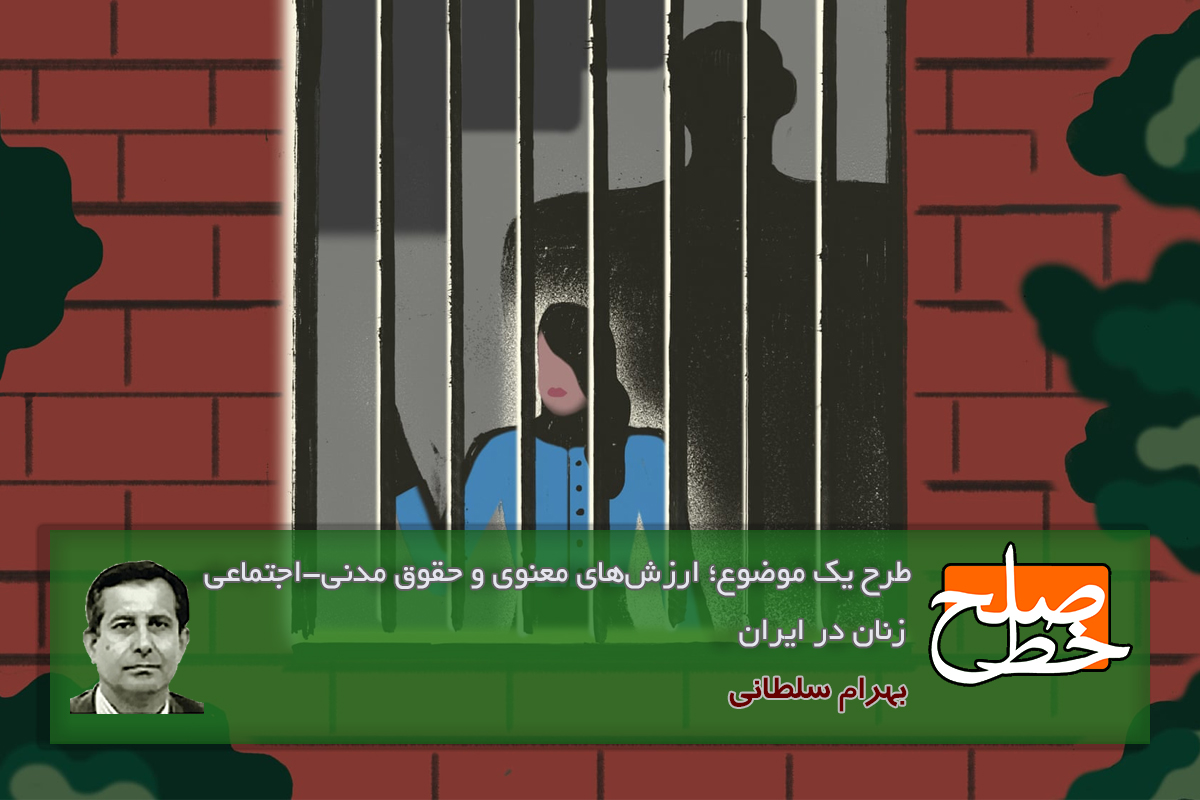
Topic: Values of Women’s Spiritual and Civil-Social Rights in Iran / Behram Soltani
The goal of this short writing is not to provide a comprehensive and clear analysis of what has happened to Iranian women over the centuries, especially in the recent decades in the patriarchal society of Iran. Due to various limitations, this writing cannot fully capture the majority of the human, social, and economic rights that have been violated for women who have chosen “rebellion and protest” instead of obedience and submission to the despotic and oppressive laws of the rulers. What is considered by the rulers, statesmen, and that part of society (including women and men who ignore the realities of society for personal purposes and interests) as “rebellion and disobedience” is not, in fact, in line with the Charter and principles of international human rights, but rather a demand for justice and the enjoyment of basic human rights. Therefore, instead of resorting to violent approaches with a superficial perspective, we should address the root causes of this crisis, just like many other cases.
In fact, the purpose of this writing is simply to propose a topic in order to possibly search and suggest fundamental solutions through discussion and conversation. These discussions undoubtedly include analysis and examination of the roots of the patriarchal society, widespread corruption and financial discrimination, and cultural backwardness of Iranian society, which despite the writer’s desire, is not possible in this short writing.
1- Women’s rights in the Constitution of the Islamic Republic.
Women are considered a significant part of society and generally there is no need to consider specific points regarding their rights. However, the Constitution of the Islamic Republic has mentioned women’s rights in several articles, but these cases seem either insufficient or completely ignored in the implementation stage.
Article 20 of this law refers to the equality of men and women, (1) but this principle of equality is subject to the observance of Islamic standards and laws, which is beyond the scope of this writing; therefore, it can only be stated that women’s access to these rights is not respected, even according to official statistics of the Islamic Republic, including in political matters such as the right to participate in political decision-making, choice of occupation, income level, and employment rate. The following statistics about this discrimination are mentioned in this writing.
Article 21 also refers to the responsibility of the government in protecting women’s rights, which due to its general nature (such as supporting mothers, preserving families, and widows) cannot be considered as a specific basis for guaranteeing the rights of women, whether single or married, in all areas.
As mentioned above, in addition to the deficiencies in legal and cultural foundations, not only are women’s basic rights not respected as a whole, but also not for a specific group of them in practice. Furthermore, the opinions, interpretations, and beliefs of individuals have taken the place of legal, moral, and social standards.
2- Women’s rights in the Universal Declaration of Human Rights of 1948 and similar international laws.
The Universal Declaration of Human Rights, which was signed by forty-eight countries in 1948 and Iran was one of the initial signatories, emphasizes the equality of women in all social, economic, and political issues without exception. Even in Article 16, it addresses women’s civil rights (such as marriage). Years later, due to the fact that some considered the provisions of the Declaration of Human Rights to be insufficient and a form of “soft law,” other legal conventions were adopted, including the Convention on the Elimination of All Forms of Discrimination Against Women in December 1979. This convention considers any discrimination and limitation against women to be against human rights laws. The official report of the United Nations High Commissioner for Human Rights, titled “Women’s Rights are Human Rights,” emphasizes women’s rights in all relevant cases and considers the failure to comply with the provisions of the Declaration of Human Rights and subsequent conventions as a violation of women’s fundamental rights.
The Islamic Republic government has been repeatedly condemned by the Human Rights Council for its failure to uphold human rights, particularly in regards to women’s rights, based on these legal foundations. Naturally, similar to other cases of human rights violations, the justification for not implementing them is that the texts and charters of human rights from 1948 and other international laws are in conflict with the Constitution of the Islamic Republic, which is based on Islamic law. Therefore, it is not enforced or is completely ignored until these contradictions and legal disputes are resolved. It should be noted that these contradictions and dominant legal interpretations have had a significant impact on the increase of political crises between the Islamic Republic and the majority of UN member countries in the past four decades, which has had negative and noticeable effects on society and the people of Iran, especially in terms of economic sanctions.
3- Some major examples among thousands of cases of oppression and injustice towards Iranian women in the past four decades.
The events of the past few months, which have begun with the significant protests of women, especially young women, in Iran, have clearly reflected their awareness of the widespread discrimination and violation of their basic rights in various civil, social, and economic areas. Historical accounts of the presence of Iranian women, even in ancient Iran (for example, during the Achaemenid, Hellenistic, or “Gordieh” periods, a warrior woman mentioned in Iranian national stories and the Shahnameh), show that they have been involved in political decision-making; although the situation of women has declined due to reasons such as Alexander the Great’s invasion of the Achaemenid Empire and later Arab invasions, as well as factors such as cultural and social backwardness in traditional Iranian society compared to other empires such as Britain and France.
In the past four decades, there have been numerous cases of widespread injustice towards women in the country, which are also examples of their bravery and courage. The unjust and inhumane execution of the educated and physician woman, Farrokhro Parsa, in 1979, the self-immolation of another physician woman, Homa Darabi, in symbolic protest against the mandatory hijab on March 21, 1994, on one of the streets near Tajrish Square, the inhumane imprisonment of Maryam Akbari Monfared and Zeinab Jalalian, two political prisoners, for thirteen years without even a day of furlough, are only a few of the dark marks on the record of the government’s treatment of women in the country. Farrokhro Parsa, a physician, was the first female director general in Iran in 1960 and the first Iranian woman to hold a ministerial position during the Pahlavi regime. She had resigned
Homa Darabi, a doctor who symbolically protested against the hijab, set herself on fire on March 2, 1994 on one of the streets near Tajrish Square. She died in the early hours of March 3 due to severe burns. Homa Darabi was born in 1939 in Tehran and had a long history of social and political activism during the Pahlavi era. She joined the National Party of Iran at the age of 20. After completing her medical studies at the University of Tehran, Mrs. Darabi went to the village of Bahmani in northern Iran and served as a doctor there for two years. After emigrating to the United States, she returned to Iran in 1967 with her husband to continue her studies. She obtained medical licenses from three states, New York, New Jersey, and California, and returned to Iran in 1974 to help the people and society. During this time, she also wrote articles on women’s
The case of Ms. Maryam Akbari Monfared and Ms. Zeynab Jalalian may be considered rare in the history of political prisoners, even on a global scale. The first particular aspect about these two political prisoners is the inhumane length of their imprisonment and sentence, which has now exceeded thirteen years. According to the writer’s information, this thirteen-year period is not only the longest imprisonment of a woman political prisoner in Iran’s history, but also on a global level. However, despite the long period of imprisonment, which is more than thirteen years, and despite various physical and mental problems that require medical treatment and surgery, these two women have been deprived of even a day of leave for medical treatment or short-term visits with their families. The writer does not believe that in the history of Iranian prisons, there has been such a level of deprivation and injustice even towards male political prisoners.
Mrs. Maryam Akbari Monfared, forty-seven years old at the time of her arrest, was a homemaker and mother of three daughters who were eleven, thirteen, and twelve years old at the time of her arrest. Now, after more than thirteen years since her imprisonment, her youngest daughter is in high school and the other two are students. According to Mr. Jafari, her husband, the children of the family only saw their mother behind the prison bars at the time of her arrest. The youngest daughter of the family, Sara, was getting ready to sleep in her mother’s arms when her mother was arrested late at night by security forces at their residence. This three-year-old, who is now in high school, has only seen her mother in person for about twenty minutes behind a glass partition in the past thirteen years. Mrs. Akbari Monfared personally had no political activities and her only crime and reason for arrest in 2009 was her family ties
Mrs. Zeinab Jalalian, a 46-year-old Kurdish woman, was arrested and imprisoned in her youth (at the age of 25) for supporting a Kurdish political group. She is known as the oldest and only female political prisoner in Iran with a life sentence. Mrs. Jalalian has strongly denied any involvement in armed activities. Despite her denial, she was charged with “waging war” and sentenced to death by authorities. Later, her sentence was reduced to life imprisonment and she has now spent over 15 years in prison since her arrest in 2007. During this time, she has been transferred to various prisons and spent months in solitary confinement. Both of these female prisoners – Maryam Akbari Monfared and Zeinab Jalalian – have suffered from various illnesses due to the long duration of their imprisonment (over 13-14 years), inhumane prison conditions, and being separated from their families and loved ones. It is uncertain when and under
There is no legal justification based on Islamic and international law. There is no political justification based on the observance of the basic principles of citizenship in the Constitution of the Islamic Republic. These two cases can be indicative of the ultimate double oppression, increasing crises, political and social stagnation, and increasing backwardness of Iranian society, similar to what was found in the Middle Ages, which has not only endangered national interests, but also the future of Iran.
4- Statistical perspective on the economic and social status of women in Iran.
Social and political protests always have various dimensions and without examining different aspects, it is not possible to understand and find a solution, even on a small scale. An overview of official information published by the country’s statistical center over the past four decades indicates a decline in women’s participation in economic affairs, increasing unemployment rates, and lack of access to minimum welfare standards. This not only applies to a large number of mothers and women who have formed families, but also includes a significant portion of educated girls who, for personal reasons or lack of financial resources, remain single. It is needless to mention that one of the characteristics of Iranian society is the presence of a young, educated and aware population, especially among women, which is not only commendable at the regional and Middle Eastern level, but also on a global scale. Despite having this active and valuable workforce, Iranian society has never been able to utilize this rich and spiritual resource.
A look at recent data published by the Statistical Center of Iran shows that out of the nearly 25 million active population in the country who were willing to work in spring of 1401, close to 17% of this number belongs to women, indicating the limited role of women in the job market in Iran. (6) According to the same report, considering that approximately 60% of women are employed in the service sector and these jobs are easily affected by economic changes and developments, the share of women in the major industrial and agricultural sectors is very insignificant. Furthermore, with 70.5% of the country’s unemployed being men and 29.5% being women in spring of this year, not only do women have a higher share of unemployment compared to their share in the active population, but also many unemployed women have higher levels of education compared to men. In fact, according to recent official statistics, out of the approximately 25 million employed population in Iran, around 24
Other statistics indicate a very high percentage of unemployment among young girls. The unemployment rate among the population of girls aged fifteen to twenty-four has reached 1.6 units, which clearly shows the very small share of women and girls in the job market and the economy of the country. How can we talk about the enjoyment of basic human, economic, and social rights in this huge part of society, taking into account the non-workable restrictions for women in civil and legal matters, including marriage, inheritance, and decision-making in family matters and child custody?
Notes:
1- Principles 20 and 21 emphasize that “all members of the nation, regardless of gender, are equal in their support of the law and are entitled to all human, economic, social, and cultural rights in accordance with Islamic standards. Principle 21 obligates the government to fully respect and implement these rights for women.”
2- For more information, refer to the .
Website.
The United Nations national team in Iran…
3- According to the Convention on the Elimination of All Forms of Discrimination Against Women, discrimination against women means any distinction, exclusion or restriction based on gender which has the purpose or effect of impairing the recognition, enjoyment or exercise by women, irrespective of their marital status, on a basis of equality of men and women, of human rights and fundamental freedoms in the political, economic, social, cultural, civil or any other field.
4- Convention on the Elimination of All Forms of Discrimination against Women, adopted on December 19, 1979.
“Women’s rights are human rights”, High Commissioner for Human Rights of the United Nations, New York, Geneva, 2014.
6- Investigating the share of men and women in economic sectors in spring 1401; the high share of women in the country’s unemployed population, Eghtesad News, 7th of August 1401.
7- How many unemployed people have higher education? ISNA, October 8, 2019.
8- 39% of Iranian girls are unemployed, Hamshahri Online, 18 Mehr month 1401.
 Created By: Bahram Soltani
 January 21, 2023
Tags
Bahram Soltani Mary Akbari Manfred Monthly Peace Line Magazine peace line Peace Treaty 141 Software rights Women's rights Zainab Jalalian