


Freedom of speech and media with borders or without borders? / Delbar Tavakoli
Two brothers who attacked the office of the magazine “Charlie Hebdo” in Paris on the morning of January 7, 2015 and targeted the cartoonists present in the office with bullets, perhaps only intended to seek revenge from the cartoonists of the Prophet of Islam. But in a way, they targeted the principle of freedom of expression. This is a challenging question that many writers and media professionals around the world are currently grappling with; where is the boundary of freedom of expression? Does freedom of expression have boundaries in the media or can anything be said?
“Agnes Callamard,” a human rights activist, previously stated in an article published in the French newspaper “Le Monde”: Respect for freedom of expression is often seen as the first step towards democracy. Freedom of expression is a common demand of political liberalism and republicanism, and is one of the foundations of freedom of conscience, which is often confronted with rigidity and censorship. This rigidity can take the form of absolute monarchy (insulting the high position of the monarchy) or religion (the sin of excommunication and disrespect). “Bo Marsha,” a famous 18th century French writer, also humorously states in the words of Figaro: As long as I do not speak of authority, religion, politics, ethics, officials, owners of wealth, opera, or other performing arts, or anyone who feels attached to something, I can freely publish whatever I want; of course, with the imposition of two or three censors.
Article 19 of the Universal Declaration of Human Rights
Article 19 of the Universal Declaration of Human Rights defines freedom of expression as follows: Everyone has the right to freedom of thought and expression, and this right includes not being afraid or anxious about their beliefs, and being free to seek, receive, and impart information and ideas through any media without any limitations or borders.
Freedom of thought and expression is also addressed in Article 19 of the International Covenant on Civil and Political Rights: No one shall be subject to interference or intimidation based on their beliefs.
Despite all of this, we are still witnessing the precise determination of the boundaries and limits of freedom of expression and the media as one of the most controversial and debatable issues in modern liberal societies, which has reached its peak after the tragic event of the assassination of cartoonists of the magazine Charlie Hebdo in Paris. Many believe that if freedom of expression and the media lead to religious, ethnic, or war conflicts, it should be stopped, while others believe that there should be no limits to freedom of expression and the media. This is happening while today, freedom of expression is widely considered as one of the fundamental human rights, meaning that humans have the right to freedom of expression simply because they are human.
Freedom of speech and media in France
It is worth mentioning that freedom of speech has been mentioned in some documents throughout history, such as the Magna Carta of 1215, and has also been important in the Declaration of the Rights of Man and of the Citizen of 1789 during the French Revolution. The French Declaration of the Rights of Man and of the Citizen is considered the fundamental document of the 1789 French Revolution, which refers to individual and collective rights for all classes. The concepts outlined in this declaration are derived from the philosophical and political principles of the Enlightenment, such as individualism, social contract, and separation of powers. The French Declaration of the Rights of Man and of the Citizen includes 17 articles and a preamble related to individual and national rights. Freedom of thought and expression of ideas and beliefs are among the essential elements of this charter. On the other hand, this declaration is the legal basis for free democracies around the world. This declaration was crystallized in the slogans of “Liberty, Equality
Perhaps it was on this basis that French President Francois Hollande, in the face of the wave of condemnation against the Charlie Hebdo newspaper’s insults towards the Prophet of Islam, which continues to be expressed by some leaders of Islamic countries, said during his trip to the city of Toul in southern France: “We have supported these countries (countries that have witnessed protests against Charlie Hebdo) in the fight against terrorism and I still want to show my solidarity with them, but at the same time, France has principles and values, especially regarding the issue of freedom of expression, for which it has respect.”
The Tragedy of Charlie Abdo and the Presence of Violators of Freedom of Expression Rights
According to published reports, around 11:30 am on January 7th, two Algerian-born brothers who were born in France and considered French, along with one of their accomplices who played the role of the driver in this terrorist attack, entered the office of Charlie Hebdo, a left-wing French magazine published in Paris on Thursdays. They first targeted Stéphane Charbonnier, known as Charb, the editor-in-chief of this magazine and the designer of the cartoon of Muhammad, the prophet of Islam, and shot him. In this terrorist attack, 12 people were killed on the first day, four of whom were well-known French cartoonists. This event was the deadliest since the Algerian War in 1961 and the worst attack during peacetime in France. According to a video uploaded on YouTube from the moment of the shooting, these individuals shouted “Allahu Akbar” and proceeded to kill the employees of this publication. Witnesses said they left the
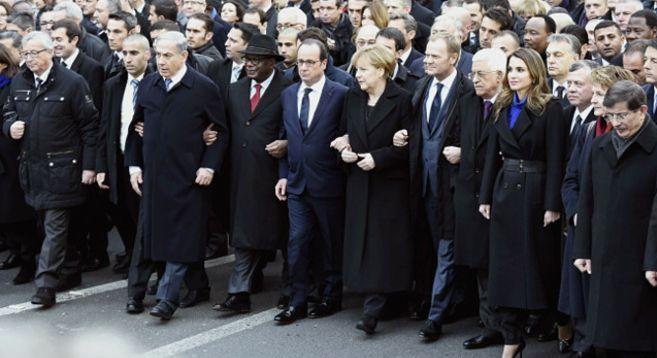
Reporters Without Borders has expressed disgust at the presence of leaders from certain countries in the Paris march, where journalists and bloggers are systematically harassed and intimidated. The statement mentions countries such as Egypt, Russia, Turkey, and the United Arab Emirates, and their rankings on the 2014 Press Freedom Index. Egyptian Foreign Minister Sameh Shoukry, Russian Foreign Minister Sergey Lavrov, and UAE Foreign Minister Sheikh Abdullah bin Zayed Al Nahyan, as well as Turkish Prime Minister Ahmet Davutoglu, participated in the Paris march. Christophe Deloire, Secretary General of Reporters Without Borders, said: “We must show our solidarity with Charlie Hebdo without forgetting any other Charlie in the world.” Mr. Deloire also said: “It is unacceptable for representatives of countries that silence the voices of journalists to try to improve their global image by exploiting the current wave of emotions, and then return home and continue their repressive policies.”
Freedom of speech and government boundaries.
Government officials always pay attention to the boundary of freedom of expression and media. They ensure absolute freedom of media and expression as long as it does not jeopardize their interests. According to Wikipedia, freedom of media and press is like a guarantee from governments to public media, in the face of limiting trends in societies. It defines the legal rights of media and also the means of resolving disputes between media and complainants. These rights are legally incorporated in many countries and are protected by their constitutions to support freedom of press. Regarding government information, each government decides which sources and materials are public or protected and should not be disclosed due to public sensitivity or classification. Many governments try to control important laws or legal freedom of information exchange, which are used to define boundaries and ensure international security, in order to distort the global view.
 By: Delbar Tavakoli
 January 23, 2015
Tags
Beloved Tavakoli Charlie Abdo Magazine number 45