


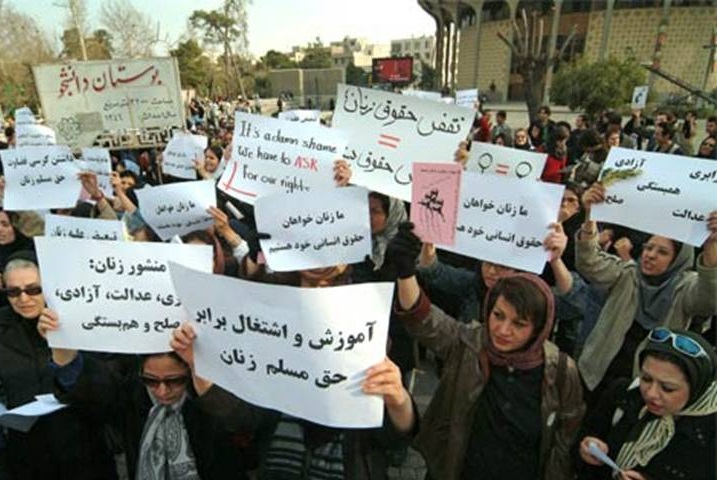
یکWhat are the minimum and maximum rights of women and the role of female representatives in parliament in achieving these goals? / Hossein Tajik
Before entering into the subject of this writing, it is necessary for the writer to express their view on women, regardless of the topic being discussed.
It seems that many activists in the field of women’s rights, unintentionally undermine the rights of those who support them. This criticism is based on the belief that special attention and grand gestures towards a cause are often motivated by a perceived threat to one’s own interests. The writer believes that this gender divide should be eliminated, not in the sense of ignoring the issue, but in order to strengthen the position of those defending this right. As long as the actor is in a position of weakness, their actions, accompanied by a predetermined theory, will only result in negotiation, debate, and argument. This predictability only serves to reinforce and solidify a shaky position.
As someone who cares about peace, justice, and rights, believes that all individuals, regardless of their natural and secondary differences, should have equal rights and be seen in both public and private spheres regardless of their gender.
Despite this, it must be acknowledged that significant and positive steps have been taken in this direction by activists in this field, the effects of which are now tangible.
So, with a brief review of the previous discussion, it briefly addresses the first section of the title.
Basically, women’s demands in underdeveloped or developing societies and countries are minimized due to the government’s focus on short-term or quick-fix goals to overcome economic and political crises, etc. In today’s Iranian society, with the expansion of communication and increased awareness, the demands of individuals (both women and men) are also not fixed and are constantly changing.
Minimum requirements for each individual include the right to a natural life. This means daily necessities such as food, clothing, shelter, employment, recreation, etc.
According to the fundamental principle, which includes all individuals regardless of gender, women and men are equally protected by the law. All human, political, economic, social, and cultural rights are considered in accordance with Islamic standards. It can be said that the foundation for women’s demands is provided and their implementation is also subject to the conditions set by the executor.
Of course, it is the natural right of any government to choose and implement its structure and methods based on public opinion. However, in exchange for this right, the government has a responsibility towards the nation and criticism of its methods is allowed if they conflict, contradict, or clash with accepted general principles and human norms.
However, the situation of women in Iranian society is in harmony with various emotions; some are satisfied, some are dissatisfied, and a third group is indifferent towards the conditions that they have no hope of improving.
In any case, women’s demands are different depending on what is accepted or not.
Let us discuss their demands in a general sense and with an introductory mention of the leader.
Coverage is an issue that has been a concern for government officials before and after the revolution and change of regime until now. Different government behaviors have been expressed towards this issue during different time periods.
Women have always been and are still exposed to this treatment (from unveiling during the Pahlavi era to compulsory veiling in this era) because in an ideological government system, religious beliefs take precedence over the law and, to put it correctly, the law supports what is deemed desirable and acceptable in religion and enforces it in prescribed ways.
The religious laws of Islam have defined the beauty of a woman in her character, not just her physical appearance, for her spouse. Therefore, the adornment of women’s clothing in society, which is in contrast with the customary view of the ruling system, is in conflict with the ideological position of the system and this ideological position is in conflict with the principles of human rights. Everyone remembers or at least has heard and read that the unveiling of compulsory veiling during the Pahlavi era was bad, but the veiling after the revolution is good.
However, demanding the acceptance of the desired coverage is part of this matter, because the secondary protest against the performance of the employed forces of the law enforcement, under the title of “Guidance Patrol”, is a defendable truth, of which an example was revealed in a live television program.
The proposed solution as a legal advocate and attorney is to accept that the law exists in every form and nature, and freedom must be sought within the framework of the law. The basis for individuals’ presence and appearance is within this framework, and conflicts arising from incorrect laws or improper implementation of correct laws should be addressed in an acceptable forum so that the general capacity of the law can be used to improve the situation.
In the opinion of many, hijab is the biggest concern for women or girls who demand freedom, because it is the most prominent and tangible example of the issue and rightfully criticizes the government’s control methods regarding hijab. The solution is also discussed in the second part of this writing.
“Rights, in every matter and in a respectful and necessary manner, are important. The issue of the restriction of the right to dress and veil based on the interests of the system is a topic of discussion. It should be noted that according to the verses of the Quran, coercion in religion is considered illegitimate, and the actions of the system have caused intellectual conflicts in the matter of religion, even though they may have been intended to protect it.”
Basically, the goal does not justify the means, although according to our belief, according to Machiavelli, using any legitimate means to achieve the goal will have legitimacy, but such a theory is not at least desirable in the current ruling system in Iran, which is based on religion.
In themselves, every person, regardless of their gender, has control over their own body. This is such a natural thing that it does not require explanation. When people have control over their possessions and are able to act according to their own will, it does not seem right to prohibit them from covering their bodies, which are part of their physical being.
Respect for public order is essential and undeniable, but the public order in question is not in line with commonly accepted definitions and what is considered a justifiable legal theory. This is because public order is essentially a subjective matter that is not explicitly defined by the law, but rather determined by what is accepted by society as a whole. However, this societal acceptance is constantly changing and this change is still based on the previous notion of criminality.
In the opinion, the lack of observing an acceptable and desirable dress code, regardless of the fact that in its true meaning, it is a legitimate right that is limited within the framework of principles and laws, does not conflict with what is meant by public order. It is suggested that this phenomenon be comprehensively examined and a solution be proposed by a committee of experts in the fields of sociology, psychology, medicine, law, and jurisprudence, while considering women’s rights and the system.
In the matter of employment, although the appointment of women in government, public, and private positions is more visible than before, but with the existence of some laws and customs, this right for women is essentially dependent on the permission of their husband and father. This issue, which has also been addressed by the legislature, is subject to fair criticism and reform in light of the current conditions of society.
However, assuming the existence of this permission and authorization from the owner of the permit, a woman has three advantages in the eyes of the owner of the business or company for employment. Firstly, the health aspect, which will ensure the physical and mental safety of the woman and will lead to her productive work for her employer; secondly, the profit-oriented and economic aspect of the employer towards the woman as a cheap and highly capable workforce; and thirdly, the discriminatory view of the employer, which is solely based on gender and femininity of the applicant.
These are the very truth and not only in Iran, but examples of it can be found abundantly all over the world.
What will happen to a girl or woman who, with various hopes, has taken steps in the field of academic competition, and after success, intends to enter the job market with the support of her scientific expertise, where every possibility of a third unfortunate event is likely to occur for her?!
Housing is also one of the basic needs of every human being. However, if a woman in Iran intends to have a home despite financial ability, unhealthy attitudes will be directed towards her.
If a woman intends to travel alone, and she is married, she must obtain permission from her husband if he has not reached the age of maturity. She also cannot stay in a hotel without permission from the police during domestic trips.
These are seemingly small concerns that are deep and despite the efforts of activists, they have not been noticed as much as they should have been so far.
And of course, the continuation of declaring its position as it has been so far, will still result in a conclusion.
By referring to the words, slogans, and limiting phrases of women in society, one can discover their demands.
“We apologize for the entry of women without proper hijab,” “We apologize for offering hookah to women,” or “My apologies for these advertisements such as ‘a well-dressed secretary with excellent public relations’ and so on.”
In any case, these issues that stem from natural and fundamental human rights create a framework under the title of “What are the demands of women” in two general sections: observation, touch, and conclusion.
First: A woman, in a closed or limited social relationship such as family, holds the position of mother, sister, wife, friend, etc.
Second: A woman in a social relationship can have a wide range of roles, such as being a leader, manager, employee, worker, etc.
In a closed or limited social relationship, such as family, one’s gender is particularly expressed, whether it is due to being a woman in this environment or in social interactions. Therefore, their desire to be seen in the form of a woman is fulfilled by the other party or in a different way by their father, brother, or friend.
It is obvious that not receiving these claims from them can put him at risk.
However, as a woman, in social relationships, whether open or broad like society, it is not because of being a woman and her gender that she moves alongside others, but her only desire is respect for humanity and a view without gender discrimination.
This separation (seen in families and the perspective of gender in society) has also caused confusion among women, which is beyond the competence and subject of the writer and writing.
In any case, based on the above mentioned levels, these demands, even if minimal, are conflicting with the interests of the government or the state, and the solution to overcome this dual crisis is in the hands of the representatives of the nation. And this is where the second aspect of the issue comes into play.
Based on the belief of the writer, it must be said that the representatives of the nation in the parliament, regardless of gender, should strive to protect and preserve women’s rights in the family and society, because both male and female representatives have the right to vote and speak at the same time.
Although, sometimes we also face some representatives who make self-deprecating statements…! (Referring to the statements made by female representatives in the parliament about the status and role of women in society, which according to experts, is a threat to the security and well-being of families, without considering the fact that their position as female representatives is undermined by such arguments in the parliament.)
In any case, all members of the nation, both women and men, as servants and servants of the nation, must consider the demands of their clients as their top priority and strive to achieve them.
Although representatives of the parliament, according to their position, become informed of the demands and concerns of their constituents, especially women, through the use of information channels, they easily find the desired solution and approach to the issues by observing, researching, and examining the circumstances of society. This is where the awareness of the responsibility of the parliamentarians comes into play, and it is their right to be pursued and demanded by the people. Therefore, it is obvious that in the current situation, it is the duty of the parliamentarians to thoroughly examine the issue of women’s rights and demands, which are their fundamental freedoms within the framework of the law.
In this regard, the council can preserve or revive the minimum and maximum demands of women through two ways.
1- Organizing, drafting, and correcting laws in accordance with legal principles (Principle 20 of the Constitution).
2- Changing the structure or framework of laws that are in conflict with women’s initial freedoms or current desires.
This section, which seems desirable to activists in this field, can either be a step forward in promoting culture and social and political relationships, or it can be destructive and contribute to the destruction of a culture that has existed for thousands of years, unless it is primarily dedicated to educational plans and cultural infrastructure.
The right to coverage and its type is a natural right that should not be granted, but rather revived in a framework that is not in conflict with public order, and is in the hands of the representatives of the parliament.
The existence of discriminatory laws leads to the emergence and increase of social problems and violent behaviors.
In criminal laws, the difference in the dowry of women and men, or in civil laws where the head of the family is placed on men, or after marriage, which is contracted with the consent and acceptance of both parties, the annulment of which has an aspect of coercion, and the right to divorce is considered to be specific to men with the support of the jurisprudence principle “divorce from his hand with his leg”. Other examples of this nature, which suggest the inequality of women and men, are in conflict with the spirit of the law, which looks at everyone regardless of gender, position, status, and rank, and must be amended and modified because, in fact, public opinion and the prevailing conditions of society and public order are desirable.
The security outlook governing criticism of performance or proposed law amendments prevents the expression of opinions on a wide scale, but it cannot suppress progressive thoughts or demands for reform. Criticisms and suggestions for improvement will lead to bettering the situation and increasing satisfaction with the system.
In any case, these demands that have only been mentioned in a few examples are not unheard of or unspoken of, and have not gone unnoticed by the attentive ear. Gatherings, writings, and various images have been organized and published in the form of women’s rights; however, what is visible or desired in this society has not been achieved.
Even though it does not harm the essence of these thoughts, it has turned into dust and has been lost in the chaos of disorder, due to personal preferences.
I do not want to ask for anything until my desire is fulfilled.
Either the soul reaches the beloved or the soul departs from the body.
Open my grave after my death and see
Like fire inside me, smoke rises from the shroud.
 By: Hossein Taj
 December 2, 2015
Tags
Feminine demands Hossein Tajik Islamic Consultative Assembly Monthly magazine number 55 Monthly Peace Line Magazine Political participation of women