


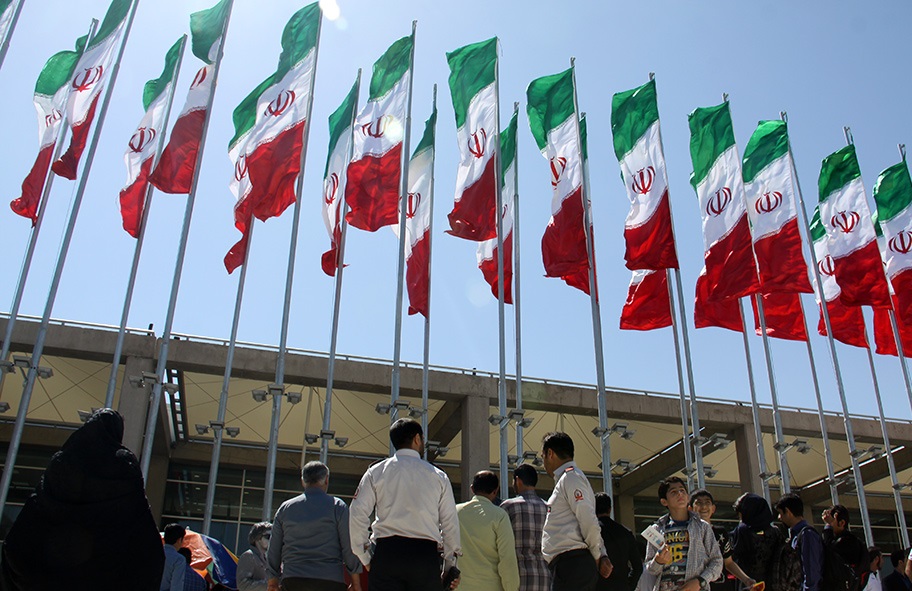
Tehran International Book Fair; Another Challenge between Book Publishers and Government Institutions/ Reza Najafi
This is a caption
“This is a caption”
Reza Najafi
The Tehran International Book Fair, alongside the Fajr Film Festival, is considered the most important cultural event in the Islamic Republic of Iran. It is held every year in mid-Ordibehesht (April/May), except for its first year which coincided with Aban (October/November). The fair has been held in the permanent location of the Tehran International Fairgrounds (at the end of Chamran Highway) from 1987 to 2006, and then moved to the Imam Khomeini Mosalla in Tehran (located in Abbas Abad) from 2007 to 2015. Finally, in 2016, it was relocated to the city of Afatap in the south of Tehran. It should be noted that these relocations were not without controversy and criticism.
History of Tehran International Book Fair
The statistics and information gathered from book fairs in Tehran, prior to the first Tehran International Book Fair, show that there has been no comparable example with international recognition or even national credibility. In simpler terms, the Tehran International Book Fair has no real history. From the beginning of the Islamic Republic until the year 1366 when the first international fair was held, occasional fairs were organized by various centers here and there, mostly in celebration of the anniversary of the Islamic Revolution. However, the number of titles and participating publishers was not significant, not to mention that these fairs were often not even national, let alone international.
For example, exhibitions titled “Great Book Exhibition” that were held before (in 1361 with the participation of 110 publishers and 1800 titles in the central library of the city park; in 1362 with 2500 titles and 120 publishers; in 1363 with six thousand titles and 88 publishers at the Museum of Contemporary Arts; in 1364 with nine thousand titles and 204 publishers; and in 1365 with even lower statistics), are considered so poor that the term “great” for such exhibitions, which sometimes had fewer titles than those in a small library, remains more of a joke.
Despite these statements, it seems that the idea of holding an international book fair should have occurred to the authorities after several editions of the “Fajr Book Fair” have been held; however, it is believed that due to the difficulties caused by the simultaneous holding of the international book fair with other ceremonies and preparations for the celebrations of the Fajr decade, it was decided or deemed necessary for the international book fair to be held at a different time; a forced success that its usefulness and accuracy were later proven by experience.
Comparative analysis of the first and last statistics of the Tehran International Book Fair.
A brief comparison between the first and last international book fair in Tehran shows the remarkable growth and expansion of this phenomenon in Iran. According to statistics, in the first Tehran International Book Fair, 214 domestic publishers with 9,000 titles and 196 foreign publishers with 18,500 titles participated, and approximately 500,000 people had visited the fair.
This is while in the 29th edition of this exhibition, the number of domestic publishers participating in this event has increased to 1426 with 266,429 titles, and 600 foreign publishers with 132,000 titles. Approximately five million people have also visited the 29th Tehran International Book Fair.
The expansion of this exhibition and the people’s reception of it has given a special sensitivity to this phenomenon and sometimes leads to differences of opinion between the publishers participating in the exhibition and the government officials organizing it. It seems that the exponential growth of the exhibition has created a phenomenon that is neither soluble nor can be ignored by government officials and authorities.
Marginal notes of Tehran International Book Fair
Since the first Tehran Book Fair was held until now, there have been many controversies and discussions about it. Some criticisms are directed towards the way the fair is organized, and the fact that unlike similar international book fairs in other countries, this fair is not a specialized event for publishers, authors, and book industry professionals, but rather a large marketplace for book sales. Some have also criticized it for being more of a promotional and showy event. Others have complained about the fact that we now have this phenomenon of a large book market, which is not just for book experts, but is actually meant for the general public, so why should this phenomenon be limited to only a few days a year?
On the other hand, considering that the days of the Tehran International Book Fair provide an economic opportunity for publishers, some publishers have complained about the discrimination and restrictions imposed on them during this event. The lack of permission to participate in the fair, the lack of allocation of appropriate booths for publishers, the prohibition of selling certain books that have previously received publishing permits, the collection of some books from the fair, and so on, are among the major complaints expressed by some publishers.
Furthermore, especially during the Ahmadinejad government, the conflict between publishers and the Ministry of Culture and Islamic Guidance regarding the organization of the book fair, the location of the fair, and current policies reached its peak. The change of location of the book fair from the permanent location of international fairs to Imam Khomeini Mosque in Tehran, under the pretext of creating traffic during the fair, was considered one of the main challenges between the Ministry of Culture and publishers. Most non-governmental publishers protested against the change of location and believed that Tehran Mosque was not a suitable place for the book fair. Some publishers also accused the government of deliberately trying to hinder the book fair and control it through this change and transformation of the Ministry of Culture institutions. The government’s efforts to separate the Press Festival from the book fair and also to designate a different location for foreign publishers’ booths ultimately led to a crisis between the government and domestic and foreign publishers, to the point where talks of boycotting the fair emerged
But perhaps more controversial than these cases was the issue of not issuing permits for companies to participate in the exhibition for some publishers who were critical of the government (such as Negah and Eghteran) and also the collection of some books (such as the works of Sadegh Hedayat, Forough Farrokhzad, Milan Kundera, Shamloo, etc.) from the exhibition; books that had received official publishing permits from the Ministry of Culture and had already passed the censorship barrier. Especially the recent action, truly had no legal or legitimate justification.
With the arrival of Mr. Rouhani’s government, efforts were made to restore lost trust between publishers and the government. At the beginning, the Minister of Culture also made encouraging statements about opposing pre-publication censorship. However, these positions quickly changed under pressure from conservatives and more hardline factions of the government.
In any case, it seems that the change of location for the book fair from Tehran’s Mosalla to Shahr-e Aftab in the south of the city is a step forward. It has also been entrusted to the Publishers’ Union to handle some of the executive responsibilities in the recent book fair, but there are also criticisms that the Ministry of Culture and Islamic Guidance does not have the ability to defend its issued licenses in the field of books (such as issuing licenses for music concerts). Officials of the Ministry of Culture and Islamic Guidance have officially announced that 883 books have been collected from the fair and eight booths have been sealed. However, officials of the Ministry of Culture and Islamic Guidance speak of collection and confiscation in case of violation, but there are publishers who have a different belief. For example, Mehdi Khazali, whose publishing house, Tabian, has been banned from participating in the fair, considers this restriction to be politically motivated. In addition to books that did not
Explanation:
The statistics mentioned in this article are taken from publications and official websites of the “House of Books, Ministry of Islamic Guidance”.
 By: Reza Najafi
 May 24, 2016
Tags
Censorship Exhibition sidelines International Book Fair International Exhibition Monthly Peace Line Magazine Reza Najafi Sun City Tehran International Book Fair Tehran Mosque