


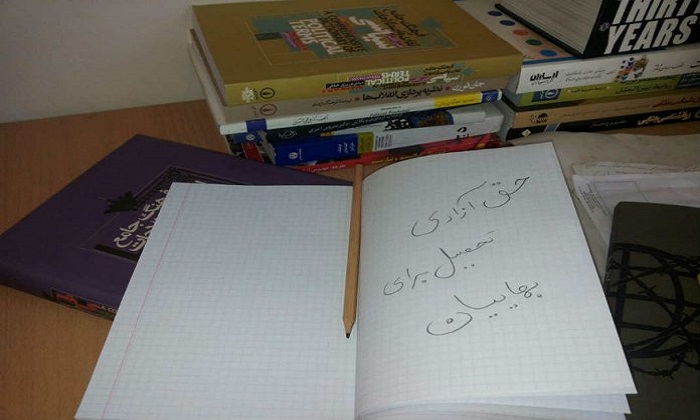
The educational status of Bahai citizens in the Rouhani government/ Free Naz
After the Islamic Revolution in Iran, in December 1982, universities and higher education institutions in Iran were reopened after 30 months of closure. This period, known as the Cultural Revolution in the history of the Islamic Republic, marked the beginning of the deprivation of Baha’i citizens from education in Iran. With the Cultural Revolution, all Baha’i professors and students were expelled from the country’s universities or, according to the Cultural Revolution Headquarters, “cleansed”. Since then, Baha’is have not been allowed to study in Iranian universities.
The Bahai Institute for Higher Education (BIHE) began its work in 1366 (1987-1988), and was created out of the need to provide a means for young Bahai students to continue their education after completing high school. This institute, which utilizes the services of volunteer professors and staff (many of whom were Bahai professors who were expelled from government universities during the Cultural Revolution), offers a semi-online, semi-in-person university education in a number of fields. Before the widespread use of the internet, education was conducted through a combination of correspondence (via letters and postal assignments) and in-person instruction.
In October 1998, during the month of Mehr in the Iranian calendar (equivalent to early October 1998), government officials raided personal homes and arrested at least 36 professors and employees of this institution. They also confiscated many of its equipment and archives, which were located in over 500 homes.
In response to this situation, with the help of the international community, the efforts of the Bahai Institute for Higher Education have been increasingly directed towards providing online education. However, the government has repeatedly arrested professors and staff who reside in Iran and support this institution.
In the year 1388 (2010), the government repeatedly attempted to shut down the Bahai Institute of Higher Education in Iran by arresting and imprisoning its administrators. In Khordad 1390 (May 2011), government agents raided around 30 homes in Tehran, Karaj, Isfahan, and Shiraz, and arrested 16 individuals who were supporting the institute. Twelve of them were eventually tried and sentenced to four or five years in prison. The strict measures against the Bahai Institute of Higher Education continued during the presidency of Hassan Rouhani.
In the month of Ordibehesht 1393, security officials went to the home of Nasim Bagheri, a professor at the Bahai Institute of Higher Education in Iran, and arrested him for serving a four-year prison sentence. Nasim was born in 1362 in Tehran. After completing high school and obtaining a diploma, he continued his education at the Bahai Institute of Higher Education in the field of general psychology due to the ban on Baha’i youth from entering universities and higher education institutions in Iran. He successfully received a Bachelor’s degree in this field from the institute.
Nasim Bagheri, who had tasted the bitterness of being deprived of education, decided to join the Bahai Institute of Higher Education instead of continuing her studies abroad. She wanted to use her abilities to help meet the educational needs of underprivileged Bahai youth. Nasim initially started her work as a collaborator with the active professors and later on, she also took on administrative tasks for the virtual Bahai Institute of Higher Education, such as admitting students, while also teaching.
On October 7, 2013, Nasim was sentenced to four years in prison by Judge Maqiseh at Branch 28 of the Revolutionary Court in Tehran. In late February, the sentence was confirmed by the appellate court. Two and a half months later, on April 27, 2014, Nasim was arrested at her home by law enforcement officers and transferred to Evin Prison to serve her sentence.
During the time that has passed since his imprisonment, he has only been granted a six-day leave once, during his sister’s wedding in December 2015. Despite being eligible for leave, he is not allowed to do so due to unknown reasons and repeated requests from him and his family. He is also suffering from thyroid disease and every six months, he is sent to the hospital for treatment and then returned to prison after a few hours.
In the month of Khordad 1392 (June 2013), Azita Rafizadeh, another Baha’i teacher, was tried in Branch 28 of the Revolutionary Court of Tehran under the presidency of Judge Moghiseh, with the same charges as other instructors of the Baha’i Virtual Higher Education Institute. This Baha’i citizen was sentenced to four years in prison, which was upheld by the Court of Appeal. His wife, Peyman Kushkbaghi, was also sentenced to five years in prison for teaching Baha’i students, while their young son, Bashir, is only six years old.
Azita Rafiee Zadeh was born in 1359 and is from the city of Shiraz. Since 1381, she has been working with the Bahai Higher Education Institute, teaching in the field of computer engineering. She completed her bachelor’s degree in computer engineering at BIHE and also received her master’s degree in the same field from Pune University in India. Azita’s husband, Peyman Koushki Baghi, was born in 1356 in Gorgan and graduated in computer engineering. He taught general mathematics, differential equations, and computer hardware at the same educational institute.
According to Azita, as was understood during the interrogation, if she committed to giving up teaching at the university, her case would face a ban on prosecution and she could return to a normal life. However, accepting this was difficult for her; because she knew that education was the undeniable right of Baha’i students who were deprived of studying in various universities in the country and were prevented from entering.
When this couple was caught up in their case at the Revolutionary Court, Bashir was 17 months old. They had the opportunity to leave Iran before any sentence was issued, but they chose to stay until the last moments of their freedom; because they believed they had not committed any illegal actions.
Finally, this young couple was sentenced by Branch 28 of the Revolutionary Court, headed by Judge Moghiseh, in Ardibil, in the month of Ordibehesht 1394 (May 2015), on charges of “membership in illegal Baha’i organizations with the aim of acting against national security through illegal activities at the BIHE educational institute”, to four and five years of imprisonment respectively. They protested these sentences, but in Mehr 1394 (October 2015), the appeals court also confirmed the initial verdicts. Their concern was the simultaneous execution of their sentences and the uncertainty of Bashir’s fate. In the end, Bashir was entrusted to a volunteer family and these days, she visits her mother one day a week and her father on another day, from behind the prison bars.
Azita said, “The day I introduced myself to enter prison, I asked the officials to send a summons or inform Bashir beforehand because saying goodbye and preparing him is very important. Even Bashir had spoken to the prosecutor’s representative several times and had been told to stay out for now.”
On Monday, the 9th of Esfand month, when citizen Bahai Paiman Kooshk Baghi went to Evin prison with his six-year-old son, Bashir, to visit his wife, Azita Rafizadeh, he was detained by three individuals before entering the visitation hall and was transferred to prison to serve a five-year sentence.
In this regard, one of his relatives had told the radio Zamaneh: “The arrest was made without prior notice. After Azita went to prison in November of this year, several times she had gone to the deputy prosecutor (Hajilou) and the head of the execution department (Nasirpour) and asked them to send her to prison with prior notice and information, due to her son’s young age and lack of a guardian, so that she could prepare Beshir. Hajilou had told her to go, for now we have nothing to do with you. But on Monday, very unexpectedly and before entering the visitation hall, they arrested Peyman in the presence of her son.”
In 1393, 14 Baha’i citizens, including 3 women and 11 men, were serving prison sentences in prison on charges of collaborating with the Baha’i Institute of Higher Education. In 1394, upon completion of their sentences, some of them were released. On Thursday, 2 Ordibehesht, Noushin Khadem, Farhad Sedghi, Ramin Zibaei, and Mahmoud Badavam were released. On Friday, 10 Ordibehesht, Riyaz Sabhani was released. On Tuesday, 4 Khordad, Kamran Rahimian was released. And on Tuesday, 26 Mordad, Emanollah Mostaghim was released after serving two and a half years of his five-year sentence due to a severe heart condition and inability to endure the punishment.
In 1394, the officials of the Intelligence Department arrested another Baha’i professor of architecture, Shahriar Cyrus, on Thursday, 10 Tir, at his personal residence and transferred him to Evin Prison. He was released on bail until the court hearing on 28 Mordad. In the same year, the court hearing of another Baha’i professor, Negar Ghodamian, whose house was attacked on 1 Khordad 1390, was held. The court sentenced her to five years of imprisonment.
At the end of the year, Nasim Bagheri, Faran Hesami, Azita Rafiee Zadeh, Foad Moghadam, Kamran Mortezaei, Shahin Negari, and Peyman Kushkbaghi, seven Baha’i professors, spent Nowruz 1395 in Rajai Shahr and Evin prisons (women’s ward) away from their families. On the first days of 1395, Faran Hesami, after serving a four-year sentence, was released from prison and Shahriar Cyrus was summoned to court for his final defense. Additionally, Kamran Mortezaei’s five-year sentence in Ardibehesht month came to an end.
In 2004, the National Organization for Educational Assessment removed the religion question from the registration form for the nationwide university entrance exam. This sudden move brought hope for Baha’i students who could finally attend university. However, they were only allowed to register for the exam. When the results were released, it was announced that the files of a large number of Baha’i students who had taken the exam were incomplete. Only a limited number of students received their scores – many of whom had high rankings – and their names were removed during the selection process for majors. Only a few were able to attend university, but later faced threats and expulsions. During Mr. Rouhani’s presidency, this situation continued and a large number of students were expelled from universities.
219 Baha’i citizens were deprived of entering university after the 1395 entrance exam due to incomplete files. Additionally, 40 people were expelled from university in various semesters of the same year due to their belief in the Baha’i faith. Among these students is Nima Eghbalian, who was expelled on the first days of the first semester of university with a rank of 155 in the national entrance exam. Maedeh Sadat Hosseini Rad from the field of statistics at Isfahan University of Technology, Dorna Esmaeili from the field of graphics in the seventh semester of her bachelor’s degree at the non-profit Arman University of Shiraz, and Farinaz Mokhtari from the Technical and Vocational Girls’ University of Birjand were also expelled. Sana Horbakhsh and Jahanegir Hedayati, two of the expelled students from Rodehen Azad University, were both exemplary students of the university
According to a report by Kian Sabeti in Iran Wire, Saraj, one of the deprived Baha’i youth, participated in the university entrance exam in one of the southern cities of Iran and was allowed to enter university. Like all other applicants, on September 20, 2016, he attempted to choose his major and university, but when he and other Baha’is visited their website and pages, it was written that due to incomplete documents, it is not possible to choose a major. He had told Iran Wire reporter that this incomplete document does not apply to him or other Baha’i applicants who have taken the entrance exam, because for registration in the exam, everyone must fill out a 49-option form, and if even one of these options is left blank, registration will not be done automatically and the applicant will not be able to participate in the exam. Therefore, the incomplete document is meaningless and is just an excuse to prevent Baha’i youth from pursuing higher education
But how does the Organization for Educational Assessment determine his and others’ beliefs? In the registration form, there is no question about the religion of the applicant, and the only option is to choose the Islamic religious exam, which Baha’is select. When registering in most schools, the student’s religion is asked, or according to various statistics taken in Iran from time to time, the names of Baha’is are identified. It seems that Baha’i volunteers are identified and disqualified from the moment of registration on the website for choosing a major for the Organization for Educational Assessment. The next steps after registration, such as trial exams, main exams, and announcement of results and rankings, are formalities and only cause a lot of time and money for Baha’i individuals; on the other hand, it has a promotional aspect to show the world that Baha’is also participate in university entrance exams in Iran like others. (4)
Mona Houshmand, a Bahai citizen living in Shiraz, was a freshman student in 1395 (2016-2017) at the University of Art and Architecture in Bojnourd. After about a month of studying in the field of architecture, she was expelled from the university on 28 Mehr (October 20) of the same year due to her religious beliefs and was unable to continue her studies. According to this Bahai student, she was asked to sign a form in order to be able to continue her studies. The top of the form stated that “I am no longer a member of the Bahai community and I have no contact with Bahai individuals.” She was told that if she signed the form, she could continue her studies. The form had two parts, and in the bottom part, after her name and last name, it was written that “I am a Bahai and I follow the laws of the House of Justice.”
Mona’s signature on the bottom led to her being deprived of her education. She had told a reporter from Iran Wire in an interview that she had tried to convince university officials that her studies had nothing to do with religion, but they did not accept and insisted that she sign one of the two parts. She signed the bottom part. University officials told Mona that she still had two to three days and if she changed her mind and wanted to continue her studies, she could come and sign the top part, but Mona did not accept and left the security office.
After these events, Mona’s father, who is intelligent, pursued the case and went from Shiraz to Bojnourd. The university deputy was not aware and after a phone call with the university president, he said that Mona’s expulsion was due to being a Baha’i and it had been officially communicated from the Measurement Organization to the university and they are subject to the Measurement Organization. Previously, they had given permission to register and now they have given the order to expel. University officials told Mona’s father that the expulsion order is confidential and they cannot make it public. After that, Mona’s father went to the office of the Leader’s Institution at Bojnourd University to file a complaint and investigate. They claimed to be unaware and said it was not their responsibility and then wrote a letter and gave it to him with the stamp of the Leader’s Institution. Mona’s father gave the letter to the university deputy to investigate. After a few weeks of following up on their fate, Mona’s
Nazanin Nikosarshat, a first semester Baha’i student at the Faculty of Literature and Humanities at Shiraz University, was expelled after two and a half months of studying in the English language and literature program. She is one of 129 Baha’i citizens who faced the “incomplete file” option during registration in September 2016. Despite being deprived of education at the university due to her “incomplete file” status on her profile page on the National Organization for Educational Testing website, she was eager to know her exam results and the university that had accepted her. She repeatedly contacted the organization for a response, but received none. She then went to her first choice, Shiraz University, and found her name on the list of new students. Like other accepted students, she happily registered for the English language and literature program and started studying with other students at the end of September, after selecting her courses and receiving her student ID. However, on December 29th
The list of accepted Baha’i applicants is displayed on the website of the National Organization for Educational Assessment, along with a picture of their incomplete file. The results are not announced to the individuals, but their names are sent to the relevant universities. Nazanin Bayani from Iranwire said, “With this method, the National Organization for Educational Assessment is preventing Baha’is from registering and studying by hiding the list of accepted Baha’i applicants and not showing the test results. On the other hand, they can claim that Baha’i citizens, like others, are accepted into universities and higher education institutions, and the names of accepted Baha’is are also present in the university offices to prevent them from continuing their education.
Afrouz Zabihai was banned from studying in the fifth semester of Shahid Beheshti University. Due to being a Baha’i, after the Ministry of Intelligence’s report was sent to Shahid Beheshti University in Tehran on December 29, 2016, in the fifth semester and after completing 90 units of coursework, she was deprived of continuing her studies at this university. The head of the faculty of education contacted Afrouz on December 29 and informed her that her student eligibility had not been approved for studying at the university and therefore she was prevented from continuing her studies. That same day, Afrouz was dropped from the semester and it was noted on the registration website that she did not have permission to register for the next semester. The head of the student selection committee, Dr. Morteza Noorbakhsh, told her that the reason for preventing her from studying was a report from the Ministry of Intelligence stating that Afrouz Zab
The pursuit of education by young Baha’i individuals remains fruitless and in some cases has resulted in arrest and imprisonment. The spirits of Safaju, Houshmand, and Shadabi were transferred to Evin Prison in February 2016 after months of writing letters to various institutions, including the Office of the Supreme Leader, the Office of the President, and the Ministry of Science. In 2014, despite their high and acceptable scores on the national university entrance exam, Safaju and Houshmand were not accepted into any of their chosen fields of study. Safaju participated in the exam again in 2015, but was once again denied a diploma. These three young individuals were released on bail after approximately one month.
In addition to being banned from studying at universities, Bahá’ís have also faced discrimination and in some cases, exclusion during their time in school. In schools, the principal has the authority to decide whether a Bahá’í student should be expelled or allowed to continue their education. This issue has continued during the presidency of Mr. Rouhani.
Bardia Rouh Al-Fada, a 15-year-old Baha’i citizen and resident of Rasht city, was expelled from high school due to his affiliation with the Baha’i faith. This student, in his first year of high school, was expelled from Kamal Boys’ School and two other high schools in the city refused to enroll him for further studies. The Industrial School of Clothing told his father that they had no place to accept his son, and Mollasadra and Shahid Rajaei schools also advised his father not to mention that he is a Baha’i. In protest, Bardia’s father said that it means he has to lie, and the school officials said yes, he has to lie or else his son cannot continue his education. (7)
Notes:
Sabeti, Kian, “Nasim Bagheri; Accusation: Teaching Baha’i Youth”, Iran Wire, September 22, 2016.
Sabeti, Kian, “Detention of Bahá’ís on charges of teaching, studying, and collaborating with the Bahá’í Institute of Higher Education – Part 2”, Iran Wire, 5 Ordibehesht month 1395 (April 25, 2016)
New wave of expulsion of Baha’i students from universities: Deprivation from education due to religious beliefs, international human rights campaign, 4 Bahman 1395.
Stability, Kian, “Deprivation of 129 Baha’i citizens from higher education”, Iran Wire, 4 October 2016
Sabeti, Kian, “Expulsion of a Baha’i Intelligent Student from the University of Bojnourd”, Iran Wire, 19 December 2016.
Honestly, expel them from the university, not prevent them from studying! Radio Zamaneh, 30 Esfand 1395 (March 20, 2017)
The deprivation of a Baha’i student from education, Zeytoon, 12 Azar 1395.
 By: Naz Azadi
 May 25, 2017
Tags
Baha'is peace line Right to education