


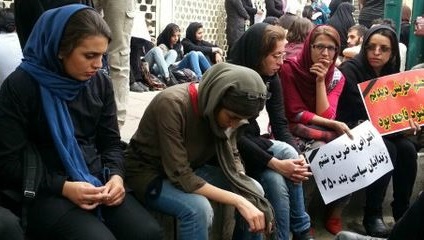
“A government that does not want to change and is afraid of gatherings / Behdad Bardbar”“A government that is resistant to change and fears gatherings / Behdad Bardbar”

Successful experiences of social movements all rely on the presence of a population. Peaceful and lawful movements bring along a part of the ruling body and history has proven that these types of gatherings, due to their focus on legitimate demands of the people, are one of the most important factors in bringing about change in political systems.
Despite the constitutional declaration, the political ruling body has always resorted to political suppression due to the consequences of such gatherings (which is the same as catering to demands). Political suppression is an effective tool for preventing gatherings. Political suppression can be carried out through various methods, including discriminatory policies such as violating human rights, misuse of technology to monitor citizens’ private space, police violence, imprisonment, attacks and beating of protesters, deprivation of citizenship rights (such as the right to education for Baha’is in Iran), forced displacement, exile, and killing of protesters.
In general, the term political gatherings dates back to the mid-nineteenth century. However, the modern term that is referred to as political demonstrations was first used by Daniel O’Connell in Ireland. O’Connell believed that demonstrations and gatherings are a form of political activity that will become more serious over time, especially if these gatherings are in pursuit of social justice and against oppression. Another historian has an interesting perspective on demonstrations and compares it to sex. Eric Hobsbawm, a Marxist historian, believes that political demonstrations are like a sexual act in which physical experience and emotional excitement are combined and one finds pleasure. But unlike sex, which is inherently an individual act, political gatherings have a collective nature.
A political gathering is a physical act such as protests, chanting, and singing through which the unification of individual identities in a group, which is the basis of collective experience, takes place.
Contrary to the 20th century, the first two decades of the 21st century have witnessed various types of political demonstrations. These include long marches, gatherings where people come together to listen to music, occupations where people take over a space, sieges where people occupy a workplace or financial institution, sit-ins and occupations, and finally, nudity (such as the Femen group where nudity is used as a form of protest).
The main difference between gatherings and protests in the 21st century may lie in the unlimited use of internet facilities; to the extent that, due to technological advancements in the field of communication technology, we are witnessing civil disobedience and non-violent resistance through the Twitter storm for the first time. Online hashtags have also apparently caused numerous problems for political leaders. It should be noted that the content of peaceful gatherings and protests is mostly related to economic and social issues. Although, rarely, topics such as lack of results in sports competitions (such as in a country like Brazil) take the form of protests.
It is also noteworthy that one of the methods used by the ruling system to prevent protests and gatherings is the launch of anti-gathering operations, which usually involve violent and bloody confrontations, such as the December 30th gathering in Iran.
The original 27th article of the Constitution of the Islamic Republic of Iran refers to the right to assembly. Assemblies are allowed as long as they are unarmed and not against the principles of Islam. However, this principle has not been implemented in all the years after the revolution.
Workers’ gatherings in Haft Tapeh, Khuzestan, as well as teachers and women activists, are all suppressed. Some activists are sentenced to heavy prison terms and in most cases, government officials do not fulfill their demands.
It can be said that for Iranian political authorities, the goal of a gathering is not particularly important, but the gathering itself and occupying the streets is something that the government has a problem with.
Why have freedom of assembly been suppressed throughout all these years?
Because every peaceful gathering has consequences if it succeeds. Protesters can challenge the government and political structures through gatherings. They can change laws or demand the removal of individuals, and the political system ruling Iran does not want to show flexibility.
An example of a civil gathering for the defense of political prisoners.
Milad Pouresi, a journalist based in Tehran, participated in several protest gatherings along with family members and a number of activists in protest against the harsh treatment of prison officials.
On April 17, 2014, a significant incident occurred in Evin Prison: an attack by plainclothes individuals and special guards on political prisoners.
The excuse for this suppression was the ban on inspections, and the resistance of prisoners was cited as the reason for the severe treatment by prison authorities. They then fabricated the news of the presence of alcohol. This led to the beating of prisoners on the same day. The protesting prisoners were transferred to solitary cells. This news was spread by social media and grassroots networks, and sparked public outrage. Civil activists showed their reaction and held protests.
The center of this gathering and protest was with the families of political prisoners in Evin Prison. In total, three protest gatherings were held. One in front of the prosecutor’s office and one in front of the Islamic Consultative Assembly. Representatives such as Ali Motahari and Zakani were present among the protesters and promised to follow up. The third gathering was held on the second day of Ordibehesht 1394 in front of the Presidential Institution in Pasteur. At the same time, the reaction of civil activists continued and it was planned to hold a gathering in front of the Presidential Institution. The argument of these activists was that the Ahmadinejad government was a coup government and the Rouhani government, as the elected government, should be accountable to the protests.
On the second day of Ardī Behesht, families of prisoners along with a number of students participated in a peaceful gathering. The slogans were completely in line with pursuing the situation of beaten and transferred prisoners to solitary cells. The slogans and demands were by no means radical or disruptive.
One of the slogans of that day was the demand for the resignation of Esmaili, the head of the prison organization. The most intense slogan was the resignation of Rouhani.
The gathering was peaceful and there were about a hundred protesters. When Milad Pour Eisi left the gathering, a motorcycle stopped in front of him and arrested him. They first took his mobile phone and told him he had to come with them. The forces of the Tharallah Sepah base arrested him and three others that day.
The question from the military base was why did you participate in the gathering? His response was that this conflict occurred in the prison and official news from the radio and television also confirmed it. The government has also reacted and we, as protesters, have asked the president of the country to follow up on the matter.
Pour Esi says: “As they themselves said, in this gathering, there were no slogans of structural disruptors raised.”
But after we were transferred to Evin Prison, which belonged to the Revolutionary Guards, I realized that the interrogations were going towards accusing me of having connections with opposition groups and armed organizations.
In this incident, a total of seven people were convicted. The total prison sentences for these seven individuals amount to over 32 years. This gathering was not against the law or contrary to the interests of authoritarian institutions. These heavy convictions were carried out with the purpose of greatly increasing the cost of organizing peaceful gatherings.
At the same time, a gathering was held in front of the United Nations office in Tehran to support the people of Kobani. The terrorist group ISIS intended to occupy the small city of Kobani and commit a massacre, while the protesters only demanded support for the people of Kobani. However, the government did not tolerate the gathering and sentenced several protesters to long-term imprisonment.
Apparently, even the goal of the gathering does not matter for the government. For example, the Kobani slogan was not only raised by the media. The problem is with the government itself. The government has a problem with the occupation of the streets by protesters and does not tolerate it. The formation of an independent power from the government to organize movements that could lead to the occupation of the streets is not acceptable for them.
 By: Behdad Bordbar
 October 29, 2017
Tags
Bahad Bardbar Monthly Peace Line Magazine peace line Right of assembly