


Reflection on the Case of the Mummified Body of Reza Shah Pahlavi / Mohammad Mahbobi
“پاییز زیباست و آسمان آبی است”
“Autumn is beautiful and the sky is blue.”
Mohammad Mohabbi
Burial or burying the bodies of dead humans is considered an ancient human tradition. Some archaeological studies estimate the origins of this practice to be around thirty thousand years ago. Even Neanderthal humans buried their dead in the ground. However, revenge against a dead human’s body and disrespect towards this tradition was not common. In human history, the death of a person meant the end of all their worldly accounts, and respecting the dead and their grave was considered a natural thing. But with the emergence of religions, different sects, and extremism in beliefs, as well as political competitions tainted with ideologies, signs of disrespect towards the bodies and graves of the dead were observed. Governments and sects, after killing their rivals and enemies, would also treat their bodies with the same hatred and animosity.
In Iran, in recent centuries, perhaps the most intense hostility and desecration of the dead occurred with the rise of the Safavids. Shah Ismail Safavi, after conquering Herat, destroyed the tomb of Abdul Rahman Jami, a great Iranian poet, and burned his remaining body. Similarly, after the conquest of Baghdad, he desecrated the tomb of Sheikh Abdul Qadir Gilani, a prominent figure in mysticism and Sufism. In addition to destroying the tomb of Abu Hanifa (one of the four Sunni imams), he ordered his soldiers to urinate on it. During the Safavid era, this style of hostility and desecration of the dead and disrespect for corpses inside tombs was common, and graves of those who had ideological differences with the ruling government and official religion were usually insulted and humiliated.
During the mid-Safavid era, a movement led by Sheikh Muhammad bin Abdul Wahhab (a Hanbali scholar and follower of Ibn Taymiyyah) emerged in Hijaz, launching an intellectual and operational campaign against religious shrines and tombs. However, this movement differs significantly from the desecration and disrespect of graves that was carried out by Shah Ismail and the Safavid era as a whole. This movement did not and does not intend to disrespect or insult the deceased, but rather opposes the construction of structures such as shrines and mausoleums on top of graves, which still continues today. Even during the destruction of the tombs of the Imams in Baqi’ cemetery (the four Shia Imams buried there, Imam Hasan al-Mujtaba, Imam Zain al-Abidin, Imam Muhammad al-Baqir, and Imam Jafar al-Sadiq), the tomb of Uthman ibn Affan, the third cal
The ideologies of grave desecration and animosity towards the dead were prevalent in Iran later on. When Agha Mohammad Khan Qajar triumphed over Lotf Ali Khan Zand, he had the body of Karim Khan Zand transferred from Shiraz to Tehran and placed on the steps of his palace to be walked over every day. This act was rooted in Agha Mohammad Khan’s personal hatred towards Karim Khan Zand and his authoritarian spirit. However, when the Qajar dynasty fell and Reza Shah Pahlavi was crowned, he ordered for Karim Khan Zand’s body to be respectfully returned to its original resting place.
Although Reza Shah and his son Mohammad Reza Shah Pahlavi put an end to the tradition of grave desecration and political and ideological persecution, and not only did they not disrespect the tombs of previous kings, but they also stopped the tradition of massacring the supporters of the previous government in Iran and even used political elites from the previous government, during their rule, there were still many actions taken to destroy graves, such as the destruction of Baha’i tombs in various parts of Iran.
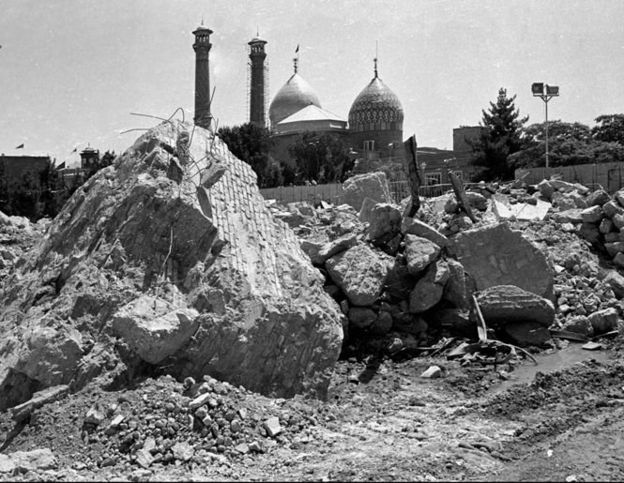
After the February 1979 revolution, due to the ideological nature of the system that emerged from it, grave desecration became widespread. The most significant of these was the attack by revolutionaries led by Sadegh Khalkhali and the destruction of the tomb of Reza Shah Pahlavi. Reza Shah Pahlavi’s body, after his death on the island of Mauritius, was mummified and transferred to Cairo and placed in the Al-Rifai Mosque. Several years later, the body was transferred to Tehran and after performing the necessary ceremonies and religious rituals, it was buried in Shahriar city. Apparently, in the attack by Sadegh Khalkhali, after the destruction of the tomb, they also intended to find the remains of Reza Shah’s body in order to completely eliminate it. However, they did not find the body and it was apparently buried in a different location, in the courtyard of Abdolazim Hassani in Shah
In the paradise of Ardi, in the month of Bahman of the year 1397, during the construction operations of the development of the shrine of Imamzadeh Abdolazim Hassani, a mummified body was found in the area of Bagh-e Tuti. Based on evidence and indications, there was a strong possibility that this body belonged to Reza Shah. The discovery of this body sparked discussions not only about the political legacy of Reza Shah and the Pahlavi government, but also about the symbolic capital of Reza Shah’s body in society. The need to preserve the sanctity of the bodies of the deceased was also brought up in these discussions.
In Shia jurisprudence, the sanctity of graves and corpses is a matter agreed upon by Shia scholars. According to this principle, there is no difference between the bodies, whether they belong to a believer or a non-believer. Damaging or disrespecting a grave and a corpse is considered as disrespecting an innocent living person. In the narrations of Shia and Sunni hadith books, there are many traditions stating that destroying, digging, and insulting the body and grave of a polytheist, disbeliever, sinner, or atheist is not permissible without any reason, let alone the grave and body of a Muslim. The only exception to this is in cases related to construction and development. For example, when a building is to be constructed in a cemetery, the bodies inside the graves can be respectfully removed and reburied in another location, or the family of the deceased may decide to change the burial place for personal or family reasons. Other than these cases, digging up a
In Sunan Tirmidhi (one of the six major books of the Sunni tradition), there is a hadith in which the Messenger of Allah responds to the revengeful actions of some Muslims who had dug up the graves of some polytheists, killed their relatives, and looted their belongings. He said, “Woe to you! Have you made yourselves equal to Allah? When a person dies, it is up to Allah to judge their actions, and no one should even insult them by name, let alone disturb their remaining bones.”
According to the most basic ethical and rational principles, disrespect towards the body and grave is a condemned and ugly act. Punishment is only applicable to a living, rational, and consenting human being; it is not logical to punish the dead body and grave of a human being.
 By: Mohammad Mohebi
 May 22, 2018
Tags
Harassment Monthly Peace Line Magazine Mummy of Reza Shah peace line Reza Shah 2