


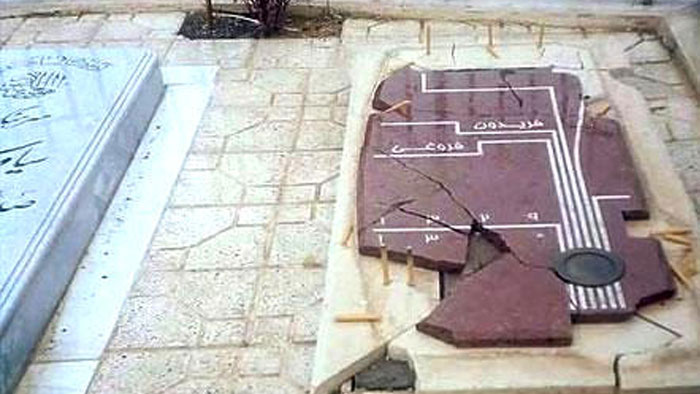
“Living Against the Dead/ Reza Najafi”
A commentary on the phenomenon of destruction of graves in Iran.
“بهترین راه برای پیشرفت، شروع کردن است.”
“The best way to progress is to start.”
Reza Najafi
Heinrich Heine, a German political poet who lived in exile, wrote a poem in 1820: “Where they burn books, they will also burn humans sooner or later.” This poem turned out to be a prophecy, as a hundred years later, in 1933, the Nazis burned books of their opponents in some city squares such as Berlin and Frankfurt, and about ten years later they burned the bodies of Jews and other victims in ovens.
But perhaps it wouldn’t be bad if Haine completed his prediction and added to his poem: Those who show no mercy to the dead, will sooner or later fall to the living!
The truth is that the Holocaust began with the destruction of gravestones. Anti-Semitism in Germany, even before the rise of the Nazis, first manifested through the destruction of Jewish gravestones. This was followed by book burnings in 1933 and attacks and looting of Jewish shops and establishments in 1938 (known as Kristallnacht or the Night of Broken Glass) until it culminated in the death camps in the 1940s. It is perhaps for this reason that in some reputable encyclopedias, such as Random House, the definition of anti-Semitism includes damaging Jewish gravestones. And perhaps it is for this reason that today in Berlin, there is a memorial for the Holocaust designed by Peter Eisenman, a famous architect, with around three thousand stone pillars reminiscent of Jewish gravestones.
But were these destructive extremist actions only limited to a period in the history of a country, and belonging to the totalitarian regime of the German Nazis? Considering the emphasis and insistence of the religion of Islam on the sanctity of bodies and especially the Shia religion on the sanctity of graves, are such events rare in our history?
Unfortunately, it must be said that this sin is not unprecedented in our history. “In the history of Iran, the eradication of these destructions can be traced back to Khwaja Rashid al-Din Fazlullah Hamadani, who, ninety years after his death, had his grave dug up and his remaining body transferred from the Muslim cemetery to the Jewish cemetery; or Shah Ismail Safavi, who, in burning the graves and ancestors of his Sunni rivals, sought revenge for his father’s death.” (1)
As soon as we lean on words and phrases like “side by side”, “losing one’s grave”, “bringing one’s father” (which was a threat to the graves of fathers and ancestors), “burning one’s father” and “burnt father” (also meaning digging graves and burning the deceased close to someone), and many others in the Persian language, it shows that the Iranian mindset has been preoccupied with the dead and their graves for centuries.
However, despite the long history of destruction of tombs and desecration of bodies in Iran, it can be claimed that in recent years this undesirable phenomenon has become more widespread and has become a common practice. While in the past some kings used this act against their most prominent enemies, or some fanatical scholars did it against apostates and atheists, in recent years this insult has been directed towards many individuals and groups, which is sometimes unbelievable and turning it into a tradition is concerning. Recently, the discovery of a mummified body attributed to the first Pahlavi has caused controversy and differences of opinion among some supporters of Reza Shah on one hand, and on the other hand, especially among his opponents. In the midst of this, the responsible authorities of the country have faced a difficult dilemma. On the one hand, in Islam and Shia religion, emphasis has been placed on the sanctity of the body, even the body of an infidel and enemy, and disrespect for bodies is
These commotions, rumors, and contradictory statements from officials, on one hand, remind us of the phenomenon of desecration of bodies and destruction of graves and tombstones of others, and on the other hand, remind us of the complexities and contradictions of Iranian culture in dealing with the dead.
Of course, it should be noted that the destruction and damage to graves in Iran or any other country and culture can occur for various reasons. For example, these destructions can easily occur due to so-called renovation or development of a cemetery, such as what happened during the implementation of the development plan for the Ibn Babawayh cemetery and the reconstruction of the Imamzadeh Abdullah cemetery. In these so-called reconstructions, the tombs of some great and famous figures, such as Hadi Tajvidi, the founder of the Tehran Miniature School, Hossein Koohi Kermani, a writer and journalist, and many others were destroyed. In this regard, even if there is no political intention or purpose, at the very least, we must complain about the lack of proper management, which knowingly or unknowingly damaged the cultural heritage of the country, and deprived these two cemeteries, which could have become the pride of Iran with the presence of the tombs of
Sometimes, some destruction is also caused by vandalism and the destructive disease. For example, the destruction of the tombstone of Amir Veis in Ardestan may be of this kind. The tombstone of this Safavid commander, who was killed in the Battle of Chaldiran, was considered one of the most valuable historical monuments of Ardestan, with a history of five centuries and was registered in the list of national monuments. In this regard, one can also criticize the incompetence of the responsible managers.
In addition to the ruins caused by lack of proper management or vandalism and hooliganism (destruction for attention and fame), we have also faced destruction for political or religious purposes, which stem from other fears and totalitarian tendencies. The main focus of this text is also on this type of destruction and will continue to address it.
This is a picture of a beautiful sunset over the ocean.
The mysterious and historic cemetery of Khalid Nabi in the eastern province of Golestan has been destroyed in recent years.
Graves or tombstones that have been destroyed or damaged in recent years belong to various social groups; for example, the destruction of Christian cemeteries in Kerman, the English cemetery in Bushehr, the Christian cemetery in Andimeshk, the Armenian cemetery in Ahvaz, the Armenian cemetery in Qazvin, the mysterious and historic cemetery of Khalid Nabi in the eastern province of Golestan, the destruction of Baha’i cemeteries or tombstones in most regions of the country, the destruction of Sunni tombstones in Naghadeh, and so on (among religious groups and communities), the destruction of tombstones of Naser al-Din Shah, Alireza Pahlavi, Fazlollah Zahedi, Mansour, Ebrahim Yazdi, the destruction of Khavaran cemetery and the destruction of tombstones of many members of organizations and political figures such as Marxists or members of the Mujahedin Khalq organization,
The domain of prejudice, narrow-mindedness, and malice has reached such a point that destruction and disrespect have become the trap of those who not only were renowned for their good name, but also had no political or religious animosity in their way of life. People like Iraj Afshar, who dedicated their lives to serving Iranian culture, or people like Media Kashigar or Sepehri, who always extended a hand of peace, friendship, and kindness even to their opponents. How bitter is the irony that on the tombstone of Sepehri, who was destroyed by prejudice, his own poem was engraved:
If you come to me
Come softly and slowly.
Do not leave.
My delicate loneliness
Sadly, many of those whose lives are short have a difficult and violent journey towards him and many others.
Unfortunately, it must be said that the destruction and damage to the tombs of people like Biuk Jadikar, Homayoun Behzadi, Gholamhossein Mazloumi, and Reza Ahadi, who were neither involved in politics nor belonged to non-Islamic religious groups, but were football players and athletes, has spread in a worrying manner and there is fear that this destruction will become a bad tradition.

Of course, these destructions were met with a lot of criticism from individuals, including Mehdi Hasheminasab, former player of the Iranian national football team who has played for both Persepolis and Esteghlal. He said: “They used to say that we Iranians are idolaters, but it seems that from now on, we won’t even have mercy on our own idols.”
But contrary to Hashemi Nesb, the emphasis of these lines is on the belief that necrophilia, pilgrimage, and worship of graves are two sides of the same coin and complement each other with animosity towards the deceased and desecration of their graves. Many psychologists and sociologists have told us that the veneration of a corpse, whether in the sense of praising and worshiping it or in the sense of taboo and fear of it, belongs to the mythological way of thinking. Therefore, in a mythological culture, individuals make idols of the dead and the bodies of their leaders or fathers, and on the other hand, they try to leave no sign or trace of the bodies of those who are not their own. The truth is that death worship and death desire have a long-standing place in Iranian culture. That is why we either have pilgrimage to graves or we destroy the graves of those we think are different from us. For us, despite all our death worship, it is
What is considered an exception in Western culture is considered a rule in Iranian culture, which is filled with historical tragedies. It seems that in this extreme and excessive culture, there is no middle ground. However, beyond this dark side of Iranian culture, the dangerous mixing of totalitarian tendencies and political agendas with our mythical beliefs is present. Only in this mixture, the mythical view of death is combined with political and ideological totalitarian tendencies, to the point where the bodies of opponents are seen as so dangerous and influential that they must be destroyed. As we mentioned, it must be emphasized and repeated that only those who worship the tombs of their leaders are capable of destroying the tombs of those who were opposed or even different from these leaders. If we see this excessive tendency towards destruction of tombs and bodies in Hitler’s totalitarianism, it is because Hitler’s totalitarianism is a type of mythical totalitarianism that fears any other concept or non-self. The common factor between anti-Semitic Nazis and those who destroy graves
From this village, the destruction of gravestones must be considered a dangerous sign of thought, a complete thought that seeks to destroy and ruin anything that is different from his mythical thinking.
Notes:
Mirzaei, Shohab, Destruction of Graves: “We do not even have mercy on the dead”, BBC Persian website, November 6, 2016.
The tombstone of some Iranian football players in Zahra Paradise was destroyed, BBC Persian website, 8 October 2016.
 By: Reza Najafi
 May 22, 2018
Tags
Harassment Monthly Peace Line Magazine peace line Reza Najafi Violation of sanctity