


Why Farzad Kamanagar?
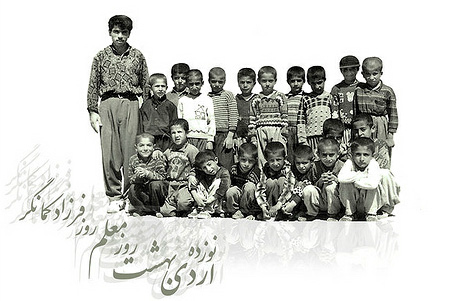
Naming the 19th of Ordibehesht as Teacher’s Day is a subject that has been brought up since 3 years ago, simultaneously with the execution of Kurdish teacher, Farzad Kamangar. Various reasons have been presented for declaring this day in the name of Farzad Kamangar. On the other hand, many people, driven solely by emotions and with little analysis, insist on their own demands. In any case, this article attempts to discuss some aspects of Farzad Kamangar’s character, but before anything else, it is necessary to briefly mention the concept of a teacher and the importance of naming one day of the year after teachers, and the significance of changing this day in such a critical period of Iran’s political history.
A teacher is someone who presents education and shares their knowledge from any source they have with others, forming their existence through their mind, thoughts, and beliefs. They share this through a one-sided partnership, receiving much less than they give. In most cultures, teachers hold a high position in society and it is undeniable that this position is solely due to their generosity in sharing knowledge.
On the other hand, since in the modern education system “teaching” is accompanied by “training” in educational centers and schools, the organized duty of “training” also falls on the shoulders of the teacher. This is where, besides the educational aspect and the advancement of individuals’ knowledge in society, the training aspect and the development of human aspects also fall on the teacher’s shoulders. Therefore, this is where the reason for the high position of the teacher in different cultures becomes clear, as there may be teachers who willingly carry this heavy burden.
The importance of naming a day in honor of “Teacher” in the official calendar of a country is a sign of the importance of the process of education and training from the perspective of its management system. With the existence of this day in the calendar of most or perhaps all countries, the importance of “Teacher” is easily understood in all systems and structures. However, there is something that highlights the differences and opens our hands for evaluation. On one hand, it is the type of political and managerial systems of societies that have their own specific educational and training systems, and on the other hand, it is the personal dimensions of the “symbol” of Teacher in societies. Therefore, a teacher with the characteristics of a secular human being and believer in the authenticity of humanity cannot be introduced as the symbol of a teacher in a religious system. So with this brief understanding of the personal dimensions of the symbol of teacher in each country, we can shed light on important aspects of the political system, and conversely
With your attention to the points mentioned above and considering the direct relationship between the political system and the symbol of the teacher (who is responsible for transmitting the values of that system), the decision to change this symbol can be seen as a decision to create a fundamental and essential change in the stability of a structure and political system. This is because either the system has made a mistake in choosing its symbol (if the change is made by the system itself) or the system has been challenged by its own people, which is not acceptable and cannot be tolerated. Therefore, the decision to change the symbol of the teacher by a wide range of people in Iran, including various nations, classes, and professions, is actually a blow to the roots of the Islamic Republic as the ruling political system in Iran. This is also considering the fact that Ayatollah Motahhari, who is the current symbol of the teacher in Iran, was one of the founders of the Islamic Republic and was killed by the opponents of that
Farzad Kamangar
Farzad Kamangar, born in 1354 in the city of Kamiaran, is a product of all the struggles that a nation has endured throughout its history. He comes from a city with a strong army of Kurdish freedom fighters, and has experienced the pain and suffering that has been inflicted upon his people. This struggle has been deeply ingrained in him and has shaped him into the person he is today. The conflict between suffering and pleasure within Farzad is not that of an ordinary human being, but that of a superhuman being. He is a product of the coexistence of power and pleasure, and is not just a mere mortal, but a being that laughs in the face of death and uses his power to shake the very foundations of the universe. He has brought his nation out of its silence and into a long-awaited revolution.
Farzad Kamanagar’s gaze towards combat was never superficial or political. With a deep contemplation and analysis of philosophical discussions and major concepts, he strives to find the roots of thought rather than simply engaging in written debates. In this field, he has several articles analyzing pre-Socratic philosophy and disregarding the limitations of conventional knowledge and pre-philosophical thought. Instead, he focuses on revisiting and representing the concepts of existence, with the understanding that this type of gaze is present in all aspects of his life. As a primary school teacher, he deals with the roots of a society and works towards the growth and representation of these roots, free from any one-dimensional prejudice or ideology, and in line with education and upbringing based on human principles and rights. Human-centered morality is one of the most prominent characteristics of his personality, evident in a simple analysis of his words and letters from prison. Humanity is above all else, and the most undeniable meanings are freedom, security, and well
With these words, Farzad found his way from the prisons to the homes, he played a role in all the notebooks and his voice reached the farthest possible places politically and even culturally, and this twisting of his voice and cries was a reminder of the forgotten meanings of humanity and true values that every human recognizes in any place they may be, even if they have been deprived of it.
The importance of Farzad after his execution is not less than his previous periods, and in some ways it can have a more prominent presence.
The execution of Farzad Kamangar, for the first time in over 30 years, resulted in an unprecedented unity that led to a month-long general strike in Kurdistan and simultaneous widespread protests in every other region of Kurdistan.
Until before the execution of Farzad Kamangar, no execution case in Iran had such a global reflection and had not received any feedback in different societies.
Less attention was paid to human rights in far corners of the world, such as the execution of Farzad Kamangar, the issue of Kurdish prisoners, and the suppression of this nation’s identity in Iran, and there were few media outlets that attempted to cover these events without trying to hide the truth.
4. Throughout the history of the Islamic Republic, no one has been able to create harmony between Iran and the Kurdish nation like Farzad Kamanegar. It is certain that during the 30 years of the Islamic Republic’s rule, through divisive storytelling and denial of its crimes against the Kurdish nation, this harmony was once again destroyed. However, with the name of Farzad as a symbol of Kurdish teachers and their defense, the language and pen of the Kurdish people is not less prevalent in all of Iran than the Kurdish language and pen.
So Farzad was able to break many of the impossible boundaries before him and by penetrating the barriers and by running a human-centered discourse, he was able to open many closed boundaries in his existence and speech.
Another point that I intend to mention is the current political situation, which is related to the 2 years after the execution of Farzad Kamangar. The situation is that on one hand, the Islamic Republic is struggling in a political crisis, and on the other hand, opposition political factions are trying to come closer and create solidarity in their conferences and meetings. Despite this, various anti-Islamic Republic views are present among different social and national spectrums within Iran, all of which show their disgust towards the ruling system.
“Every anti-dictatorship fighter needs a strong and universally accepted symbol to believe in.”
In the past year, there have been many efforts to bring opposition factions and political groups closer together, but unfortunately, there have been no significant results. This is mainly due to the lack of acceptance and understanding of each other’s demands and expectations, as well as various reasons for the disunity among these forces. On one hand, the demands of the Kurdish people are met with strong opposition, while on the other hand, the chosen method for bringing about a change in the system is a subject of debate. The Kurdish side in these talks is facing a lack of sufficient knowledge about the Kurdish struggle, which is partly due to the lack of confidence caused by insufficient promotion and cultural influence of the Islamic Republic in shaping the perspectives of non-Kurdish factions regarding the demands of this nation. Even the discussions among other factions involved in this issue do not reach a consensus on the method for creating change. In any case, the purpose here is not to propose solutions for advancing the talks, but rather to suggest
As I mentioned in the earlier sections of this text, one of the significant steps towards overthrowing this system is to create real disruption in its main structures. This includes changing one of its official symbols and moving towards a symbol associated with the people rather than the ruling system. I believe that Farzad Kamangar, who carried a human message and his slogan of freedom was not for anything other than the elevation of human dignity, and his sacrifice had no goal other than opposition to the dictatorship of freedom. This shared symbol has the potential to unite the opposition against the Islamic Republic and I suggest that it be seriously discussed and considered.
Farzad always remains a teacher.
 Admin
Admin October 9, 2013