


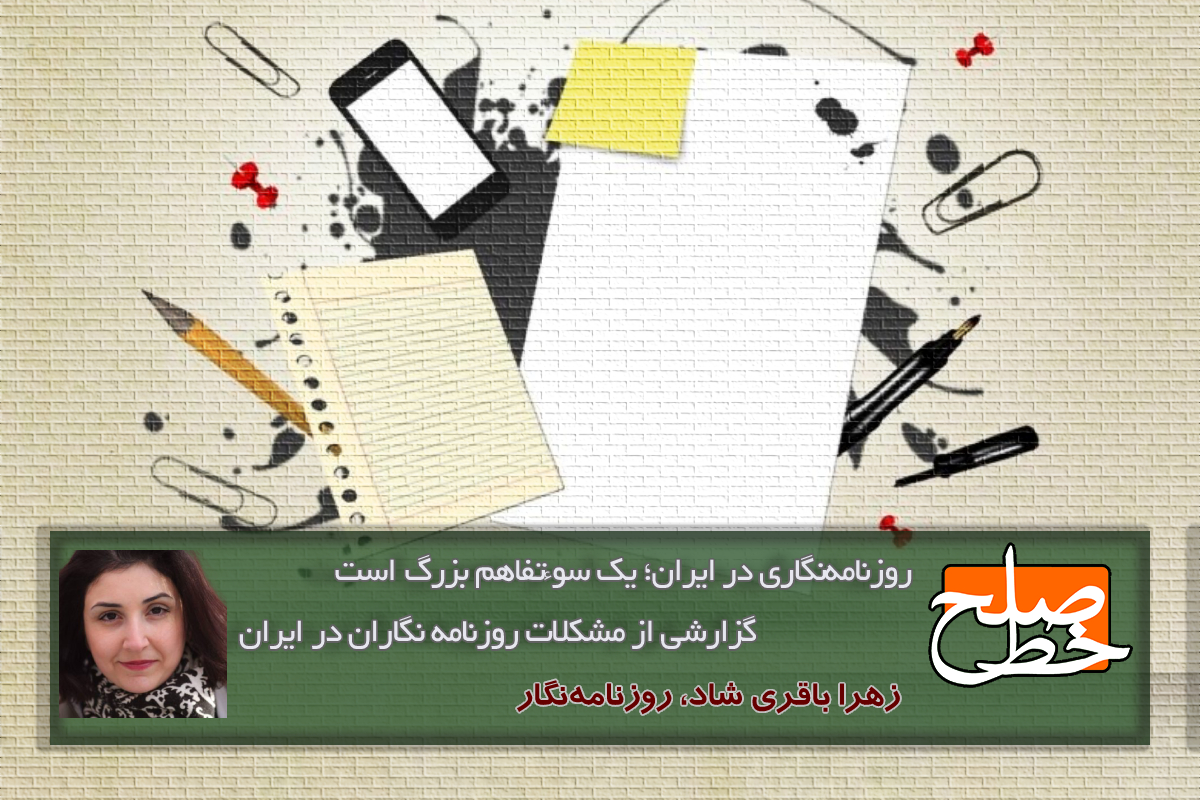
Journalism in Iran is a major misunderstanding; a report on the problems of journalists in Iran / Zahra Bagheri Shad
Years ago, when I was working on a file with my dear friend and colleague, Sheyda Laleh, titled “Why and How I Became a Journalist,” I had a conversation with Ali Akbar Ghazi Zadeh, a prominent journalism professor. I had fallen in love with reporting and editing in his classes, and now I was sitting in front of my teacher, listening to his account of “Why I Became a Journalist” in the same calm and bitter tone as he told me: “Bagheri Shad! Journalism in Iran is a big misunderstanding!”
“When I left Iran eleven years ago, I said goodbye in the midst of despair and darkness, with the scent of torn-up newspapers. I had fallen in love with journalism and the pain of it, and I couldn’t be like one of my journalism professors who said I should be a “dead poet” and continue my work in this field no matter what. The 1988 election coup had caused a long depression for me and many of my colleagues of the same generation and era in the field of journalism, even though it is better to search for the beginning of this depression in that “great misunderstanding” that Judge Zadeh used to talk about. A misunderstanding rooted in the lack of democracy in the dictator-ruled society of Iran!”
Today, after years of following journalism in Iran from afar, I am going to visit my former colleagues. I know the situation is still the same, or maybe even worse. However, their perseverance and impact in the news industry they work in makes me want to ask them a secret; the secret of how they have managed to stay in the field of journalism despite all the seasonal layoffs due to the confiscation and cancellation of newspaper licenses, all the efforts to not become a public relations employee, even in the midst of unemployment, all the poverty and empty pockets that are filled with meager salaries every few months, all the insecurity of the profession, all the fears, self-censorship, and efforts to not be bought.
Large red lines
Nun. Alif forty-one – is a two-year-old, has learned journalism both academically and experientially, and has started reporting and writing in the social field. Despite this, according to himself, he has not been able to continue in this field and now four years have passed since his activity as an economic reporter. He says that journalism in the field of social problems is a big challenge; that you are forced to not say and not write many things: for me, who was interested in working on social problems related to women, a big red line was drawn around many issues and I could not enter them; like incest cases that were very common in Imam Khomeini Hospital, but the Ministry of Health had ordered the hospital’s public relations department not to report these cases.
According to him, as the “harsher government” takes action, strictness and red lines in the field of social harms become even more severe: in the social realm, only if you want to write advertisements, your work will be welcomed. Institutions that claim to help people try to launch false advertisements in the media. For example, we could have written about the greenhouse and rescue mechanisms for addicts by the municipality in the field of addiction, but if we wanted to analyze this issue and say that the municipality is not allowing negative points to enter, we could not do so.
“Experience shows that journalists and reporters in the field of social issues cannot write in a way that the “system” would approve: This was one of the things that held me back. Maybe I was weak and couldn’t continue this game!”
Economic news reporting, however, according to this experienced journalist, is accompanied by bolder and more complex red lines, especially since the economic conditions in Iran have become more severe. He says this field of news is much harsher for reporters, although he emphasizes that a considerable number of economic journalists today are busy writing “advertorials”. But if you are a professional and do not want to do advertorials, this field is like a double-edged sword.
From security and sexual accusations to reassurance.
Sin. He begins his letters with this sentence: There is no real meaning of media anymore!
According to him, censorship has increased from within the media and there is also heavy censorship of information in various fields and news sources, to the extent that journalists and reporters may have difficulty or even rarely be able to access accurate information about a topic. He is a journalist with twenty years of experience in the social field; he says that information has never been as channeled and out of reach for reporters as it is today: now, in many places, in order to prepare a news story, you have to be in contact with the public relations of an institution or organization and as a journalist, you do not have access to the primary source or the responsible person. Public relations waste time and what you should be following today, they will respond to three days later. More importantly, when you directly communicate with officials, you may come across a hundred new topics, but when the necessary information reaches you through public relations, it will be completely channeled and confusing. In addition, public relations are
According to him, previously the responsibility of reports and news that were prepared was on the editor-in-chief, but today the journalists themselves have to be accountable for complaints that may be made against them by various organizations and institutions. For this reason, public relations allow themselves to easily complain about journalists, even threatening a seasoned journalist if they have a critical approach. He continues: You have no respect or value as a journalist! Look at the way Isa Kalantari sits; it says a lot of things.
But Noon, due to being a woman, has witnessed or even experienced a different type of accusations that are referred to as “sexual accusations”: When you are a critical and persistent journalist and talk too much, they start accusing you; like the things they said about me, including “this lady is flirtatious, what does she want?” They quickly start spreading rumors that you see this woman is not right.
According to him, in the economic sector, threats and accusations against journalists are much different and even include intimidation.
The dominance of public relations over the media.
Although the recent dismissal of three out of five political reporters from the daily newspaper Etemad without prior notice or explanation has made headlines, this is not a new occurrence. The lack of job security for Iranian journalists is not only limited to government pressure, arrests, and revocation of media licenses, but also, according to Seyn, an internal media issue. He believes that one of the main reasons for jeopardizing the job security of journalists is the debt-bondage between media managers and officials of organizations and institutions. These debt-bondages and joint projects lead to public relations managers determining which reporters cover their news; inexperienced reporters who do not have enough knowledge about the issues in their field and instead of questioning, they confirm and promote the performance of organizations and institutions. On the other hand, according to Seyn, journalists must obtain approval from public relations in order to work in different news fields, and this is true for most organizations and institutions. In this process, experienced reporters who have a
Saeen emphasizes that since 1988, this situation has intensified: especially during the Ahmadinejad era, the audacity of being a reporter and asking questions has disappeared. Many reporters who entered the media field after 1988 are easily purchasable.
He believes one of the reasons for this issue is the widespread launch of news websites in recent years, which have replaced newspapers. According to Sina, during Mohammad Bagher Ghalibaf’s tenure as mayor of Tehran, a large number of news websites were created with the financial support of the municipality, which extensively hired reporters and journalists. These reporters did not have the opportunity to gain experience, become professionals, ask questions, and criticize, and mostly played the role of supporting public relations and reflecting the news in a biased manner, in line with the municipality’s interests.
In addition, individuals who had not completed an internship or journalism course suddenly became the editor-in-chief, taking on the responsibility of a media outlet without knowing the principles of journalism. After the end of the Ghalebaf course and the completion of work on websites affiliated with the municipality, these individuals entered the media and were less accepted than the previous editor-in-chief.
Noun. Alif also confirms these statements. According to him, if a service secretary is dissatisfied with a reporter for any reason, they give the reporter one month to leave their job; while no reporter takes advantage of this one-month opportunity in such circumstances; because the conditions are so distressing for them that they practically cannot use this one month.
Nun believes that the income situation of journalists and reporters in Iran is subject to a foolish formula and says: “Apart from the main media where I work, I work for two other places as a freelance to reach a salary of ten million tomans; while the poverty line in Iran is fifteen million tomans.”
He sleeps for three to four hours at night in order to complete the reports he writes in handwriting. On the other hand, he emphasizes that the handwritten reports may be paid with a significant delay – for example, two years.
Sexual harassment and gender discrimination
A few days ago, reports were published about the sexual harassment of Iranian female journalists and reporters, and even during the Me Too movement, accusations were made against some editors-in-chief and male reporters for sexual harassment. But now, another type of sexual harassment is mentioned. According to her, Iranian female journalists and reporters have the most experience of sexual harassment not in the workplace, but in their interactions with interviewees and various officials: I would go to interview someone who seemed very religious and conservative, but two days later, they would start sending me irrelevant messages and that was the beginning of the harassment. This could happen from a 25-year-old man to an 80-year-old man.
She says as a female reporter, she always has this fear that when she goes to interview a man, she won’t be left alone in the room with him or she will pretend that another colleague is on the way and will join them soon: this way, she keeps her interviewee on their toes until the end of the interview.
“Noun. Alif refers to cases where there is no need for a face-to-face interview, but the interviewee insists that the female reporter must meet him in person, even outside of office hours. Then everyone tells me that I was foolish to go after office hours. I say, well, you as the editor-in-chief are pressuring me to get that interview… When a woman faces sexual harassment, she believes that she is at fault. For example, even my father tells me not to wear makeup and to be careful during interviews so that nothing happens! It has been over a year since I was touched by an interviewee during an interview, but I still question myself and ask why? Is it because of my body language or because I was a reporter that this happened to me?”
Gender discrimination is another common experience among Iranian female journalists and reporters; from the low number of female editors to the unequal income of male and female reporters. Many experienced and professional female journalists are capable of rebuilding bankrupt media outlets, but their names remain hidden behind the names of male managing editors and editors-in-chief. According to Non. Alif, these discriminations become more apparent when female journalists have a different style, appearance, and behavior than the defined norm and do not fit into the traditional definition: no matter how flexible we, as female journalists, are, it is enough for us not to be what they want! Then we are removed from high positions in the media.
Sina. He speaks from experience and similar realities. According to him, the number of female editors in Iran is very low; even the number of female service editors is less compared to men. He emphasizes that the attacks, excuses, sabotage, and harassment against the few women who work at high levels in the media are numerous: they can easily throw you out of life, find false faults, and not give you enough strength to stand your ground!
On the other hand, according to him, when a woman reaches a high position in Iranian media, she may quickly be subjected to various labels and accusations, including sexual accusations.
They are not regretful.
من به دنبال یک ماشین جدید هستم
I am looking for a new car.
After hearing all of this, I ask both of them if they would choose this job again if they could go back. And the answer from both of them is: definitely yes!
Nun says, when she writes and even achieves ten percent of her goal – like pointing out an error or criticizing an organizational performance – she experiences a satisfaction that cannot be replaced by any other feeling. She talks about the excitement of pursuing subjects that she still thinks about; of the day when she can go to Kurdistan to report on the lives of Kurdish women: this opportunity to produce our desired reports is not often given to us, female journalists, but I still want to pursue my ideas.
Saeen responds similarly and says: Because my perception of my work is that I have been and am effective in my field, this motivates me to continue my work. The fact that in these twenty years they have never been able to buy me out, they had no excuse to put me under pressure, even though I have been heavily censored, it still gives me energy to know that I have been effective to this extent.
Despite all of this, he ends his words with a bitter taste of familiarity; when he says that with the beginning of the presidency, even the slightest glimmer of hope has disappeared for many journalists, and they feel like the last generation of lonely vultures abandoned in the midst of insecurity, unemployment, and despair.
 By: Admin
 July 23, 2021
Tags
45 Number 12345 Journalism Journalism in Iran Monthly Peace Line Magazine peace line Problems of journalists Zahra Bagheri is happy.