


Religious seminaries do not trust education and training.
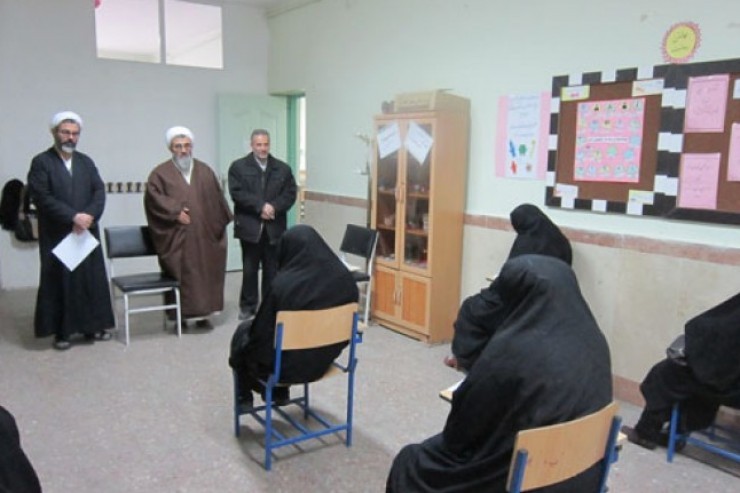
Amin schools, pre-seminary schools, and Sadra schools are new types of schools that have been established in recent years. The common feature of these schools is the direct involvement of clergy in management and administration. In addition, a large number of clergy are sent to schools in various capacities, such as leading prayers and answering religious doubts of students and teachers. Seminaries also offer training and re-education courses for religious teachers and educators, and play a direct role in writing textbooks.
Signing of the Memorandum of Understanding between the General Directorate of Education and Training of Tehran and the Seminary District of Brothers regarding the transfer of a number of government schools to seminaries has once again brought the controversial issue of the role of clerics in schools to the public sphere. The Ministry of Education has not yet provided any explanation for the reasons behind signing this memorandum.
The memorandum is so one-sided and imbalanced that some teachers compare it to the Turkmenchai Agreement. The Director General of Education in Tehran, by signing this memorandum and handing over the educational affairs of some schools to the clerical sphere, has essentially confirmed the incompetence and lack of qualifications of approximately 70,000 teachers and educators working in the schools of Tehran. According to this memorandum, a number of government schools will be converted into “schools affiliated with the seminary” by the choice of the clerical management, and the clerical management will take over the educational management of these affiliated schools. The number of schools added to this plan each year will be determined based on the capacities announced by the clerical management. The Ministry of Education has committed to justifying the selected managers and educational deputies of the regions and schools in relation to the plan. While most schools have a shortage of classrooms, the Ministry of Education has committed to appointing an office for the “clerical school” which
In recent years, and precisely since the establishment of the Cooperation Headquarters for the Seminary and Education, the seminaries have directly added their guidance and theoretical role to schools. Of course, the clergy does not have the ability to be present in more than one hundred thousand schools and directly educate more than 12.3 million students, but it expands its presence in schools to the extent of its capacity. The establishment of Amin schools or pre-seminary schools began four years ago within the framework of the Charter of Cooperation between the Seminary and Education. The exact number of Amin or pre-seminary schools is not known, but in November 2013, Hojat al-Islam Mohammad Hassan Nabavi, the Deputy for Propagation and Practical Education of the Seminary, said: “1800 pre-seminary or Amin schools with the management of 300 seminaries will be established throughout the country.” The Deputy for Propagation did not mention the number of
Hojat al-Islam Mardanpour, the director of the Amin schools in the country, also says: “In the educational plan of affiliated schools, ten Quranic characteristics such as self-awareness, love for oneself, God and the Ahl al-Bayt, honesty, the value of knowledge and respect for the world and knowledge, modesty in religion, enjoining good and forbidding evil, and commitment to the guardianship and Islamic system are taught.”

One of the goals of establishing pre-seminary schools is to attract talented students to religious science schools. Mohammad Hassan Nabavi also said in the third educational and seminary conference: “The average level of talent entering the seminary is low. If we launch attractive schools where talented individuals can attend, we will encourage them to join the seminary… By implementing this plan correctly, many of the shortcomings in the current acceptance, attraction, or expulsion of individuals will be addressed… We have started this work in high schools and middle schools, but we believe that the necessary comprehensive educational work is to engage in the battle from the first day of education; meaning that we also believe in establishing these educational centers in pre-school levels…” In response to the question of whether you use the seminary budget to build these schools, he says: “No! Education has a budget of several thousand billion and we should not spend the seminary’s money on it… Recently, we had a meeting with the Minister of
The Ministry of Education has always been criticized by political officials, scholars, and religious authorities for using the excuse of incompetence in religious education to justify the lack of proper training for students. Many officials and scholars complain that even after 35 years since the victory of the revolution, the Ministry of Education has failed to educate a generation of morally upright and religiously devout students based on the principles of the Islamic Revolution. During regular meetings with religious authorities and high-ranking clerics, the Ministers of Education report on their plans to Islamize schools and listen to the guidance and concerns of the elders, but so far no comprehensive research has been conducted on the reasons for the failure of the educational deputy. A simple solution suggested is to add more religious topics to the curriculum, but this has not been effective. The Ministers of Education consider the seminaries as the source of theoretical principles of education and training. They admit to the shortcomings in the education of students and ask for the help of the seminaries to address
The Islamic Revolution in 1979 inherited thousands of modern schools with over seven million students and 350,000 teachers. Teachers and students actively participated in the victory of the revolution. Although in the early years of the revolution, some suggested dissolving the education system and returning to traditional schools, the leaders of the revolution aimed to Islamize education based on the model of religious schools such as Alavi, Refah, and Kamal. From the early days, changes were made to the curriculum, textbooks, and selection of teachers based on ideological criteria, and the establishment of educational affairs was put on the agenda. In the years 1979-1981, thousands of managers and teachers were dismissed or retired for political and ideological reasons, and more than 30,000 revolutionary youth took over as educational instructors, becoming the pulse of the political atmosphere in schools. In the first academic year after the revolution, textbooks and school programs were changed. Ideological rivals, such as Marxists, were expelled
In recent years, the volume of religious discussions in elementary school textbooks has significantly increased. The clergy, who were solely responsible for educating and raising children in traditional schools before the establishment of modern schools, have not shown much interest in education and training in new schools in the past hundred years. In their view, these new schools have been established based on Western models and their goal is to weaken the religious foundations of Muslim students. The conservative clergy has maintained its guiding role in education and training without any competition in the past 35 years. However, the clergy and political authorities are not satisfied with the outcome of these schools and believe that there is a lack of proper education and training for children and adolescents. According to officials, 35 years of religious education in schools has not led to the formation of individuals who are on par with the ideals of the Islamic Revolution. Finally, the seminaries have come to the conclusion that they should take matters into their own hands and directly implement religious education theories in schools
 Admin
Admin February 21, 2014