


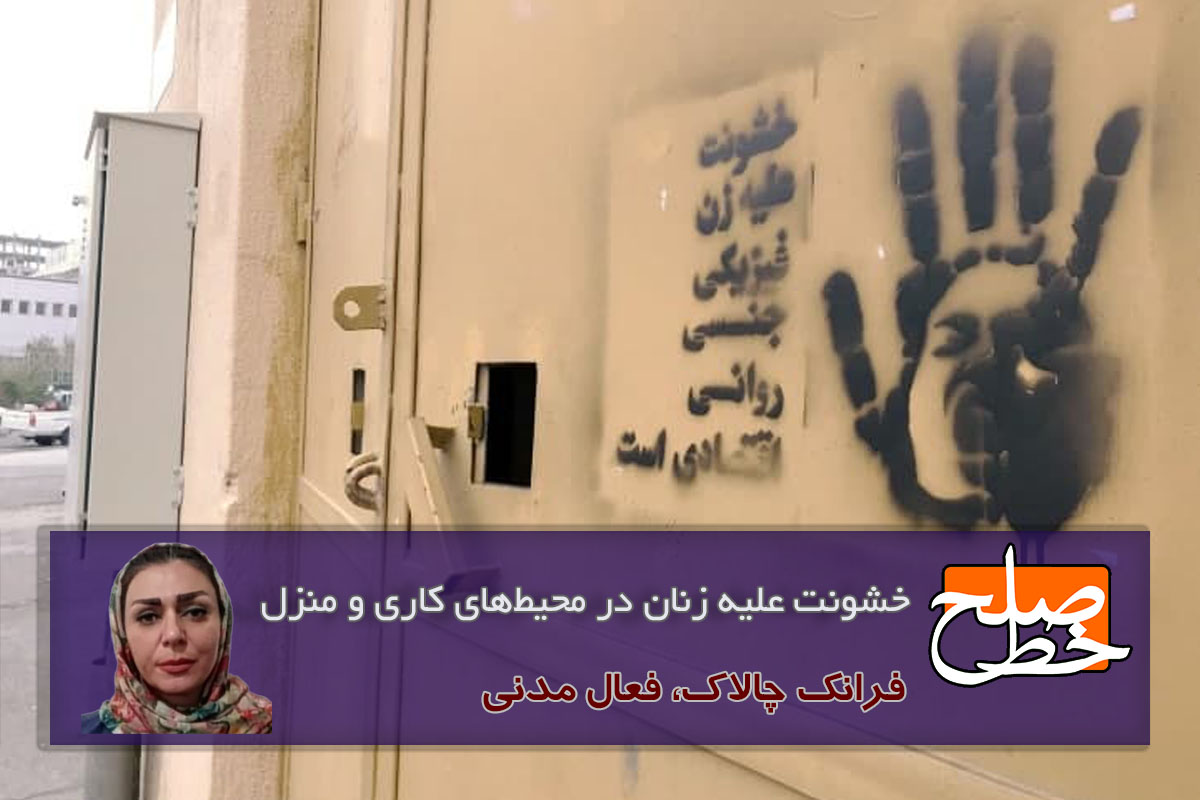
“Violence against women in work and home environments/ Frank Chalak”
In the definition of violence, it can be said that it is a general set of behaviors that one person performs towards another person, which causes various damages including physical, psychological, and sexual damages, and is caused by multiple cultural, social, and economic factors.
Given the special conditions of the patriarchal culture, severe economic problems, and the lack of cultural awareness, violence against women has become systematic and is increasing. Although women have made efforts and taken action to fight against this mindset and bridge the deep gaps, the flaws and weaknesses in laws, caused by a lack of understanding and willingness from men to address these issues, have created an unsafe environment for women. This has hindered women’s efforts to eliminate these weaknesses and problems, which cause deep physical and psychological pain, and has instead aided the systematic violence against women by the existing system.
This article specifically addresses two issues of violence in the workplace and at home. Violence against women refers to any act of violence based on “gender” that causes harm to them; it also includes threats and harm that result in forced or voluntary restrictions on freedom in life (public/private).
It should be noted that the level of violence in lower economic classes, outskirts of cities, and areas further from the center is higher.
Violence in the workplace
There are four types of institutional violence that can be observed in work environments against women:
1- Physical violence: Any type of action and reaction that is violent by employees in the workplace; especially violence that is directed towards female employees by employers. In this type of violence, various forms of harassment by employees and employers can be mentioned, which leads to women being unable to demonstrate their abilities and position in that specific job.
2- Psychological Violence: Using aggressive phrases or actions, intimidation and threats of dismissal or relocation, and even discrimination, is mostly directed towards women in the workplace, leading to humiliation or creating shame. It should be noted that this type of violence is not only carried out by employers, but a significant portion of it is also perpetrated by male colleagues. Since psychological violence cannot be perceived as tangible as physical violence, it can be more damaging; affecting the individual’s quality of life, self-confidence, social presence, and so on.
3- Sexual Violence: Sexual abuse can be a subset of psychological violence. The use of offensive, shameless, and derogatory words or actions related to gender or sexual orientation, including sexual violence, also has psychological consequences.
4- Financial violence: Employer’s prevention of timely payment of wages and benefits, lower wages for women compared to men in a position, or unjustified dismissal are examples of this type of violence.
Another noteworthy point that can be mentioned is that in many cases, multiple types of violence are simultaneously inflicted on women in work environments, which leads to insecurity in various aspects of women’s lives. This overall lack of job and workplace security, along with the resulting problems that contribute to social and economic issues for women, increases.
“Human rights obligations and resolutions have been passed in various assemblies to combat violence against women, but since the Islamic Republic of Iran does not consider itself obligated to adhere to and implement human rights laws, it pays minimal attention to providing platforms for fighting violence against women. As a result, in explaining laws related to women and addressing their issues, it tends to lean towards a direction that not only does not reduce systematic violence, but also contributes to its stability and increase. For example, recent legislation has helped reduce women’s social activities and even eliminate their minimal social participation, which in turn gives employers more permission to hire women less or with lower wages than usual, creating a cycle of more blatant and hidden violence that will cause irreparable damage to society.”
Violence in the home and family
The dimensions and layers of various types of violence are very vast and in some cases, discussing them is considered taboo and can lead to immense pressure, even from many intellectuals in society. To reduce and eliminate many forms of institutionalized violence, it is necessary to openly and continuously talk and write about them so that the public is constantly aware; because the cycle of ignoring and not treating these forms of violence leads to the emergence of anger and violence with even greater magnitude and pressure in other layers of the home or society.
All types of violence mentioned in work environments can also be added to increasing violence in the home and family; for example, physical violence in the home can escalate to the point of causing physical harm. In this regard, one can refer to the infamous honor killings.
These murders, which are mostly carried out by close relatives (known as honor killings), have caused great tragedies. In many cases, even society is not aware of them and only in very few cases does it come to the attention of the community through pressures such as online pressure and the like. One of the cases of honor killings that made headlines was the murder of a teenage girl named Romina by her own father.
According to existing jurisprudential laws, women have a guardian named “wali” and because of this law, a woman is considered a commodity that, before marriage, belongs to the father and paternal grandfather (even in some cases, a male child) and after marriage becomes the property of her husband. Considering this, and the fact that the father is considered the guardian, the legal guardian gives himself the right to use violence, even up to murder. Due to the weaknesses in the laws, it is known that the punishment for murdering a child will ultimately result in a few years in prison, as the mother, as the other party in the matter, has no share in the law. This is not a deterrent for the commission of these acts of violence, which are considered first-degree crimes, as the weight of the scale of murder and the existing law for punishing the murderer (the father/guardian) is heavier, and there is legal, religious, and jurisprudential justification
Considering some of the issues mentioned above, it is necessary to consider some solutions in order to reduce and ultimately put an end to workplace and domestic violence.
In order to achieve these great goals, it is necessary for the government to seriously reconsider its subcategories of power (executive, judicial, and legislative) including changing current laws from religious to human rights laws. In the subcategories of work and home, it can also address work and home crises through the creation of multiple social support centers in government centers, social security centers, and neighborhoods, etc. with a modern legal approach and necessary education to familiarize women with their rights in the workplace and family. It should also provide facilities for women to use in times of crisis.
On the other hand, there is a strong need for increasing non-governmental organizations. The women’s society, with relentless efforts and occasional ups and downs, strives to create positive and progressive movements in society to change laws and promote gender balance. Strengthening this segment of the human society, which comprises almost half of the country’s population, is crucial in strengthening civil society through the diversity and concentration of organizations. This will not only help identify weaknesses, threats, and limitations, but also bring about effective changes from ideological to human and human rights approaches, and educate women to reduce such damages and carry out important movements.
 By: Faranak Chalak
 November 22, 2021
Tags
Frank Chalak Monthly Peace Line Magazine peace line Sexual violence