


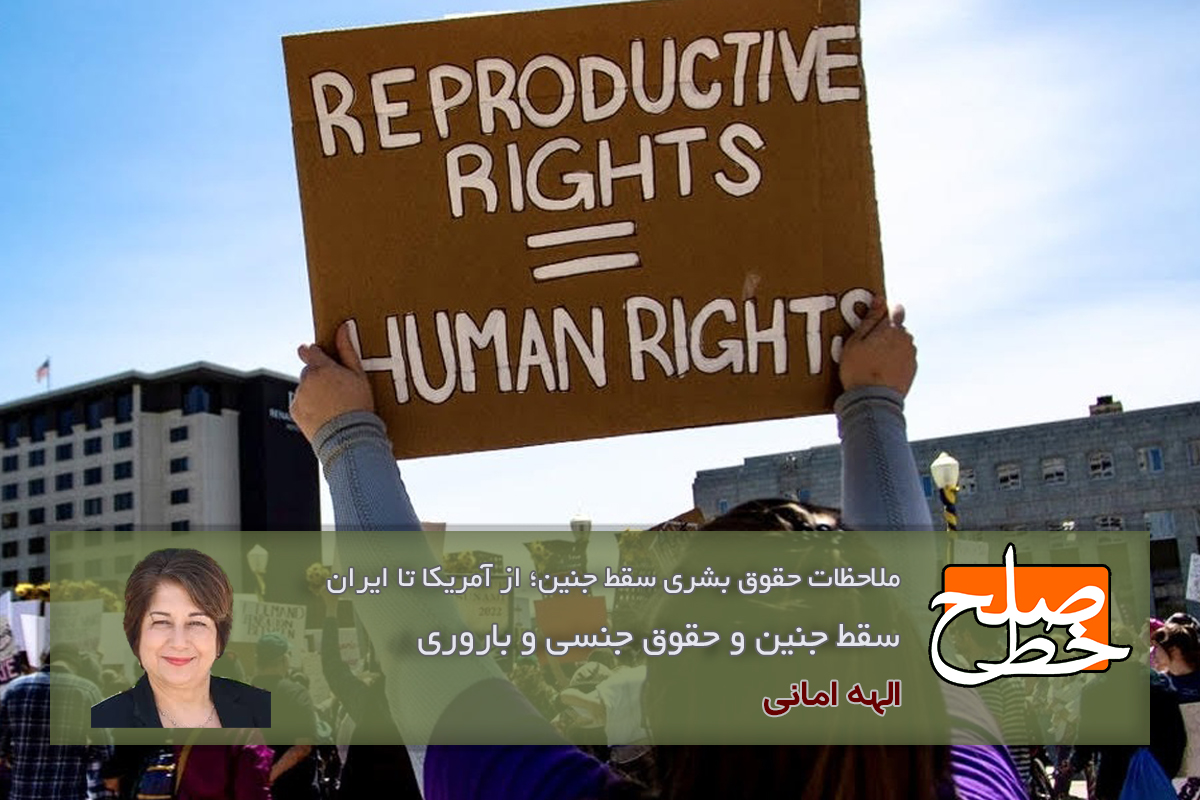
“Notes on Human Rights and Abortion; From America to Iran / Elaheh Amani”
Miscarriage and reproductive rights and fertility
In the third decade of the 21st century, we are witnessing a major wave and trend towards reclaiming women’s rights not only in countries on three continents, especially in Western Asia, North Africa, and South Asia, but also in European and North American countries. In America, after nearly half a century, the law on women’s rights to abortion or “Roe Vs. Wade” is in danger of being criminalized by the Supreme Court of America; a trend that has started in recent years in some states, including Texas and Colorado. In Europe, since 2010, six countries have restricted women’s sexual and reproductive rights and abortion, and this growing trend seems to continue; however, in contrast to this global trend, we see that women in Argentina, Ireland, and Colombia and progressive and human rights activists have legalized women’s right to their own bodies. Restrictions on access to sexual and reproductive health, women’s human rights, and girls’ rights, which are basic human rights
Human rights institutions and global conventions have clear and precise guidelines on the need to eliminate criminalization of abortion, and governments are obligated to respond to this. Access to safe abortion services and reproductive health for all women and girls under the age of eighteen is a fundamental right and must be respected. In many countries, abortion has been legal for decades, and until two decades ago, it was only restricted in a few countries with a majority Muslim or Catholic population. The restriction and criminalization of abortion is explicitly mentioned in a document by the United Nations Human Rights Council and in particular, the Committee on the Elimination of Discrimination against Women, which states why governments should provide services and facilities for access to sexual and reproductive rights for women, including abortion, family planning methods, and education on sexual and reproductive rights for girls, in line with their commitments to conventions and international law. These rights are enshrined in the spirit and text of international commitments, including:
1- Universal Declaration of Human Rights;
The International Conference on Population and Development in 1994 in Cairo;
3- The final document of the Beijing Conference, the 4th World Conference on Women in 1995;
4- Convention on the Elimination of All Forms of Discrimination against Women;
5- Convention on Economic, Social and Cultural Rights;
In the text of these international documents, the rights of women to life, sexual and reproductive health, privacy, decision-making about their bodies, economic, social and cultural rights, the right to live without discrimination, shame, stigmatization and abandonment regarding access to abortion services are detailed.
The Committee on the Elimination of Discrimination against Women, which operates under the supervision of the Human Rights Council, refers to the heavy burden that women in various countries bear due to limited access to sexual and reproductive health services in the meetings of the working group on abortion. Many women from their own countries travel to neighboring countries, especially recently to the United States, and are exposed to violence, harassment, physical and psychological abuse, and inhumane treatment. In addition to the economic burden imposed on them, many, especially in rural areas, resort to abortion in environments and methods that may endanger their lives. Criminalizing abortion also causes shame and humiliation for those who are forced to do so and leads to psychological pressures. International institutions and laws have examined this issue to the extent that even in countries where abortion is legal, any restrictions on waiting and long waiting times for abortion, limited facilities and services that cause women to travel long distances and the heavy cost of abortion for some women, the need for the
The Convention on the Elimination of All Forms of Discrimination against Women also recognizes the importance of providing access to private counseling on abortion, pregnancy tests, education on relationships and sexual health, and prevention of pregnancy, as well as HIV and AIDS testing, to girls without the permission of parents and spouses (regarding child-spouses) in accordance with international documents on the right to life, the right to access to sexual and reproductive health, the right to life without discrimination, physical and mental pressures, the right to live with human dignity and without shame and humiliation, and the right to respect for economic, social and cultural rights.
The right of women to reproductive and sexual health in America and Europe.
“Roe versus Wade” is a historic ruling by the Supreme Court of the United States in 1973 regarding the legalization of abortion. In this ruling, the Supreme Court declared that the United States Constitution supports a woman’s right to choose to have an abortion without government interference. This ruling led to the overturning of many federal and state laws regarding abortion in the United States, including questions about the legality of abortion, who should make decisions about its legality, what methods the Supreme Court should use when considering cases related to the Constitution, and the role of religion and moral beliefs in these decisions. It is important to note that international laws and treaties signed by governments have a commitment beyond national laws, and this also applies to reproductive and sexual rights.
This file is about a person named Norma McCorvey, who is referred to as Jane Roe in the file. Jane had become pregnant for the third time in 1969. She wanted to have an abortion, but she lived in Texas where abortion was only legal if the mother’s life was in danger. She first consulted with two young friends and attempted to have an abortion under the label of being a victim of rape, as in Texas a woman could legally have an abortion if she had been raped. However, this attempt did not work out for her. She then turned to two lawyers who filed a lawsuit on her behalf against the district attorney of that area, Henry Wade, stating that the abortion laws in Texas were unconstitutional. A panel of three judges from the Northern District Court of Texas heard the case and ruled in favor of Jane. However, by the time the court’s decision was made, Jane had already given birth to her child and due to financial constraints, had given the child
Jane sent her request for reconsideration directly to the Supreme Court of the United States after that Texas state.
In January 1973, the Supreme Court, in a ruling with seven in favor and two against, declared that the due process clause in the Fourteenth Amendment of the United States Constitution recognized the “right to privacy” of individuals. Therefore, a pregnant woman has the right to choose whether or not to have an abortion. However, the Supreme Court also added in this ruling that this right is not absolute and must be balanced against the state’s interests in protecting women’s health and preserving the life of the fetus. To establish this balance between the two state regulations regarding abortion, the Court set three stages of pregnancy: “during the first three months of pregnancy, state governments cannot prohibit abortion in any way. During the second three months of pregnancy, state governments can establish reasonable regulations regarding the health of the mother. And during the third three months of pregnancy, abortion can be completely prohibited, as long as the laws make exceptions for cases where the abortion is necessary to save the life or health of the
We must mention that in the continued growth of right-wing and populist forces in America, especially during the Trump presidency, many states have imposed heavy restrictions on women’s right to abortion. In just the past two years, forty percent of US states have further limited their abortion laws. The number of independent abortion clinics has decreased by thirty percent in the past decade, and many government clinics also did not provide these services in some states during the COVID-19 pandemic. In May of this current year, a draft ruling by one of the judges of the American court (Samuel Alito) was leaked, sparking a new wave of resistance to reclaim the legal rights that women have fought for. Progressive and forward-thinking forces, human rights advocates, feminists, and women’s equality activists are concerned that in the coming month, the federal law may violate and criminalize women’s right to access abortion services. Women’s right to abortion is closely linked to other civil rights, including maternity leave, health insurance, economic ability
One of the national organizations for women in America that is active in the field of reproductive and sexual rights for women and respect for women’s privacy in the religious and Christian community in America is “Catholics for Choice”. It was founded in 1973 and has a significant political influence. They believe that in all religions, including among Catholics, abortion has always been performed for various and justifiable reasons, and restricting and criminalizing it only serves as a barrier to its safe practice.
Today, with the rise of right-wing forces, populist groups, and fascist groups resulting from the alliance of Christian extremists and right-wing forces, the fight against women’s human rights has intensified more than ever in America and we must expect a deeper polarization around women’s human rights and the fight against it.
In Western Europe, there has also been a violation of women’s rights due to the rise of right-wing and populist forces, albeit at a slower pace. Eastern European countries have enacted stricter laws for access to reproductive rights. While in the past, abortion was illegal in Sweden and women had to go to Poland to have one, today, with the existing restrictions, abortion is almost prohibited in Poland and is only considered a crime in exceptional cases of sexual assault, incest, or when the mother’s life is in danger. In Europe, since 2010, six countries have restricted women’s rights over their bodies, including Armenia, Belarus, Russia, Georgia, Poland, and Hungary; and eleven countries have restricted their laws on abortion. In Italy and Croatia, doctors can refuse to perform abortions for moral reasons. Many researchers and sociologists believe that the fight for preserving women’s reproductive and sexual rights is closely related to equality for all gender minorities and individuals who adopt diverse gender identities and do not conform to
ت
Iran, fertility rights and gender
After the establishment of the Islamic Republic, the birth rate in Iran increased significantly and the population of Iran, despite the casualties of the Iran-Iraq war which left hundreds of thousands dead, increased to 18 million during the decade of 1360 to 1370. After the end of the war in 1989, birth control was effectively implemented with the slogan “Fewer Children, Better Life” and laws were put in place to control the population. This was so successful that in 1999, Iran received an award from the United Nations for its effective population control policies, alongside Vietnam. However, in 2010, population growth policies were once again highlighted and in 2014, plans were presented to encourage childbearing to the parliament and comprehensive efforts were made. However, due to economic pressures, chronic unemployment, and a decrease in desire among Iranian youth, these government efforts and new population policies did not gain much popularity and the population growth rate in 2019 reached less than
One year after his presidency, in 1399, Rouhani’s government presented a plan called “Youth, Population, and Family Support”. This plan has seventy-three articles, and articles 53 and 56 were immediately highlighted. Article 53 severely restricts and essentially eliminates prenatal screening. Article 56 also rejects the previously approved therapeutic abortion law from 2005 and does not consider a mother eligible for abortion under any special circumstances. It should be noted that Iran has considered abortion a crime since the establishment of the Islamic Republic, except in exceptional cases.
Despite all the opposition, the above plan was approved in the parliament on the tenth of Aban 1400 and was implemented on a trial basis for seven years. A legal expert said in an interview with ISNA in Bahman 1400: “The purpose of this law is to support pregnancy and childbirth, but it does not take a realistic approach to the risks of pregnancy and the future of the newborn.” Many aspects of this law violate the basic human rights of women and girls who are married and do not have access to proper medical care, sexual and reproductive rights, which are one of the fundamental rights of women. Many rural women do not even have access to abortion in very limited cases allowed by the law; furthermore, if it is determined with modern medical technology that the fetus has a disability, there are still restrictions in this law that are very concerning. In Iran, despite mental attitudes, dominant culture, traditional values, and even laws regarding cases of sexual assault, incest, or pregnancy
Criticism of this plan is not only from women’s rights activists and legal and health experts in the country. Soheila Jaloudarzadeh, the head of the Workers’ Women’s Union, considered the approval of the Youth Population Plan equivalent to the entry of lawmakers into the privacy of the family and said: “I think the most important law that needs to be passed in parliament is that no branch of government has the right to legislate for the privacy of the family, except for its defense. It seems that this plan has not paid attention to these issues and instead we are witnessing manipulations in laws related to screening or laws related to controlling births and preventing pregnancies, which have entered the privacy of the family. A human being is not an object that parliament can legislate for. Even when it wants to pass a law about breathing, it must consider the opinions of the voters. Being elected as a representative does not mean that one is the ruler of their voters, but rather
It seems that despite the government’s efforts in the field of population growth and childbearing policies, as long as the majority of Iranian society is facing economic pressures, as long as the poverty of women is increasing day by day, as long as young people do not have a secure future, as long as unemployment rates are rising, as long as the inefficiency of those in power and economic sanctions, along with other crises in Iranian society, have put it on the brink of a “complete storm” which is the result of the convergence of these crises, limiting the rights of women’s fertility and harshly punishing it cannot guarantee the success of the plan for population growth and youth.
If the owners of power in Iran have placed their hopes in this plan and even official media here and there encourage child marriage, it is these women whose reproductive and sexual rights are violated and their right to life, especially child brides who are at risk due to lack of access to medical centers. It is these women whose right to privacy is violated. These families, especially poor families, whose privacy and decisions about limiting the number of children, especially with rampant inflation and very poor economic conditions and lack of education to prevent pregnancy and access to modern medical facilities, are violated. It should be noted that restrictions and violations of women’s reproductive and sexual rights are not the same in all countries with a Muslim majority. In the laws of Tunisia and Turkey, women’s reproductive and sexual rights, including abortion, are not considered a crime. Iranian women also deserve to enjoy their human rights, including reproductive and sexual rights, and have always strived for their realization and have not remained silent.
Note:
For more information, refer to:
Article
Miscarriage, United Nations High Commissioner for Human Rights website, 2020.
 By: Elahe Amani
 June 22, 2022
Tags
8 Peace Treaty 1348 Abortion laws in America Child marriage Goddess Amani Iran's Abortion Laws Miscarriage Monthly Peace Line Magazine peace line Preventing pregnancy Prevention of conception