


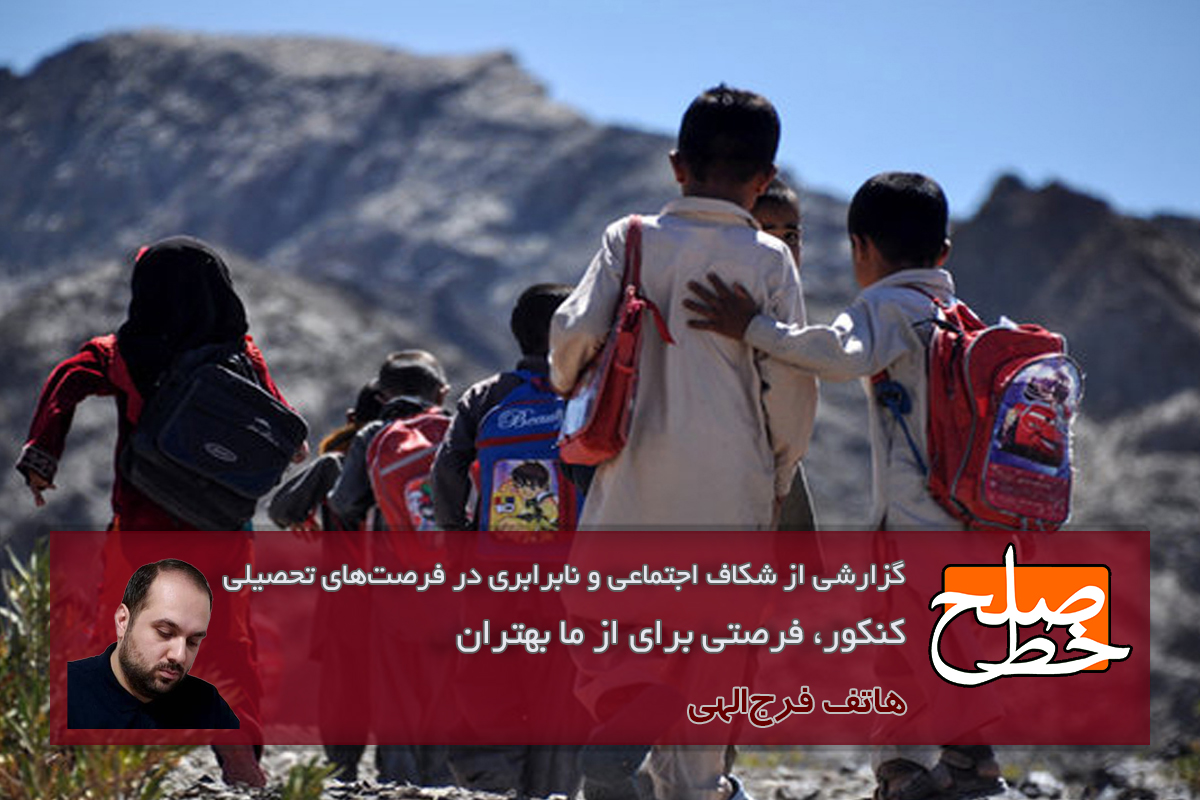
“A Report on Social Gap and Inequality in Educational Opportunities/ Hattaf Farajollahi”
“Konkur, an opportunity for us to become better”
A few days ago, Saeed Reza Ameli, the senior secretary of the Cultural Revolution Council of the Islamic Republic of Iran, announced in an interview with Hamshahri Online: “Eighty-four percent of the accepted students in the top three thousand ranks of the entrance exam are among the top ten percent in the field of economics, and eighty-six percent of the accepted students in the fields of medicine, dentistry, and pharmacy also belong to this group.” The issue of access to educational facilities, which ultimately leads to admission to university, has been the subject of the past decade of higher education and the entrance exam; a barrier that seems to have been disrupted by rent and mafia, making it difficult to access free and equal education and creating a deeper divide among different social groups.
New students should bring a referral for registration.
Inequality in educational opportunities in our country is not a new issue, but in recent years, this inequality has become so widespread that it is no longer hidden and the gap between ordinary people and the wealthy in educational opportunities is becoming deeper day by day. This may have come to the attention of many parents that in order for their children to be accepted in the entrance exams and achieve high rankings, they must choose special schools for their education; schools that are not accessible to all social classes.
Rumors suggest that these schools offer guarantees to parents to ensure their children’s acceptance in the university entrance exam, in order to persuade them to pay exorbitant tuition fees and enroll in the school. But can these guarantees really lead students to higher levels of education, or do they promote credentialism and lower the level of knowledge and awareness in society?
Therefore, we went anonymously to several non-profit high schools in Tehran, each of which receives significant tuition fees from parents to bring desired results for their children. You will read about some of the conditions of these schools in the upcoming report.
An interesting point to note is that many of these schools did not accept new student registrations under any circumstances and some even required a referral for enrollment. Among these, some schools also make the registration process easier to some extent due to the significant financial contributions they receive from students, but the conditions for admission to these schools are still difficult.
One of the schools’ education officials explained: “Enrollment in the school must be done in several face-to-face sessions between the student and the school officials, and after the school administrators get to know the student, it will be possible to enroll in this school.”
In response to the question of whether there is a guarantee for students to achieve a satisfactory rank in the university entrance exam if they attend this school, he said: “Most students attending this school achieve their desired ranks and every year a considerable number of students from this school are accepted into reputable universities in the country; therefore, parents can confidently enroll their children in this school.”
It was not left unsaid that most officials of non-profit schools in Tehran believed that students should be evaluated precisely in their first year of high school and after evaluation, work on them for acceptance into desired universities begins. However, they did not provide a proper explanation about whether this evaluation is only scientific or not, and what exactly working on the student means.
Another one of the officials of these schools said, “The student must have a reference for enrollment in this school; in a way that this school must confirm the managers and previous schools, and then the student should refer for enrollment with a letter of introduction from their previous schools.”
Fifty million tuition fees, excluding additional expenses.
These are in cases where the average tuition fees of these schools are over fifty million tomans and with the consideration of current expenses that the school imposes on parents throughout the year, the annual tuition amount increases; of course, the approved tuition for the current academic year has not yet been announced by the Ministry of Education, but many of these schools, especially high schools, are outside the approved amount and under various excuses, they take money from families.
The question here is whether these schools can truly elevate the academic level of society or are they only focused on their own income from the exam? It seems that the national exam has been pushing the country’s educational community towards a specific type of education that the government has in mind; that is, educating individuals who are mostly from the upper classes of society and are somehow related to the ruling authority.
But this is not the only problem in this exam, and the more important issue is that students are pushing themselves in any way possible to succeed in this exam, because they believe it can determine their future. Therefore, access to schools that claim to have a high chance of acceptance in the entrance exam is a desire for every student who wants to have access to top universities in the country. As a result, parents who have the financial means to support their children and pay the exorbitant tuition fees of these schools do not turn a blind eye to enrolling their children in them, and once again we will see that children from wealthy families have more opportunities to achieve high rankings in the entrance exam and enter prestigious universities.
What mechanism determines the higher scores of children from wealthy families for acceptance in the entrance exam? Non-profit schools enter this competition and use various techniques such as consecutive exams, communication with previous years’ exam question designers, and holding summer and extra classes to emphasize the importance of the entrance exam for students more than it actually is, in order to continue their profitable activities. These activities undoubtedly require an exam like the nationwide entrance exam, and if one day this exam and its controversies are eliminated from the country, we will see a high percentage of these schools being left behind.
Based on this, it can be understood that what is referred to as the “conquer mafia” is not an organized institution, but rather a collection of small and large foundations and non-profit schools that can generate income through the existence of the entrance exam (konkur) and are willing to spend whatever is necessary to prevent its elimination. The foundations that organize konkur classes are also not exempt from this rule and fight alongside non-profit schools to ensure the survival of the exam and strive to maintain its importance.
As mentioned, non-profit schools are one of the most important factors in creating unequal educational opportunities in society. Undoubtedly, these schools and foundations, in addition to providing high-quality educational facilities, also benefit from government and governmental relationships; for example, the education department of each region is responsible for preparing a list of schools every year and making it available to parents. Among these, if non-profit schools have special relationships with the officials of that organization, they are placed at the top of the list of recommendations.
The next question is: Can these opportunities, which are only available to wealthy families, bring the country’s level of education to a desirable position? Educational experts believe that achieving a high rank in the entrance exam cannot guarantee a person’s academic growth; because most of the individuals who obtain high ranks in this exam through attending classes with the sole purpose of passing the exam, do not have the necessary knowledge for further education and the knowledge they have gained is only for the purpose of succeeding in the exam and does not have much use for them after the exam.
Imagine the condition of students who, with the high expenses of their parents, the insistence of their relatives, and the teachers and administrators of non-profit schools, have obtained high rankings in the Konkur exam and have entered university; students who, in many cases, have no interest in the fields they have been accepted into.
These students, through the type of education they have received, strive to pass exams and achieve high rankings, as well as obtain their desired qualifications. Many of them forget the main subject, which should be acquiring knowledge, and ultimately enter the job market with high rankings and qualifications but without sufficient knowledge; a job market that today in our country is witnessing the presence of individuals without significant knowledge and expertise more than ever.
However, among them, students who had suitable capacities for acquiring knowledge and participating in critical social activities, due to their parents’ financial inability and unequal opportunities, are not able to obtain the necessary scores for studying at their desired universities. And what about those individuals who, with these considerable capacities, turn to false occupations.
As a result, we can look at the situation in a way that creating unequal opportunities for wealthy families and eliminating educational opportunities for other classes is one of the most important factors in the decline of scientific progress and the level of knowledge in society. As long as the acquisition of astronomical incomes continues to create these opportunities, we cannot expect educational equality to be possible.
Therefore, many political institutions and figures who have access to the necessary resources, engage in establishing non-profit schools; because they know there is a great profit in this business. It is possible that the influence and power of these individuals who own non-profit schools and educational institutions, is what prevents the government from abolishing the entrance exam and they do not allow this profitable table to be removed; a table that benefits only a select few and brings about a decline in scientific progress and social division for the rest of society.
 By: Hatef Farajollahi
 July 22, 2022
Tags
Education and training Entrance exam Exam class Free education Monetization of Education Monthly Peace Line Magazine Paragraph peace line Right to education Telephone operator