


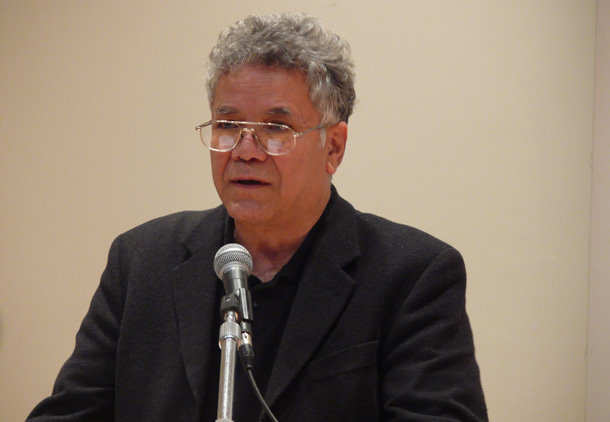
Abbas Samakar: People are not in favor of violence.
A proposal regarding human rights and the February 1979 revolution.
In light of the Shah’s conviction and the report from the International Red Cross Organization regarding the use of torture on political prisoners by SAVAK in prisons as an example of human rights violations, to what extent were the concerns of the revolution and revolutionaries about human rights standards and principles? How much did the slogans of the revolution refer to human rights concepts? In terms of human rights and freedom of expression, what was the situation in Iran before the revolution in February 1979 and what was it like after? What were the main reasons for the people’s protests? Some believe that the revolution itself cannot be free from violence; but what is considered violence in reality? Do you consider yourself a revolutionary today or someone who adheres more to human rights standards?
“These are the questions that we have wanted to find answers to different perspectives on, so that we may ultimately come to a unified conclusion. Therefore, we have approached a group of political and social activists who were involved in the political and social events in Iran during the late 1950s; most of these individuals were also victims of human rights violations before and after the February 1979 revolution.”
Abbas Samakar, a poet, writer, and filmmaker who was sentenced to execution in 1352 along with Khusro Golshakhi and several others, is one of the individuals who has answered our questions in this proposal and is appreciated for his cooperation…
At that time, under the title of human rights issues, problems were not taken seriously. The main concern was not about how these issues were being evaluated and judged – I don’t care about that – but rather that the Shah’s regime had no tolerance for people’s participation and involvement in their own social and economic issues. It was believed that what was dictated must be done and people should obey. In no area did he accept that people have the right to act independently. This is why if an individual or a group protested in any way, they were immediately arrested and subjected to torture in prisons. They were sentenced to long-term imprisonment and depending on the severity and type of their protest, there was a possibility of execution. In many cases, prisoners were denied visits from their families. Generally, relationships within prisons were also limited, meaning that any movement or communication between prisoners was considered a conspiracy against the police and prison guards. The prisoner would be interrogated and if they did not provide the necessary information
The reactions of the Shah’s regime in prison were generally of this nature. Of course, suppression also took various forms and it was not just imprisonment and torture; there were also various boycotts, unemployment and exile.
I do not consider a specific group as revolutionaries and believe that the revolution is the work of the people and the masses; meaning that a particular group, whether willing or unwilling, does not make a revolution. Therefore, in my view, in any social struggle, there are various motivations including class, political, and social issues. I think that in our society, during the February 1979 revolution, there was a structural change in the class structure of our society, the middle classes were growing, many workers and laborers were marginalized in the production sector and were unable to compete with the new agricultural products that were being imported and sold in the society, so they moved to the outskirts of cities and became job seekers. These issues, especially after the rise in oil prices in 1973, resulted in them being attracted to work in industrial projects or the service sector and living their lives in this way. But whether they wanted it or not, this kind of marginalized life could not attract them to
After the overthrow of the military, administrative, and judicial rule of the Shah regime, in the first year, since the Islamic Republic regime had not yet been established, the people enjoyed the highest level of social freedoms. The existence of various white-covered books, newspapers, tapes, formation of gatherings, etc. were examples of these wide social freedoms that could not be easily suppressed. However, with the terrifying influence of Ayatollah Khomeini among the masses and urban dwellers, and with the mobilization and organization of military forces in committees, they tried to overcome it and the conflicts and disputes lasted for 2-3 years until finally, on June 30th, 1981, they established their own rule over society and began to suppress social and political freedoms by massacring political prisoners…
I am not someone who adheres to the concept of human rights as it is presented. I still consider myself revolutionary and a supporter of the revolution. Human rights standards are not enough for comprehensive freedoms. For example, these standards accept exploitation and private ownership, which in my opinion, is one of the foundations of injustice and a violation of human rights in the world. The rule of law must exist in all areas and also in the economy and livelihood.
On the one hand, it is natural that people are not in favor of violence. People do not want execution, massacre, or imprisonment, and they certainly want to have a peaceful and humane life and have the opportunity to satisfy their hunger without being humiliated or oppressed, and have a bright future ahead of them. But the reason that revolutions are inevitably drawn towards armed action is because regimes use force to suppress the desires of the people. It is not the people who want to establish their demands through violence, but it is the regimes that do not respond to the wishes of the masses and force the people to overthrow the rulers. You cannot ask the soldier, the gunner, or the military personnel who have pointed their guns at you to leave! They do not leave even if you beg and plead, they will kill you. In my opinion, revolution is not considered violence. Because revolution is a movement to prevent violence and is a defensive argument.
Many consider resistance against regimes as violence, but they do not consider state violence as violence. And even if they do, they do not provide a proper solution to confront it, which is not the case. For example, in 2009, people simply wanted to demand their rights from the government, but the government stood against them and the people resisted against this issue, even though they did not have guns, tanks, or weapons.
 By: Admin
 February 24, 2015
Tags
Abbas Smakar Magazine number 46 Monthly Peace Line Magazine Simin Daytrip The Revolution of Bahman 57 Peace Line Monthly