


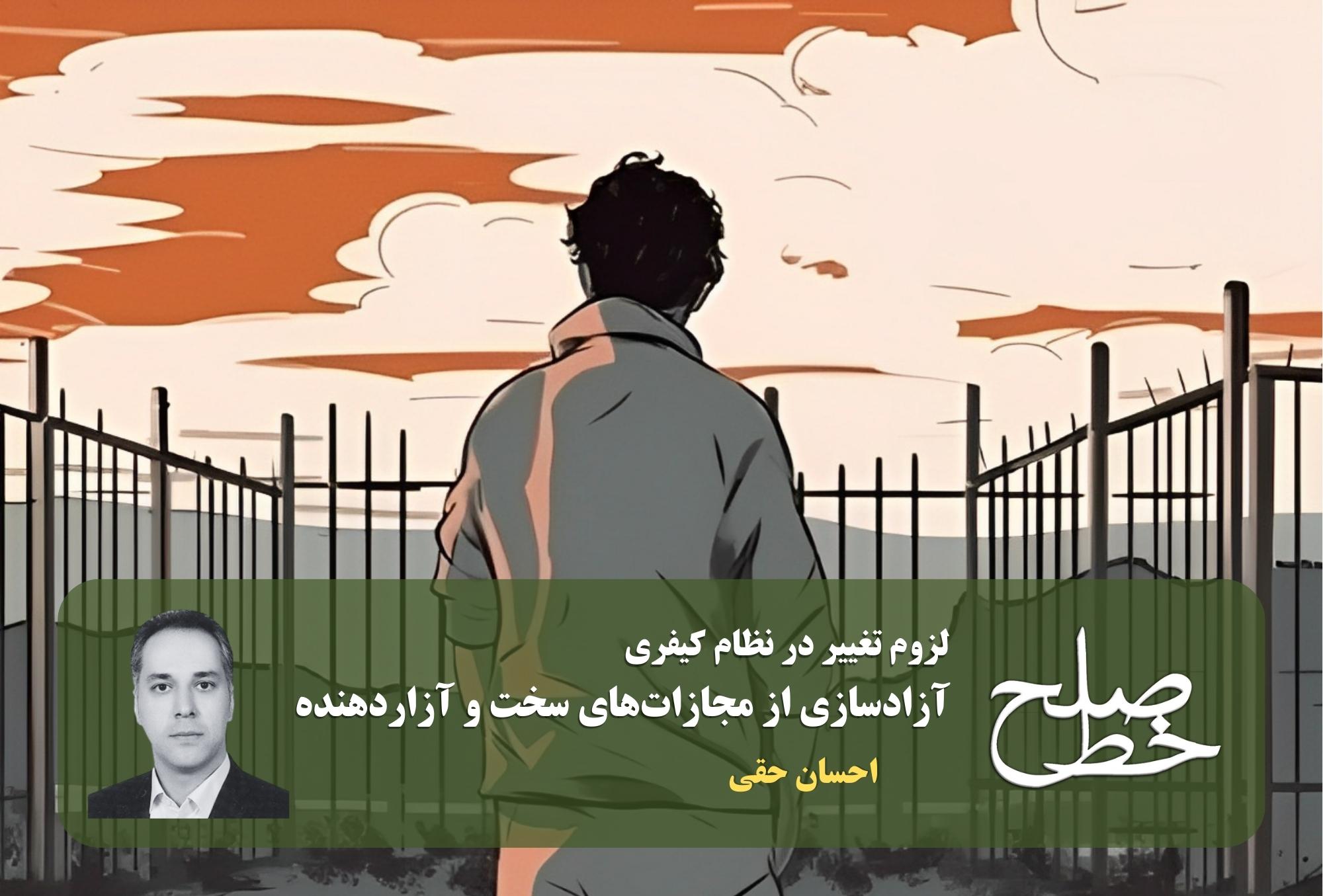
Liberation from harsh and oppressive punishments / Ehsan Haghani
One of the punitive reactions that currently exists in all criminal systems as a legal punishment is deprivation of freedom or imprisonment. This punishment is accompanied by harsh conditions for prisoners and these harsh conditions are considered part of the legal punishment. For example, the legislator has prescribed “imprisonment with hard labor” in the General Punishment Law of 1304 (influenced by the 1810 French Punishment Law) to impose these harsh conditions.
Gradually and under the influence of new approaches in criminal law and criminology, and a change in attitude towards the concept of punishment, the imposition of harsh and oppressive conditions on criminals during their sentence has been abolished in most criminal systems around the world. The Iranian legislature, also influenced by these advancements, in 1352 (1973) and through an amendment to Article 8 of the General Penal Code, stipulated: “From the date of implementation of this law, none of the criminal imprisonments will be accompanied by hard labor, and instead of life, perpetual, or permanent imprisonments with hard labor, permanent imprisonment will be imposed, and instead of temporary or non-permanent imprisonments with hard labor, first-degree criminal imprisonment will be determined, and instead of solitary confinement, second-degree criminal imprisonment will be imposed.”
In addition, concerns about human rights and the efforts of intellectuals and activists in the field of human rights have led to the inclusion of rules, standards, and recommendations in international documents to prevent the imposition of harsh conditions on prisoners; including in the “Standard Minimum Rules for the Treatment of Prisoners” adopted at the first United Nations Congress on the Prevention of Crime and the Treatment of Offenders held in Geneva in 1955 and endorsed by Economic and Social Council resolutions 633 (July 1957) and 2026 (May 1977). In one section of this document, it is stated: “The treatment of convicted prisoners or prisoners subjected to any other measure should be such as will strengthen their will to lead a law-abiding and self-supporting life after release and to become a useful member of society. The nature of such treatment should be such as to instill in the prisoner a sense of dignity and responsibility.” In another section, it is also stated: “Imprison
Based on what has been said, the policy of transferring prisons outside of cities, which has recently been pursued with special attention by the judicial authority of the Islamic Republic, contrary to its stated political and security objectives (which are not the subject of this discussion), goes against the findings, principles, and criminal and human rights rules, and undoubtedly will have negative and unpleasant consequences for society. The transfer of prisons outside the city limits, which mainly have limited access to basic amenities (such as clean drinking water, sanitation and medical facilities, sewage disposal systems, etc.), imposes difficult conditions on prisoners that go beyond the legally prescribed punishment, and in addition, creates problems and difficulties for the families of prisoners, which is in no way justifiable and is an example of punishment without fault. It should be noted that although legally, the judicial authority is obligated to transfer prisons and correctional facilities outside the cities (approved on 2001/11/28), but this legal obligation (despite the twenty-one-year
 By: Ehsan Haghi
 June 22, 2023
Tags
Accused Criminal system Ehsan Haghie German Harsh and severe punishments Judiciary Monthly Peace Line Magazine peace line Peace Treaty 146 Prison Prisoners The relocation of prisons. Torture 2