


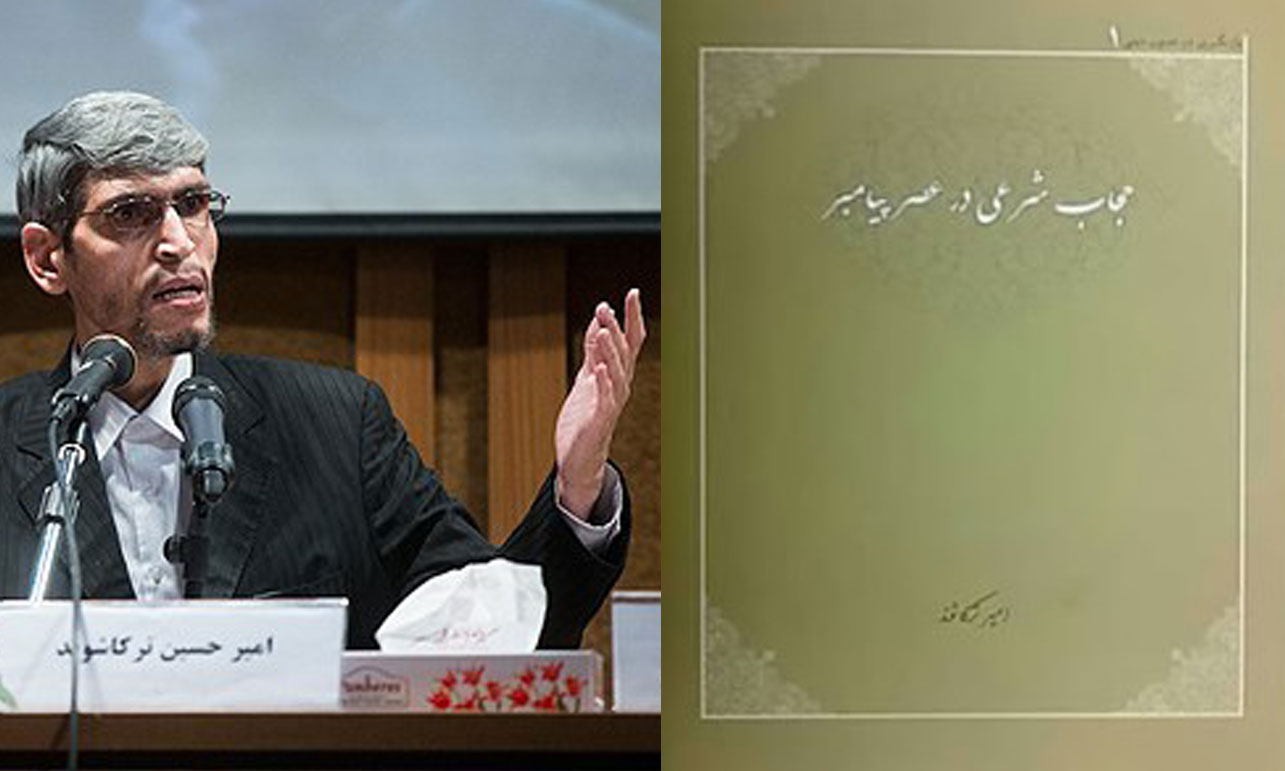
Book Introduction: The Islamic Veil in the Time of the Prophet
The controversial book “Islamic Hijab in the Time of the Prophet”, written by Amir Hossein Tarkashvand, is a research on the Quran and religious texts. The book, which did not receive a permit from the Ministry of Culture and Islamic Guidance and therefore has never been officially published, was released in the virtual space and made available to interested readers in the spring of 2011. The author challenges the concept of hijab for Muslim women and argues that Islam does not insist on covering women from non-mahram men. His hypothesis is that the Islamic hijab during the time of the Prophet was not as strict and only required covering the chest, arms, and legs, and that Islam does not insist on covering women from non-mahram men.
Mr. Turkashvand, who is writing his preface for his book, states: “In this research, I am attempting to depict the perception of Muslims regarding the level of proper hijab for faithful women of that time, and in this regard, I will explain the obligatory and permissible areas of uncovering, such as the face, palms, hair, neck, arms, feet, and legs, in accordance with the prevailing laws at the beginning of Islam.” He also mentions the purpose of the book, stating: “The main goal of this book is to demonstrate, firstly, what parts of their bodies people used to cover with clothes before the Prophet’s mission, and which parts were left uncovered, and ultimately, to obtain the reaction of the Islamic society, led by the Quran, towards it.”
The mentioned book has three main sections: “Section One: The Pre-Islamic Dress Code and Muslims’ Reaction to Hijab”, “Section Two: Discussions about Quranic Verses”, and “Section Three: Jurisprudential Discussions (Examining the Compatibility of Jurisprudential Opinions with the Level of Religious Hijab in the Time of the Prophet)”.
In the second section, an example of an argument that rejects existing interpretations of Quranic verses is related to verse 31 of Surah Noor: “And tell the believing women to lower their gaze and guard their private parts and not display their adornment except that which is apparent, and to draw their headcovers over their chests” [they should draw their headcovers over their chests]. This does not indicate the obligation of covering the head and neck, but rather the intention is for women to cover their body openings with fabric, meaning the purpose of the verse is to cover the private parts (and possibly in addition, the space between the breasts). However, as a third possibility, the intention may be to cover the openings of the garment (through which the private parts of women are visible). The reason for this interpretation is that firstly, the word “khimar” does not necessarily mean headscarf, but can refer to any type of clothing (especially a long garment used to cover the
In the third section, where the opinions of jurists regarding hijab are discussed, while the popular view of jurists regarding the hijab of women, which is “covering all body parts except the face and hands,” is incorrectly interpreted, evidence from the statements of some jurists from the tenth and eleventh centuries is presented, which shows that the necessary level of hijab according to them is “covering the chest, thighs, and arms,” and even in the fourth century, a jurist ruled that the necessary hijab for women is “covering the private parts.” The author argues that Islam, based on the concern to prevent free sexual relationships in society, has determined this level of hijab and the discussion of hijab has no connection to modesty and chastity.
Amir Hossein Torkashvand stated in one of his book review sessions that: “Hijab should not be confused with clothing. Hijab is not clothing; clothing is based on climate, heat and cold, and can be more or less, while hijab is for covering parts of the body that showing them would lead to sin. We must know which body parts must be covered and which ones would create sin by showing them.”
من یک کتاب خوانده ام
I have read a book.
Book Name: The Islamic Veil in the Time of the Prophet
Author: Amirhossein Torkashvand
Publication date: 1390
 By: Hossein Torkashvand
 August 23, 2018
Tags
Amirhossein Torkashvand Hijab Introduction to the book Monthly Peace Line Magazine peace line The Islamic veil during the time of the Prophet. پیمان صلح ماهنامه خط صلح