


Monthly Peace Line Magazine

A controversial statement and against all principles / Morteza Hamounian
The constant reform of existing laws, especially in the judicial realm, has had its own ups and downs; particularly in Iran, only 112 years after the Constitutional Revolution. A revolution that had one of its main demands the establishment of a House of Justice. Its decree was issued by Mozaffar ad-Din Shah Qajar, but the […]...
Read More Created By:
Admin
Created By:
Admin June 22, 2018
The problem of removing security labels from political files / Mohammad Mohabi
This is a caption This is a caption Mohammad Mohabbai The new Criminal Procedure Code, which was approved in 1392 and had beneficial changes and new legal provisions for the criminal justice system, remained for further amendments in the ninth parliament. Between 1392 and 1394 (the date of implementation of this law), new articles and […]...
Read More
Created By:
Mohammad Mohebi June 22, 2018
Is it a political crime or a government-appointed crime? / Ibrahim Noori
This is a caption This is a caption. Ibrahim Noori After a long delay, the law on political crimes was finally approved about 40 years after the February 1979 revolution. This sparked discussions about the definition and examples of political crimes, as well as the serious implementation of Article 168 of the Constitution through the […]...
Read More
Created By:
Ibrahim Noori June 22, 2018
اییDefending the University/ Majid Daryaei
The university, due to its inherent nature – which is avant-garde and influential – has always been coveted; whether by the government or the opposition. The government tries to control it and use it for its own benefit. However, its rebellious and critical nature stands against it and always pays the price for it without […]...
Read More
Created By:
Majid Dori June 22, 2018
Book Introduction: Dancing in Brazil with the Devil
“Brazilian Dance with the Devil” is one of the five books by Dave Zirin, a renowned American sports writer and editor of Sports Illustrated magazine, who has a unique perspective on sports. This book, which is the result of Zirin’s research and observations from the World Cup in Brazil, has a non-sports tone and tries […]...
Read More
Created By:
Admin June 22, 2018
The bill that has become a victim like children; in conversation with Mohammad Ismail Saeedi, member of the Cultural Commission of the Parliament.
Last year, among the events related to the violation of children’s rights in Iran, news of kidnapping, harassment, and murder of children caught attention. In the early months of this year, news of children being tortured by their family members has become hot topics. However, all of these cases indicate a lack of a comprehensive […]...
Read More
Created By:
Admin May 22, 2018
Examining Shari’a’s Perspective on the Rights and Dignity of the Deceased; in Conversation with Mohammad Javad Khalili/ Ali Kalai
This is a caption این یک عنوان است. This is a caption. Conversation with Ali Kalai Mohammad Javad Khalili, holds a PhD in Political Science and is also a graduate of Hawza studies from the Qom Seminary. He has been conducting research in the field of Islamic political thought and the Arab world for years, […]...
Read More
Created By:
Ali Kalaei May 22, 2018
The relationship between collective memory and collective graves; in conversation with Raha Bahraini and Shadi Sadar/ Simin Ruzgard.
Simin Rouzgar “Conquering the collective memory is an action that many ideological governments have undertaken in order to impose their desired narrative of history. Milan Kundera, in one of his famous stories called “The Unbearable Lightness of Being,” writes: “The struggle of man against power is the struggle of memory against forgetting.” This renowned […]...
Read More
Created By:
Simin Rouzgard May 22, 2018
Monireh Baradaran: Destruction of mass graves is an international crime/ Siavash Khoramgah
Monireh Baradaran Khorshahi is a writer and researcher who herself has experienced years of imprisonment and torture during both pre- and post-revolution periods of Azar 57. She is the sister of Mehdi Baradaran Khorshahi, a leftist activist who spent more than seven years in prison before the Azar 57 revolution and was executed in 60 […]...
Read More
Created By:
Siavash Khoramgah May 22, 2018
Legal rights of the deceased; desecration of graves/ Mohsen Kadiour
. Mohsen Kadiour The dead have the same legal rights as the living. They have the right to not have their graves destroyed or desecrated. But is this right for everyone, or only for righteous believers? Is it permissible according to Sharia to destroy the graves of individuals who, in some way, are considered enemies […]...
Read More
Created By:
Mohsen Kadivar May 22, 2018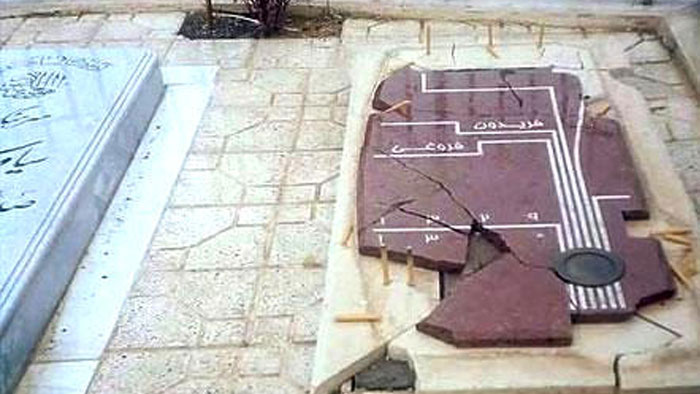
“Living Against the Dead/ Reza Najafi”
A commentary on the phenomenon of destruction of graves in Iran. “بهترین راه برای پیشرفت، شروع کردن است.” “The best way to progress is to start.” Reza Najafi Heinrich Heine, a German political poet who lived in exile, wrote a poem in 1820: “Where they burn books, they will also burn humans sooner or later.” […]...
Read More
Created By:
Reza Najafi May 22, 2018
Looking at the dignity of non-Muslims’ corpses, between two perspectives / Mojtaba Lotfi
“متن فارسی را به انگلیسی ترجمه کنید” “Translate the Farsi text to English.” Mojtaba Lotfi In Islamic thought, there are two perspectives on human beings: the traditional view and the human rights view. A person is either a Muslim or a non-Muslim. Muslim cemetery In the religious perspective, just as a human being is respected […]...
Read More
Created By:
Mojtaba Lotfi May 22, 2018
