


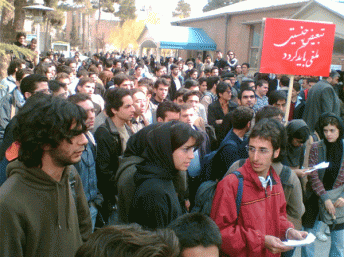
Gender segregation or discrimination!?

Since the time when in Iran, the traditional schools gave way to modern schools and the clergy, who were the administrators of these centers, lost one of their important bases and intellectuals became their successors in the educational institutions, a historical conflict between the seminaries and modernism and the university as a modern institution began. Intellectual opposition is one of the main characteristics of seminaries and since the clergy saw the university as a factory for producing intellectuals from its inception, it was natural that after the victory of the 1979 Revolution, they would not allow the university to continue its natural course. At the same time as the Cultural Revolution, which was nothing but an effort to eliminate the brain of this modern institution, the long-term project of gender segregation was initiated by separating girls’ and boys’ schools and its implementation in universities aimed to turn this modern institution into one of the subordinates of the seminaries. Recently, a new phase of segregation in the educational space has begun under the banner of
After thirty-some years since the day Ayatollah Khomeini struck the “will of integrity” with his cane and declared, “If we had broken the corrupt regime from the beginning… if we had broken the pen of all the media… if we had raised the sticks in the big squares… this effort would not have been necessary” (1); discriminatory behaviors continue, with recent examples including separating textbooks by gender, segregating some girls’ schools by creating inner courtyards, cutting off the heads and breasts of female mannequins, prohibiting women from sitting in a row of seats behind the bus driver, banning women from entering stadiums, and approving a bill in support of polygamy.
A brief look at history shows that traditional clergy has always been in conflict with the education of girls, and although it was defeated in this battle after the Constitutional Revolution and was pushed to the sidelines until the 1979 Revolution, with the return of religious fundamentalists to the scene of power, we are witnessing a gradual regression of women in society and the implementation of reactionary programs, such as gender segregation, which has another goal besides confining women to domestic imprisonment. This is the final phase of attacks that have been designed against them in the past thirty years and aim to isolate women in the university, the last remaining stronghold outside the home. Unfortunately, the university is the only place where Iranian women can connect with the outside world and now, by dividing it in two, at least half of their facilities have been lost and they are truly under attack. Undoubtedly, with the full implementation of gender segregation, the academic level of female students will decrease.
Currently, educational spaces are suffering greatly from the lack of specialized teachers and educational facilities. The implementation of this plan will only widen the gap of this scientific and material poverty, and it is not unlikely that female students will also be deprived of these limited facilities. Considering the dominance of male culture in the job market, women have a small share in it and undoubtedly, the full realization of the gender segregation plan will eliminate this narrow waterway, and the share of women in the job market will decrease while the number of them becoming housewives will increase.
The first vice president of the Islamic Consultative Assembly says: “If someone enters our house now, there is no veil between them and our family, and our schools must have both external and internal divisions.” (2) This division of society into internal-external (or masculine-feminine) will only lead to the consolidation of male dominance and the obligation of women to perform repetitive and remedial tasks.
A few days ago, in line with completing the project of control and discrimination, Mohsen Gharaiati, the head of the National Prayer Headquarters, addressed the university presidents, saying: “Create an environment where student marriages and temporary marriages can be facilitated, and create a space in universities where girls and boys are separated from each other to reduce millions of sins.” (3).
In recent years, the gender equality movement has been very active in universities and undoubtedly its implementation will eliminate it from within and the separation of male and female students will destroy the unity that has been achieved after years and there will be no more cooperation in work. In other words, gender segregation has become the Islamic name for the same gender discrimination that has prevented the powerless sexual class from creativity and has veiled it.
Resources.
1- Speech by Ruhollah Khomeini on 18 August 1979, at the Islamic Center of Washington.
2- Speech by Mohammad Hassan Abuturabi Fard, 17 Esfand 1387, Jamjam.
3- Mohsen Ghorbani’s Speech, September 11th, 2012, Hamshahri Online.
 Admin
Admin December 26, 2013