


The end of poverty, soon.

“When President John F. Kennedy, fifty years ago, was striving for peace, he said to the Irish Parliament: “The problems of the world cannot be solved by the doubts or negativity of those who have limited horizons and are faced with obvious realities. Today, we need men who have dreams of things that have never been and ask why not?”
Today, people are increasingly wishing for a world without poverty. In April, the Development Committee at the World Bank announced the goal of ending extreme poverty by 2030.
Recently, the United Nations General Assembly’s Sustainable Development Goals group also expressed their opinion: “Eradicating poverty in the world is a lofty but achievable goal.” As someone who wrote in 2005, our generation is one that can put an end to extreme poverty, and I am proud to see this idea taking root at the highest levels.
Are these just illusions of haste, confusion, and rooted in the struggles and changes in the weather, or is the widespread trend towards the idea that has recently emerged from real things? The evidence supports the optimistic view. The evidence also supports both perspectives; both the perspective of those who value the market and the perspective of those who believe more in the strategy of public ownership (meaning national ownership or the Scandinavian model of social democracy where all major companies are national, unlike America where everything, including the military, is made up of private cartels). These are essentially appendages of a content.
The global image will definitely amaze negative-minded people. According to the World Bank report, the number of households living below the poverty line in developing countries (currently measured at $1.25 per person per day based on international prices) has been decreasing rapidly; from 52% in 1980, to 43% in 1990, and 21% in 2010; even the countries in sub-Saharan Africa, which have the highest poverty rates, have experienced a significant decrease from 58% in 1999 to 49% in 2010.
Indicators are prominently present in the field of health. According to the latest UNICEF study in September 2013, the mortality rate of children under five in Africa has decreased from 177 deaths per thousand births in 1990 to 155 deaths per thousand births in 2000 and to 98 deaths per thousand births in 2012. The indicators are still high, but progress is accelerating.
When there is no suspicion in the mentioned statistics, the question will be: How can we ensure improvement in income, health, and other dimensions of poverty eradication (in addition to access to education, safe drinking water, electricity, and sanitation) will continue until the end of extreme poverty in the world. It must be acknowledged that heated debates and arguments usually generate more heat than light.

The foundation and basis is economic growth, and therefore the market economy is vital. Poverty in Africa has decreased, due to the fact that the economic growth rate has increased from 3.2% in the black years of 1970 to 2000, to 7.5% in the period of 2000 to 2010. Without economic growth, stability in income and health improvement cannot be achieved. Continued progress is dependent on major infrastructure – water, electricity, and waste management – which in turn requires financial support from the private sector on a large scale and, of course, a suitable market framework.
Therefore, anti-market sentiments do not have a positive impact on reducing poverty, while a free market approach will not be suitable either. Economic growth and poverty reduction cannot be achieved solely through a free market. Disease control, public education, advancement and introduction of new knowledge and technologies, and environmental protection are public functions (meaning that they should be carried out with the participation of the public). It is obvious that when we talk about a free market, the opposite point in this world is the presence of the government in the economic sphere. Therefore, these public functions should be combined with private market activities.
Consider two key points in recent poverty reduction: first, the introduction of mobile phones, which has revolutionized communication and many other aspects, from remote villages in Africa to the streets of Manhattan, New York.
Furthermore, smartphones have aided in the transfer of knowledge, medical care, financial matters, and agricultural supply chains. The control of malaria has become possible through the use of new technologies, the introduction of long-lasting insecticide-treated bed nets, rapid diagnostic tests, and a new generation of effective drugs, all of which have had a crucial impact on reducing poverty in Africa.
In both cases, the presence of the private sector is necessary, not only for innovation and development of technologies, but also because this sector is able to promote and distribute these achievements in the short term. Hundreds of millions of mobile phones and mosquito nets have helped reduce poverty in rural areas in recent years.
Now the private sector also holds a sensitive position; public budgets are essential for sciences and development of technologies. A global budget is necessary to combat diseases such as AIDS, tuberculosis, and malaria. The agency supported by the international community has played a crucial role in the widespread distribution of mosquito nets, resulting in a 30% reduction in malaria. Mobile phone applications, supported by both the public and private sectors, are widely used by healthcare workers.
It can be said that the fight to end poverty actually helps create a new form of integrated capitalism. Old debates between public and private spheres have now been replaced by new strategies that encompass both. The need for both is now more urgent, as climate change and water scarcity continue to worsen. It will also prove that the belief in bold global goals requires bold actions, and that pessimism and negativity are wrong. A world committed to ending extreme poverty will have effective creativity and will take action.
As Kennedy stated half a century ago: “By clearly defining our goals – by emphasizing more control and reducing disparities – we can help everyone see it and draw hope from it and move forward in an unbreakable way.”
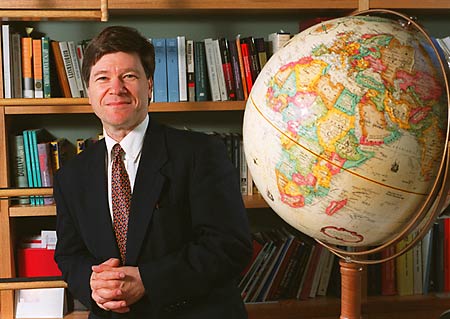
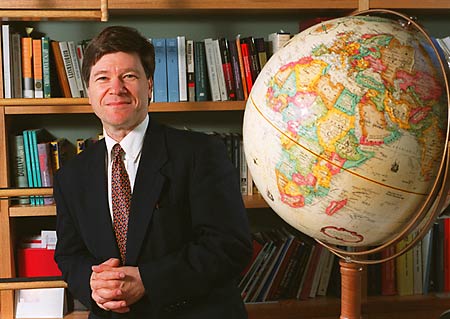
Jeffrey Sachs: Economist, Director of the Earth Institute at Columbia University, and Special Advisor to the UN Secretary-General on the Millennium Development Goals and several African countries, including Ethiopia, Kenya, Nigeria, and Uganda.
Geoffrey Sachs, who has a high influence in the world of politics and fame, introduced his most important and ambitious project called “The Millennium Villages Project” in 2005. According to this project, he promised to fight against the root causes of poverty in these areas by creating a series of villages as a model for the rest of Africa. It was planned that these villages would demonstrate the impact of targeted actions in providing healthcare, education, and employment, which keep many people in the world trapped in poverty. This project has had many supporters and opponents so far, especially from a methodological perspective.
 Admin
Admin November 25, 2013