


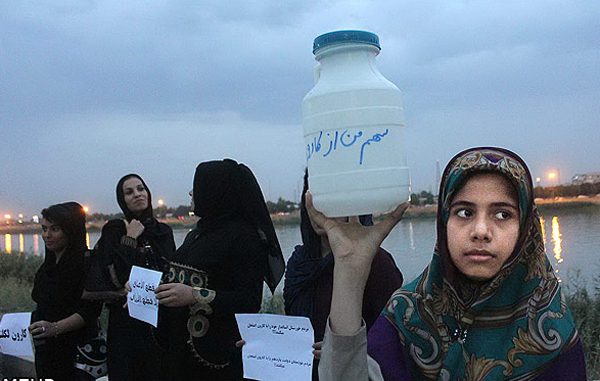
Karun, a half-dead river that flows to Isfahan with its remaining life.
“We need Karun water to revive the Zayandeh Rud. Everything from this conversation and interview with the new governor of Isfahan, Rasoul Zargarpour, published by Iran’s Water News Network, and his 9-hour visit to the ongoing project of the third Koohrang tunnel to transfer water from Karun tributaries to Isfahan, sparked a debate and argument between Isfahanis and Khuzestanis on social media.”
How can we sit and watch as our beloved Isfahanis suffer from the plunder and death of Karun, filled with anger and memories, while their fellow citizens, who couldn’t even bring a few small pipes to transfer water to the farmers of Yazd, responded with bulldozers and hammers? How long will the statesmen and people of Isfahan continue to beat the drums of their greed on the resources of the Iranian people? How long must the people of our land be sacrificed for the political games that only benefit a few cities and provinces, while our hero Khorramshahr, with its martyrs and fortresses, still lacks drinking water? How long must the citizens of Khuzestan, deprived of even the most basic necessities of life, bear the burden of the wealthy cities and statesmen? This is the same Khuzestan that is a part of Iran, and from this part, its people are only given wounds, pain, and pollution from

This is only a part of the sharp response and open letter of 155 artists, political, social, civil and environmental activists from Khuzestan to Mr. Hassan Rouhani, the President of Iran, and Masoumeh Ebtekar, the head of the Environmental Protection Organization. It was published in less than a few hours after Mr. Zargarpoor’s statements, the governor of Isfahan, were released in news agencies and quickly spread in Ahvaz market and received strong support. Abdul Hussein Mokhtadi, the new governor of Khuzestan, was also put in the spotlight, to the point that Ms. Masoumeh Ebtekar quickly announced her opposition to this transfer during a short trip to Khuzestan and added: “Despite the political pressure groups that enter for their own interests, the decision to build a dam and transfer water is not solely within the authority of the Environmental Protection Organization.”
The story did not end here and environmental activist groups in Khuzestan, with the release of a statement, invited people to participate in a human chain called “Karun Rescue Chain”. The Khuzestan Governor’s Office also showed its full support for this gathering by publishing an interview with Abdolhossein Moqtadayi, the governor of Khuzestan, on Fars News Agency.
The first gathering of Ahvazis was held on the second Friday of Aban month, with the presence of more than ten thousand people on the banks of Karun river. The participants, in complete calmness and holding placards in both Persian and Arabic, chanted slogans such as “We are all for Karun”, “Take the air from me, not Karun”, “Karun is the red line” and “We will save Karun”, showing their opposition to the transfer of Karun river water. In response to the environmental movement in Ahvaz, both domestic and international media, including Iran’s national broadcasting, covered the news of this gathering. However, the plan for the third tunnel in Kuhrang and the construction of dams on the branches of Karun river still had the support of the Ministry of Energy and the Isfahan governorate on the government’s agenda…
“Strongly worded speech by Seyyed Sharif Hosseini, representative of the people of Ahvaz in the parliament, and the news of the mass resignation of 18 representatives of Khuzestan, which was withdrawn through the mediation of other representatives, laid the foundation for the next gathering and chain of support for Karoun. On November 9th, with the presence of over 20,000 people from Ahvaz and cities such as Abadan, Khorramshahr, Bandar Mahshahr, and Shadegan, as well as prominent artistic and sports figures from Khuzestan, including Seyyed Sharif Hosseini, representative of the parliament, Abdulhossein Moqtadaei, governor of Khuzestan, and members of the Ahvaz City Council, the gathering was held. The protesters once again demanded the complete halt of the plan to transfer Karoun water to Zayandeh Rud, chanting the same
But a few days later, Masoud Asadi, the head of the Agricultural Trade Organization of Khuzestan province, in a letter to Ayatollah Mousavi Jazayeri, the Friday prayer leader of Ahvaz, and Ayatollah Shafiei, published on the Khuznews website, revealed more behind-the-scenes details of this incident and the biased dismissals and appointments in the Water and Power Deputy of the Ministry of Energy, governorships, and water resource management of the country.

Dr. Ghomshi, a professor at Ahvaz University and an advisor to the governorate of Khuzestan, also spoke out against this water transfer in an interview with the mentioned news agency, saying: “First, the Karun River can fully meet the agricultural needs of Khuzestan. Second, the transfer from the Karun River will affect the energy production of five large power plants located along the route and will cause major damage to national interests. Additionally, the cost of transfer is extremely high. For example, in a case where a 60-kilometer tunnel must be built at depths ranging from 300 to 1200 meters, a minimum cost of seven trillion tomans must be spent, while with this investment, nearly one million hectares of land in Khuzestan can be irrigated, using pressurized irrigation methods. On the other hand, reducing the flow of the river creates serious environmental problems and issues downstream, in Khuzestan.
The Karun River is the only river in Iran that connects to international waters and the ocean. It is also the only navigable river in Iran. In the past, the name Karun was associated with joy and life in Khuzestan. However, due to incorrect environmental policies and multiple non-standard dam constructions at the source of the river, it has now become a low-water river that is slowly dying. In 2009, due to the transfer of over 100 cubic meters per second, the source of the Gotvand Dam was diverted to Isfahan, resulting in a drastic decrease in water flow and an increase in salinity levels, reaching more than 30 units above the standard level for several months. This has caused a major environmental disaster for the ecosystem of the riverbed in Ahvaz. Ismail Kahrarm, an environmental expert in Tehran, stated in an interview with Radio Farda: “The Gotvand Dam has caused the Karun River to
And now, from the Karun River, which was once a symbol of life in a land where summers reach over 60 degrees and severe air pollution caused by local dust storms, and the normality of oil and petrochemical pollution from Iraq, nothing remains but a half-dead corpse whose transfer of its remaining life to Isfahan can forever extinguish the light of life in the hot and war-torn homes of Ahvaz, Mahshahr, Abadan, and Khorramshahr. The remaining joy of the dusty streets of the oil and gas-less people of a land whose homes are built on oil barrels and memories of eight years of war, and who still lack access to city drinking water.
 Admin
Admin December 26, 2013