


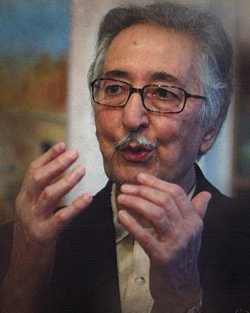
The role of human rights in the 1957 revolution in a conversation with Abolhassan Banisadr.
What was the position of human rights in the discussions of the 1957 revolution? Did the Iranian society generally recognize human rights? Or if they did, did they value it? How did the revolutionaries view human rights? In the following conversation with Abolhassan Banisadr, the first president of Iran, we will inquire about his opinions on this matter.
Dear Mr. Banisadr, if we were to have a dominant discourse or statement for every revolution, just as the dominant discourse in the American Revolution is freedom or in the Soviet Union is equality, what was the dominant discourse in the 1957 Revolution?
The nationalization movement of oil had two guiding principles: independence and freedom. Independence meant freeing Iran from foreign domination and establishing a national and Iranian government, while freedom meant eliminating the despotic nature of the government and establishing national sovereignty and a representative government for the people. After the coup of 28 Mordad, a dispute over principles arose and four major tendencies emerged in society. One tendency prioritized freedom, which was manifested in the second national front with the slogan of establishing a rule of law. Another tendency prioritized independence, which included nationalistic tendencies. The third tendency sought both independence and freedom, and most of the Mossadegh supporters fell into this category. The final tendency was the leftists, who prioritized social justice. After 1942, Ayatollah Khomeini entered the scene with the slogan of Islamic primacy, while the Pahlavi regime also emphasized progress as its main slogan.
But the Iranian Revolution fundamentally presented a new definition of balance. Islam encompassed freedom of independence, freedom, growth, and social justice, and from this perspective, the priority of Islam over these principles was also lost. Because without including these principles, Islam becomes empty. Unfortunately, Mr. Khomeini put aside Islam as a symbol of freedom. He had taught the concept of Vilayat-e-Faqih in Najaf, but not in the sense of what is now ruling over Iran, but in the sense of the rule of Islamic laws. According to his teachings in Najaf, people are in the position of minors and the Faqih is responsible for their leadership. After Mr. Khomeini’s arrival in France, seventeen issues were raised by the world media, and among these seventeen issues, the role of clerics in the next regime and the danger of religious fascism are of interest to me. The proposed solution was for Mr. Khomeini to step down from Vilay
The steadfastness of Mr. Khomeini against the elected president was a new form of confrontation between the clergy and the people. For example, Mr. Kashani also stood against Mossadegh and opened the way for coup and foreign interference, but this confrontation was between a clergyman and a national leader. However, Mr. Khomeini’s coup was a major confrontation between the clergy and Islam as a symbol of freedom. This blow caused the clergy to start thinking about a rights-based Islam, for example, Mr. Montazeri published a booklet on human rights a few years after the publication of the book “Rights and Judiciary in Islam”. These days, I am reading a book published in Iran under the title “Religious Veil in the Time of the Prophet” which tries to correct a religion that has been imposed on Muslim countries based on patriarchy. Similarly, there is an important transformation taking place in the principles of religious guidance. Finally, there have been discussions about the
“You mentioned the four principles of independence, freedom, growth, and social justice as the dominant discourse in the 1957 Revolution. From the perspective of revolutionaries and society, where did the discourse of human rights rank among the dominant discourses in the Iranian Revolution?”
There were two major currents. For example, the ideology of the left currents was Marxism-Leninism. They believed that human rights were bourgeois formulations. Shia and Sunni jurisprudence, on the other hand, is a jurisprudence of obligation, not rights. In this jurisprudence, humans are obligated, but beyond these two currents, there were those who supported proletarian dictatorship and those who supported the righteous oppression. Tendencies in favor of independence and freedom considered human rights to be of great importance, as evidenced by the formation of the Human Rights Defense Committee during the revolution. We had been abroad for a long time, under the leadership of Jean-Paul Sartre, we had formed a committee to defend political prisoners, a committee that was formed at our request and with his consent, and defended them equally regardless of the tendencies of political prisoners. Similar committees existed in other countries as well, because it was very necessary to show the people of the world how indifferent the Shah regime
I must remind my young compatriots of an important issue at this time, when we did not think we would have a disagreement with the clergy about human rights. Our assumption was that jurisprudence is the epitome of human rights, we did not know that this is not the case and that jurisprudence is, in fact, duty-oriented.
Is your defense of political prisoners and clerics directed towards defending human rights or advancing the fight against the Shah regime, Mr. Banisadr?
I explained that the defense of human rights from the perspective of prominent Western figures was the only option, meaning we did not expect more from them because it was a universal defense. A good example of this was our defense of the rights of mass prisoners, even though we did not agree with them and even considered them traitors, we still defended them based on human rights. We even defended some clergy who were not actively fighting against the Shah’s regime, but from our perspective, they were still human beings and we defended their rights. In our view, human rights were above one’s thoughts and actions, even if they were a criminal.
In the second half of the 1950s (years 55 to 60), how was the concept of human rights perceived by the majority of society? In other words, did the general public and revolutionaries hold human rights in the same universal sense as today? Or did they view it as a religious right for all people? Did they recognize Islamic human rights as the Islamic Republic does today? Or did they generally reject the idea of human rights as a Western or even colonial concept?
At that time, Islamic human rights were not even mentioned. Initially, it should be noted that the Universal Declaration of Human Rights was drafted by representatives of the three major religions through an agreement. This declaration does not exclude any religion and has been agreed upon by these religious representatives. The ambiguities in this declaration are due to the different perspectives of these three religions, which have caused some parts to be left ambiguous in order to reach an agreement. At that time, this declaration was referred to and there was no mention of Islamic human rights.
After June 15, 1981, two French lawyers came to me and said that we can defend the human rights of Iranians under the oppression of the Mullah regime whenever we want. They say that Islam has its own rights. What is the meaning of these independent rights? This means that I wrote the book of human rights and judgment in the Quran, which has been published in different languages. It has also been translated into Arabic, but no Arab country has allowed its publication. This lack of publication is very telling, because Arab leaders are afraid that Muslims will know that the Quran contains a complete list of human rights.
You have stated in the book “The Right to Judgment and Humanity in the Quran” that the human rights mentioned in the Quran are more complete than the Universal Declaration of Human Rights. Do you still hold this belief?
Yes, I have listed more than fourteen principles in that book, which are present in the Quran but not mentioned in the Universal Declaration of Human Rights. The Universal Declaration of Human Rights, human rights from the perspective of Islamic scholars and the human rights that I have extracted from the Quran have been compared in a book and it has been concluded that the most comprehensive and unambiguous statement of human rights is the human rights that have been extracted by Ibn Sadr from the Quran.
These are related to after the revolution, during the revolution it was assumed that the clergy would respect human rights, but if they do not adhere to more than the Universal Declaration of Human Rights, they will do so. But in practice, not only were human rights not addressed for them, but even human life had no importance. Let us remember the famous words of Mr. Khomeini or Mr. Gilani who used to say that if the people we kill are innocent, they will go to heaven.
You believe that besides certain groups such as the leftists and some clerics, the majority of Iranians recognized the values of human rights during the years of revolution in accordance with the Universal Declaration of Human Rights. How is it possible for a society to value human rights, yet easily impose mandatory hijab or execute thousands of political prisoners without any hesitation?
There is an important issue here, I have written a book called “Universal Despotism” or “Totalitarianism” which is in the process of being published. In it, all forms of totalitarianism, from its ethnic form to its contemporary forms such as Nazism, Fascism, and Stalinism, have been identified. One of the studies conducted is related to Germany. At that time, Germany, in terms of education level and the power of left and liberal political organizations in Europe, was leading the way. However, in such a country, the Nazi party came to power and established a universal despotism. In the Iranian Revolution, people understood and demanded freedom and independence, and wanted a system based on independence and freedom. But accepting the idea of independence and freedom is one thing, and acting on it is another.
It seems that your intention is for the people of Iran to recognize human rights, but the totalitarianism of the Islamic Republic has created an atmosphere where this idea has been forgotten for a long time.
Exactly. Since people did not act in this direction, Iranians were much more prepared to return to obedience to power than Germans were to Nazism. Iranians had a revolution, but human nature is such that if the revolution is not firmly established and the pillars of power are not rebuilt, the revolution will be lost. This is not unique to Iran; it was also the case in the French Revolution, and in Russia, where it was not a revolution but a coup by Lenin that led to the same situation. At that time, people were regularly warned, but unfortunately those who should not have built the pillars of power did so. New pillars of power, such as the Revolutionary Guards, Basij, Jihad of Construction, Revolutionary Courts, and Committees were built and placed alongside the old pillars of power.
“These [events] brought society back to obedience to power, and know that they did not do this easily. In this regard, the history of Iran reports a great transformation, with the hidden collusion of Reza Shah and Boosheh, the coup of Khordad 60, keeping Iran in eight years of devastating war and sacrificing a generation, and establishing the tyranny of mass killings and executions. It has been thirty years that they have been at war with this nation. Therefore, this Iranian society has shown more resistance against widespread tyranny than the German society did against Nazism.”
Now it is clear that what is against this regime is the people’s inclination towards democracy. Although most people who want freedom also desire power. Michel Foucault says that a type of power discourse is democratic power discourse, meaning the power that secures its legitimacy from the people. But the freedom we desire is for society to perceive power as anti-values and for relationships within society to be based on human rights, and for international relationships to be defined based on national rights. Although freedom of expression is not well-known in Iran, this country has the experience of electing me as president by the people and fighting against the pillars of power, which is an alternative to the tyranny of totalitarianism with totalitarian tendencies.
During your presidency, you have repeatedly witnessed and condemned various human rights violations in Iran. A famous example of this is presenting four hundred photos of post-revolution tortures to the representative of Amnesty International and speaking about the six prisons. If these actions can be considered a defense of human rights, what proactive steps did you take at that time, such as educating citizens or institutionalizing efforts to improve human rights?
“Coincidentally, we focused more on the positive aspects. I went from city to city and explained to people about the four principles of independence, freedom, growth, and social justice. During the presidential election, I also told people that if they agree with these principles, they should vote for me, because I am not prepared for any other work, and seventy-six percent of the people voted for these principles. I went from city to city and talked about women’s rights. No one in the history of Iran has made as much effort as we have for the status of women. We have also achieved great accomplishments, regularly assessing thoughts and measuring men’s behavior towards women, and researching actions that can accelerate this transformation. In the one or two months before the coup, the assessment of thoughts showed that the desired transformation was progressing, to the extent that the relationship between the husband and wife in Iranian families had largely shifted to a cooperative relationship. My book, “Women and Marriage,” is the most
Please compare the human rights situation during the Pahlavi era and the Islamic Republic.
Translating to English:
The violation of human rights in the current regime, which is neither a republic nor Islamic, is more widespread and damaging than ever before. Firstly, it is done in the name of religion, a religion that is of no use if its goal is not to express rights. The expression of power, which is nothing but censorship, enslavement, and massacre of people, does not need religion. Humans have created and continue to create infinite systems of power. Religion is meant to grant humans freedom, independence, and their own rights, and to rid society of conflicts. Religion is meant to create a society with a logical structure, activate motivating forces within itself, and allow humans to grow. Transforming such a religion into what it has become now is not just a simple crime, it is an indescribable crime.
The dissolution of a great and cultured nation and the destruction of a great historical opportunity, at a time when two superpowers were disintegrating and the international arena was opening up to Iran, is a great crime. The young society had the necessary capital, could have had rapid growth, and today could have advocated for the expression of human freedom and the realization of human growth, not just the growth of capital or power. These atrocities are incomparable to the atrocities of the Pahlavi regime.
Thank you for participating in this conversation.
 Admin
Admin February 3, 2014