


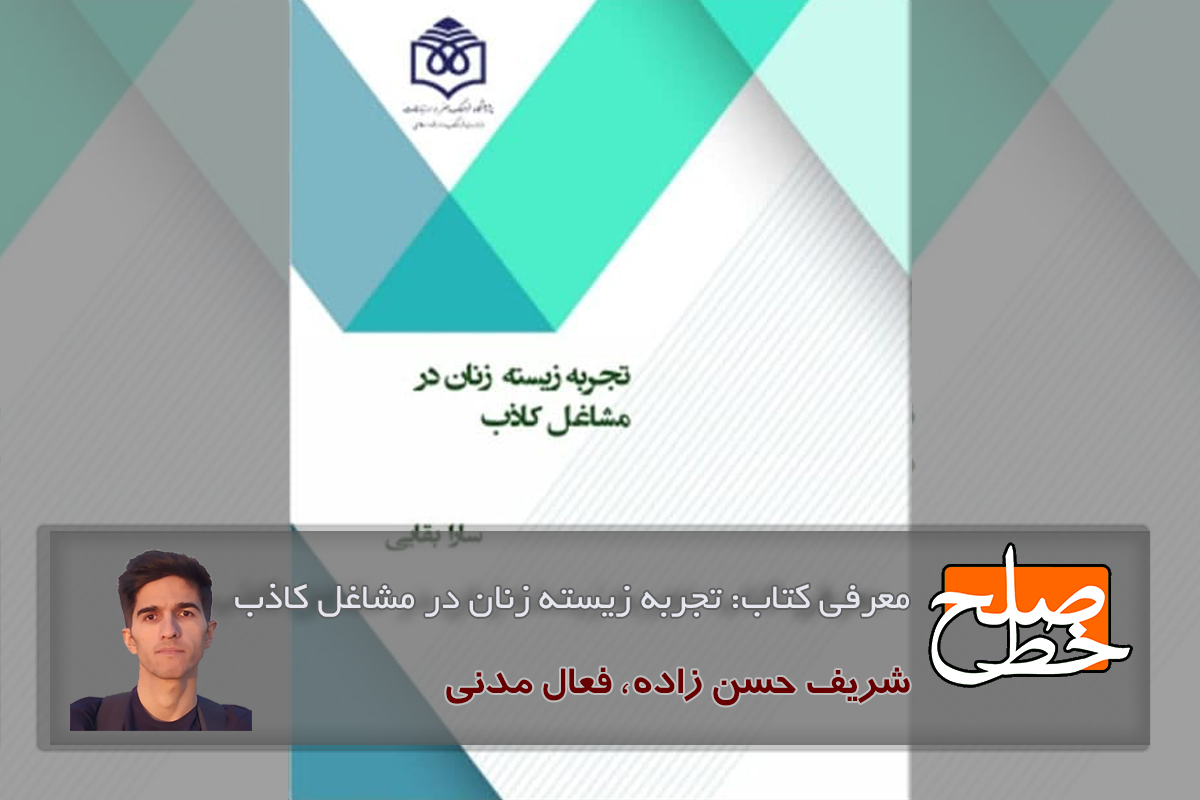
Book Introduction: Women’s Lived Experience in False Professions/ Sharif Hassanzadeh
When talking about women’s work and employment, inequality against women and any topic related to gender becomes a dominant perspective, and a cliché view of how much we should talk about women and how much their situation has improved today is taken into account. Today, perhaps in comparison to a hundred years ago, the situation of women in Iranian society has improved, but this improvement is an absolute matter that has happened in all global dimensions and quality of life. However, when it comes to a relative perspective and comparing the situation of women to men, considering the current conditions of Iranian society, we realize that we still have a long way to go.
Activities that are not in line with social norms or do not meet the individual’s satisfaction and do not provide economic sufficiency due to lack of necessary stability, cannot be considered as a job or profession, but rather they are referred to as secondary or fake jobs.
Despite significant progress in recent decades, the job market remains segregated by gender and it seems that progress towards gender equality has stalled. Women’s participation in the workforce is lower than men’s and they are more likely to be employed in unpaid jobs. Even when they are employed in positions with rights and benefits, they are often hired in informal and low-paying sectors. They often face discrimination and pay disparities compared to their male colleagues.
The book “Women’s Experience in False Jobs” describes the conditions of women in false jobs, who officially have no role in production and lack fixed rights, insurance, and legal conditions. Therefore, the experience of Tehran’s female marketers has been examined in this book. The author has investigated the experience of female marketers in dealing with marketing, methods of employment and entry into the profession, difficulties and challenges, the type of confrontation with challenging conditions, positive and negative aspects of marketing, as well as the attitude of male employers towards female marketers.
This book discusses how marketing has become a feminine profession that has significant effects on women’s identities. Despite the democratic and modern processes of supply and demand in this field, where individuals enter through job advertisements and without any prior connections or referrals, problems and lack of proper supervision have created subsequent challenges in this profession, accompanied by specific conditions.
The author considers factors such as high market demand, easy entry, lack of expertise, lack of commitment, part-time work, etc. as reasons for women entering this profession. They also list social unacceptability, low job status, use of tools, loss of privacy, and lack of government laws and supervision as problems faced by women in this profession.
The concept of identity (based on true and false self, self-expression and self-censorship), insecurity (social, economic, psychological, sexual and ideological), lifestyle (based on financial needs, habits, pleasure, ambition and modernization), work experience (with features such as work norms, belief in the ideal company, hard work, profit logic, hierarchical investment, involvement and exit, and gaining experience), survival mechanism or performance strategy (rethinking identity), and unawareness (of marketing mechanisms as well as labor rights and laws) are the main themes resulting from the study of women’s lived experiences in this book.
In a section of the book, the author writes about the “conditions of written employment” from the experience of two women.
26-year-old woman: “It didn’t matter much to me whether it was a secretary or marketing, but the thing was that I was usually not accepted for secretarial positions. For example, one time I went for an interview with a friend – it was a law office – and my friend was a well-dressed person with a good appearance, so they scheduled a second interview with her and talked to her for half an hour and forty minutes, but for me, it was enough to be a scapegoat to be rejected.”
31-year-old woman: “In reality, the first thing that exists in many informal jobs is the type of confrontation with the employer. Many employers I have seen want their marketing to have a show that attracts customers.”
The first chapter, titled “Overview,” discusses women’s employment in informal spaces, its importance, necessity, and research goals. Chapter two includes “Identity and Women’s Life Politics in Informal Jobs” and “Comprehensive Cognitive Approaches to Entering the Women’s World in Informal Jobs.” In chapter three, the author writes about “Women in the Economy of Iran.” The title of the fourth chapter is “The Lived Experience of Women in Marketing,” which includes topics such as background factors, finding a job, unwritten employment conditions, job advertisements, interviews and employment conditions, job status and conditions, factors that encourage women to enter marketing, women’s difficulties in marketing, positive consequences in social relationships and women’s lives, employers, marketing issues and problems, characteristics that attract women and good marketers. In the final chapter, the author analyzes and concludes the subject, and suggests ways to improve the employment situation for women and preserve their identity in society, such as making it mandatory for all university
Book Name: Women’s Experience in False Professions
Author: Sara Baghaei
Publisher: Institute of Culture, Art, and Communication, Ministry of Culture and Islamic Guidance
Publication Year: 1399
 Created By: Sharif HassanZadeh
 January 21, 2022
Tags
False occupations Introduction to the book Monthly Peace Line Magazine Peace Line 129 Sara Baghaei Sharif Hassanzadeh The lived experience of women in fake professions. ماهنامه خط صلح