


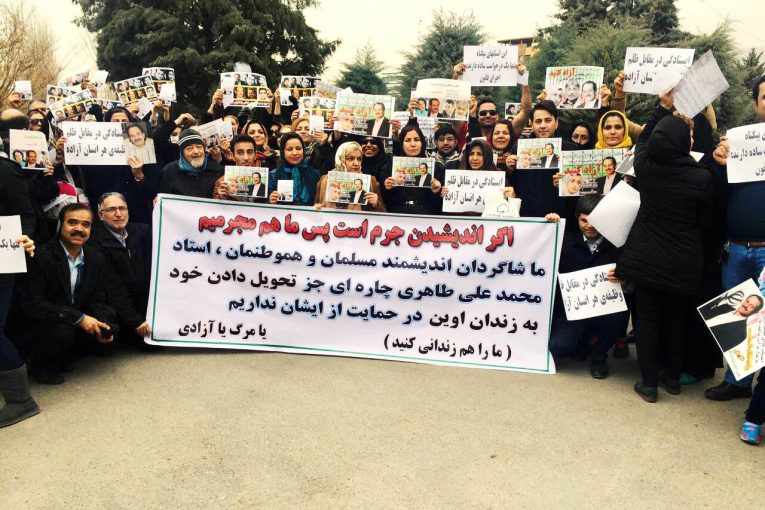
How can we reverse the destruction and execution? / Reza Alijani
“این عکس یک پسر کوچک در حال بازی در پارک است.”
“This photo shows a little boy playing in the park.”
Reza Alijani
The issuance of a cruel death sentence for Mohammad Ali Taheri once again highlights the issue of torture, punishment, and even execution for “belief” in the judicial and security system of the Iranian government.
The issuance of such laws and punishments in the judicial and security system and the creation of the current power in Iran is unprecedented. From the abduction and disappearance of Baha’i leaders at the beginning of the revolution, to the official execution of other leaders and the arrest and imprisonment of many others; the chain killings for religious reasons (such as the late Forouhar in Mashhad, or a number of Sunni scholars in different parts of the country, or the assassination of some priests during this period, or the issuance of heavy sentences and execution for some Kurdish cultural activists and the like) are not uncommon. And finally, the systematic massacre of leftist prisoners in 1988 based on the fatwa of apostasy is another example of this dark and gruesome point.
But what are the roots of issuing such heavy and harsh judgments?
It is evident that at times, religious rulings are used solely as justification for political executions. Similar to what happened to leftist prisoners during the Black Summer of 1967. The same ruling was used in the chain murders that targeted writers, or in the death of political activist Payvand Davani.
But what is the reason for this fear, hatred, and resorting to murder and execution? One root of this issue goes back to conspiracy theories and false beliefs about political and ideological opponents, who are believed to have secret connections with foreign enemies and are carrying out their plans for cultural destruction, soft overthrow, infiltration, etc.
Another influential factor in the formation of these violent and inhumane encounters is the security forces’ belief in the “government of terror” and their use of fear tactics to create a sense of isolation and cemetery-like security in society (victory through terror). It is necessary to suppress and harshly deal with any fear that would prevent individuals, thoughts, or movements from pursuing their goals that are deemed contrary to the system!
“Hatred” is an important element in the political discourse that governs power and the judicial and security apparatus. The critic and opponent in this view is not just an individual with flawed and deviant beliefs, but rather a mysterious and vile entity that pursues evil goals and has hidden, secretive, and complex relationships with foreigners.
The use of the term “foreign enemies” by the founder of the system from the beginning of the revolution and labeling any critic or opponent as mysterious and devilish “foreigners” is one of the important symptoms of this disease.
However, this political-security perspective not only serves the purpose of “preserving the system” from the evil enemy, but also carries traces and roots of ancient jurisprudential principles. Jurisprudence has deep roots in the intellectual apparatus of power. The characteristics of this important source (jurisprudence) have also been transferred to the political and judicial apparatus of power.
One of the most important characteristics of the dominant intellectual approach in jurisprudential thought is narrow-mindedness, dogmatism, and rigidity. Throughout history, jurists have formed the drier, more inflexible, and harsher part of the colorful spectrum of Islamic approaches (such as philosophers, mystics, theologians, etc.).
The issuance of fatwas on apostasy and death (which have sometimes been carried out by certain jurists in appropriate circumstances and with power) has a deep-rooted history in the civilization of Islam against scholars and philosophers.
In later years, during the Safavid era, one of the most important descendants of the current clerical system, Ayatollah Majlesi, made great efforts against the Sufis and caused them to be driven out of Iran to India. He wrote numerous articles against the Sufis and mystics, using a tone full of sarcasm and hatred towards them. He said, “Satan has made it obligatory for some of the Sufi innovators to abandon the consumption of animal meat, which is against the path of Sharia. They sit in a hole for forty days and weaken their powers, allowing illusions and fantasies to take over their minds. They are deluded by these false thoughts due to the weakness of their minds, thinking it is perfection!” (1)
The issue of “innovation” and “apostasy” has been one of the most important weapons of the jurists against any kind of internal and external religious deviation. In the current power structure of Iran, the tool of apostasy has also been used extensively for political and security purposes to enforce violence. The discussion of apostasy itself is another matter.
When the founder of the Islamic Republic faced criticism from the National Front regarding the Retribution Bill, he responded with political anger and intolerance, labeling it as “apostasy” and bringing it into the political arena.
Apart from the legal aspect and the use of harsh legal tools as a cover for political suppression and domination through fear, there is also another layer of dealing with intellectual and religious dissent: fear of organization and gathering.
Those who have dealings with security apparatuses know how much they fear gatherings and organizations. When someone speaks individually – even if they express the harshest criticisms against the government – it is less sensitive until it becomes a collective and group work. Of course, sometimes hatred against certain individuals can also be seen in the judicial-security apparatus, but the dominant line of information is more afraid of organizations and groups.
They imagine an organization that can be completely harmless and even entertaining nowadays, but later on and in crisis situations, it can become a security threat. That’s why they try to control and dominate even the fan clubs and organizations of some popular sports teams. For example, for a long time, the management of a fan club of one of the popular teams in the capital was under the control of one of the officials of the Revolutionary Court (Seyed Majid Pourseif), who was a well-known figure for the nationalist-religious groups whose cases were in Branch 26 of the Revolutionary Court.
Because of this, the security apparatus is afraid of the “gathered fear” of the “dervishes” who generally have no interest in politics and are even sometimes anti-politics. Although anti-ism also has ancient roots in dervishes, since in the current power structure in Iran, the use of selective jurisprudence is sensitive and meaningless and the harsh treatment of dervishes is mostly rooted in security perceptions and fears.
In the veins and roots, it is only a matter of thought and jurisprudence, but one can also refer to the characteristic of monopolistic profession of the clericalism, which considers any other religious approach as a kind of market stagnation. This is where, as the saying goes, sometimes “enmity among brothers is more intense”!
Fear and inhumane treatment towards Mr. Mohammad Ali Taheri, despite the fact that he was initially approved, encouraged, and promoted, was mostly due to the fact that he gradually gained social influence and reach, which made the tentacles of the conspiracy and the intimidating thoughts of security officials sensitive.
And finally, we must also mention another element in the behavior of the security system. It is an element that arises from a characteristic that I call “rationality of Lampani”. In this type of “logic” of behavior and “practical reason”, authorities believe that they must “reduce the prisoner’s burden”!
In this context and approach, a person who remains steadfast in their position and particularly considers it a legal matter, must be respectful and sit in their place, otherwise it will lead to weakening and humiliation of the intelligence and security apparatus. “Reconciliation” has various roots, one of which is this approach and rationality of Lampani.
One reason that after years, even the danger that the authorities assumed could threaten the security of Tehran’s streets if the leaders of the Green Movement were released, has now been resolved. However, they still remain under illegal and inhumane house arrest. It is this same logic that they must repent and their power must be reduced, otherwise their freedom will be a sign of our defeat! Turning every challenge into a win-lose competition is one of the characteristics of this ideological system, which unfortunately has also dominated our irrational and anti-national foreign policy. Comparing the relationship between Iran and America to a ship that must have one winner is an example of this situation.
Finally, we must mention a secondary but sometimes influential element, which is the personal vendetta of some interrogators against the accused in their custody. This vendetta, in the past, has sometimes resulted in long imprisonments and even the deaths of some prisoners at the hands of the judicial-security apparatus interrogator Salar. However, nowadays, due to the influence and expansion of social networks and the empowerment of the “public opinion” institution, it has become very difficult for these types of interrogators and the judicial-security apparatus interrogator Salar to carry out their work.
In conclusion, it can be said that the way to combat such behaviors and harsh and inhumane laws is through intellectual enlightenment that exposes the violence of religious jurisprudence, the resistance of prisoners against illegal behavior and excessive demands of the security apparatus and backward and narrow-minded interrogators, effective public opinion shaping to increase the political cost for the perpetrators and supporters of such medieval behaviors, and ultimately the use of various civil methods by various civil institutions to push back against this destructive and terrifying phenomenon, which is currently spreading in Iranian society.
The journey of dealing with the Baha’is, from secret abductions to public executions, and from issuing prison sentences to the point where some children of powerful individuals openly and bravely visit their former cellmates, shows a difficult, challenging, and costly path, but one that is positive and leads towards a better future. The way of life and the environment of political prisons from the 1990s until now, and similar examples, are enough to prove that continuous effort, cultural, political, and civil resistance will eventually bear fruit and push death and destruction back. Although only a small portion of this path has been taken and there is still a long way ahead.
Notes:
 Created By: Reza Alijani
 September 27, 2017
Tags
Mohammad Ali Taheri Monthly Peace Line Magazine Mysticism circle Reza Alijani ماهنامه خط صلح