


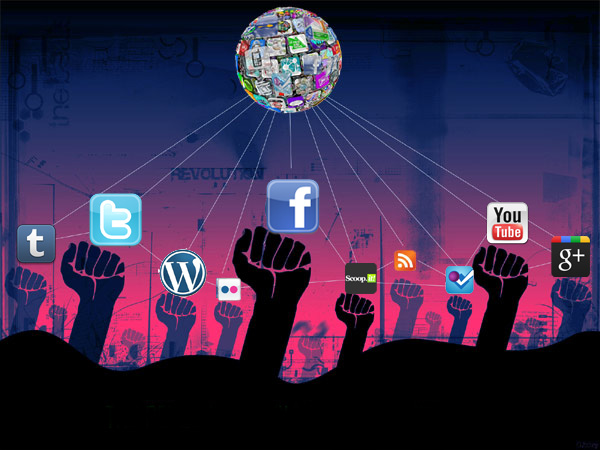
Social networks, the arm of powerful social movements/ Elaheh Amani
This is a caption
This is a caption.
Goddess Amani
In recent decades, the field of political science and social movement studies have paid very little attention to the important and key role of communication and the mechanisms of communication tools in shaping and sustaining protest movements. However, today – especially in the light of social media networks – communication, how it is established, and the tools that make it possible, have received attention. Social movements are a process of modernity, industrial society, urbanization, technological advancements, and democratization of human societies. These characteristics have led citizens to openly seek change in the dominant social order outside of official institutions of governance. The conflicting actions of individuals and social groups for their demands, access to resources that are valuable to them, and defense of marginalized parts of society, have criticized official institutions and given social movements the credibility to express structural contradictions in the social system that emerge with political, cultural, and social tensions and crises. As social movements are dynamic and fluid, their members are potentially ready to disrupt the dominant social order. Achieving
The modern social movements, in other words, the process of globalization of capital and neoliberal policies, have turned the world into a vast “production line” with the intention of maximizing profits for capital supporters and multinational companies. They have ruthlessly exploited natural resources and utilized the labor force of women in poor countries – who are the cheapest labor force in the world. Modern technology and communication have created the basis for a new global order, with the speed of information transfer and a complex network of financial transactions. However, modern technology and the ease and speed of information transfer have also opened the way for social movements and their capabilities. In the light of modern technology, social movements – especially modern social movements – have become more inclusive, transnational, non-religious, non-ideological, and demand-oriented, and have gained new trust and power. The globalization of capital and the global production line have made the convergence of popular movements inevitable and have given a transnational dimension to many of these modern social movements.
Classical and modern social movements have commonalities, but they also have differences in various areas. The origins of class, age groups, and dominant trends in communication regarding the May Day protests, which take place in many countries around the world, and the actions of the social movement for workers’ rights are different from those of modern social movements such as environmentalist movements, the right to access modern technology, respect for the human rights of individuals with different gender identities, and LGBTQ+ rights. These diverse and extensive struggles for human rights and gender equality, fighting against xenophobia, and more, have distinct characteristics.
In the world of the 21st century, we are witnessing the rise of new social movements that sometimes cast shadows on class divisions and are beyond ideological divides. Since the mid-20th century, right-wing and reactionary forces, independent of political parties, have emerged as growing political forces in the world. These forces, including extremism in various religions, racism, xenophobia, and the fight against gender diversity, are growing in Europe and America. Right-wing Christians, fascist forces, and neo-Nazis are among the social movements that share common characteristics and have used modern technology to promote their beliefs and theories. They openly and blatantly encourage violence, exacerbate social tensions, and confront media, journalists, social media networks, intellectuals, and other social groups. Additionally, the group ISIS, using social media, guides the discontent of young people, even in the Western world, towards their own right-wing, reactionary, and anti-people goals.
If it is said that in the cultural history of humanity, after the invention of writing, no event has been as significant as printing, it is because it opened the locks of treasure troves of knowledge and brought down the walls of monopoly. The internet, with its much wider dimensions, has made possible the harmony and convergence of information distribution channels and communication platforms, including social networks, and for this reason, the current era is called the Information Age, the Digital Age, the Computer Age, and even the Age of Social Networks. The characteristic of this era is the speed in transferring information and creating opportunities for social interaction and coordination, not only in written form, but also in spoken and visual forms in the virtual space.
Social networks have become intertwined in the fabric of daily life, the survival and social and professional livelihood of many people around the world. The virtual world and social networks are the same place where we are present every day alongside various personal, political, social, and professional identities in parallel with the real world.
Contrary to the industrial age where citizens were only recipients of information and had no role in shaping the discussions, social networks and Web 2.0 have provided users with the opportunity for two-way communication and interaction in the virtual space. The immense transformation that has taken place in the world of communications and social networks has quickly moved users from millions to billions. Large social networks like Facebook are now considered the “third largest country in the world” (in terms of number of members). Amazon is the largest book seller in the world, Wikipedia is the largest encyclopedia in the world, and eBay is the largest marketplace in the world. This immense transformation has also changed the lives of many people and the systems that they have identified as their grievances and demands. Despite great distances, the global community has opened up opportunities and challenges for millions of people to interact with each other at a rapid pace and with ease, even if they cannot physically meet in the real world.
The website of Internet Live Stats (www.internetlivestats.com) reflects the unimaginable dimensions and vastness of social networks and their increasing interaction in a live and variable manner.
Is this extensive virtual space, two-way communication, and powerful social networks a tool for the growth and advancement of social movements? Can they have an impact on power dynamics in society? Can individuals in positions of power in society, whose voices have not been reflected by local, national, and global power structures, use modern technology to voice their demands and play a role in the advancement of social movements through interaction and collective action?
Literature is experiencing a growth in the field of social movements and social media, exploring how individuals and institutions of civil society use social networks, the various forms of communication, opportunities and limitations, conflicts and tensions among users in the virtual space, and the impact of media and social networks on strengthening or weakening power dynamics. This not only exists, but also possesses an unprecedented dynamism.
Gillan et al. states that the use and relationship of social movements with social media can be evaluated at the intersection of social conditions, political goals, and technology. Users of social networks, in a space where their freedoms are respected, can fully utilize the potential of these networks to advance popular movements. Although the virtual space and social media platforms are for personal presence, the interwoven fabric of individuals is not limited to their personal identities; it also encompasses their political and social identities. The way these spaces are utilized cannot fully realize their potential if society is not equipped with social freedoms. What the feminist movement brings to light is that “what is personal is political and what is political is personal,” which can now be explored in new ways through social networks.
Although presence in virtual space and social networks can lead to a different identity than one’s real identity, the existence of social freedoms, just as the source of life and vitality of the media, provides a platform for the targeted empowerment and role-playing of social networks in promoting popular movements. The targeted actions of individuals and institutions in social movements must have precise strategies and goals in order to have an impact. Clay Shirk was one of the first researchers to study social networks as an effective tool for social movements to collaborate. He argues that the world’s communication system has become more complex, dense, and inclusive of widespread participation in recent years. This has created more opportunities for raising awareness in the virtual space, ultimately empowering collective action.
Dorothy Kidd believes that the role of social media in democratizing communication and challenging the vertical structure of traditional media in today’s world allows for mutual communication between citizens/regular users in the virtual space. The five stages of social movement formation, including communication, organization, mobilization, gaining trust and credibility, and dissemination and expansion of the scope of social movements, are still strong today, while social media has replaced the old structure of mobilization and organization. Alongside places such as universities, face-to-face meetings, urban community centers, churches, and mosques, which were public spaces for the formation of social movements, there are now also virtual spaces that can accelerate mobilization and organization. In fact, social media can be effective and influential in all stages of growth and advancement of social movements. If information used to be transmitted through handouts, posters, faxes, cassette tapes, etc., today social media can easily and quickly provide information to users. Perhaps the most prominent feature of social networks
But can virtual space and social networks alone be the cause of social changes? The reality is that virtual space and real arenas of social movements are in a dialectical relationship with each other. This interaction can lead to collective action towards social changes.
Tools, facilities, and new capabilities of virtual space do not necessarily lead to individuals without social commitment to engage in collective action. However, individuals and groups who are committed to a social demand and demand have the opportunity to strategically participate in social movements and elevate them with the help of modern rules, mechanisms, and capabilities of virtual space and social media.
Women’s Grand March – March 21, 2017
The massive protest movement on January 21, 2017, known as the “Women’s March,” brought together millions of women and men, young and old, from diverse social backgrounds. It mobilized 3.3 million people in the United States and hundreds of thousands in various parts of the world, taking to the streets in 673 countries and cities simultaneously to protest against the election of Donald Trump as President of the United States. It was a remarkable example of the power of social media in organizing and mobilizing social movements and protests against institutions of power.
The suggestion and idea of this protest march on the day after the announcement of election results was given by Teresa Shook, a retired grandmother with no political background, in the state of Hawaii. By November 11th, her proposal was welcomed by around 10,000 people on social media, especially Facebook. Discussions and interactions, sometimes with tension, took place in the public space of some social networks to create a cohesive statement that could include various groups that could potentially participate in this protest movement. Jia Tolentino mentioned in an article in the reputable New Yorker magazine that “it is unfortunate that Facebook is the best place for mobilization and the worst place for political discussions and interactions.” Although modern technology tools were very effective and efficient in planning, coordinating, gathering photos, documents, information, and statements, and overall in the extensive and transnational communication of this protest movement, what was achieved in the streets of Washington, Los Angeles, and other major cities in America was essentially the same factors
Some researchers in the field of social movements and social networks believe that the speed of dissemination and spread of collective protest movements is actually the same factor that causes the silence and rapid collapse of these movements. The Occupy Wall Street movement, which had a short but memorable and successful life for many activists and researchers of social movements, is one of the examples that is worth considering in this regard. In fact, the lack of pillars on which a social movement can rely in the real world puts its stability at risk. Arundhati Roy says, “Another world is possible, and one day I hear its footsteps in my silence.” In order to achieve a world that is based on human values and promotes peace, progress, and human excellence, not only is a purposeful presence and effort in the virtual space necessary, but without the presence and role-playing of the majority in the real world, it cannot be realized.
 Created By: Elahe Amani
 February 24, 2017
Tags
Goddess Amani