


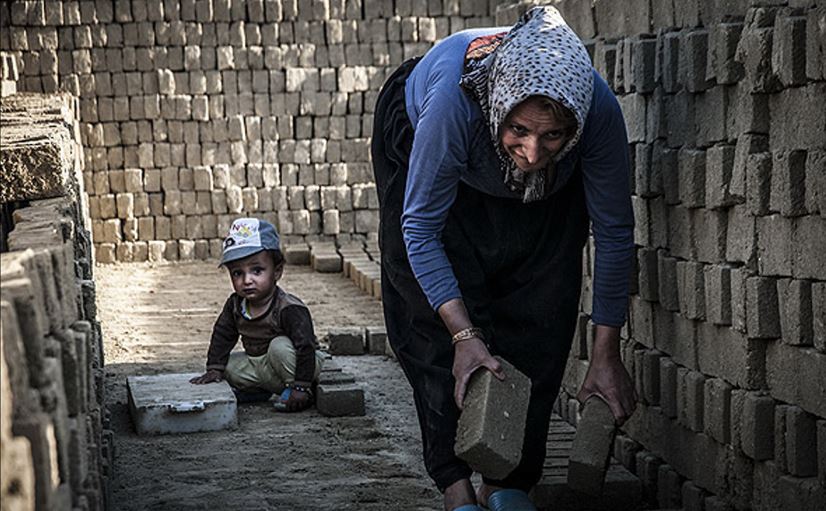
“Forms of modern slavery in Iran that are not seen/ Sussan Mohammadkhani Ghiasvand”
This is a caption
This is a caption.
Sousan Mohammadkhani Ghiasvand
According to a new report by the Walk Free Foundation, approximately half a million people in Iran are victims of modern slavery. According to this report, Iran is among the top 10 countries with the lowest efforts in combating modern slavery. Iran also ranks 20th in modern slavery among 167 countries worldwide.
There are different definitions of modern slavery. However, in most of these definitions, the focus is on those who are considered victims of modern slavery, who are trafficked by human smugglers from poor countries to other places to be used as sexual workers or to be exploited as laborers in forced labor camps or modern industries. These are individuals who have lost their right to ownership of their body and time, against their own will, by human smugglers or groups and organizations that exploit them, using force, threats, and violence, to the point where they are forced to remain in these conditions.
In all the different definitions of modern slavery, “sexual slavery”, “forced labor”, “forced marriage”, “slavery or marriage for debt repayment”, “child labor”, and “forced begging” are considered examples of modern slavery in the world.
Limited familiarity with Iranian society and the laws of the Islamic Republic regarding family, marriage, work, and children causes doubt about the statistics presented by the Walk Free Foundation regarding the number of victims of modern slavery in Iran. These are the same laws that serve as a breeding ground for slavery for women, workers, and children.
Silvana Bayazidpour, a graduate of law and a Kurdish activist, says: “In a research method that is both scientific and relatively accurate, three methods must be used: survey, field studies, and experiments. Each of these methods also requires its own investigation and research. It cannot be said that the foundation has used the best options for its study, but if it has only relied on official statistics and numbers from governments, at least in the case of Iran, one should doubt its accuracy.”
He continues by referring to the definition of slavery: “If we add the two characteristics of ownership and control to the concept of slavery, which is being held captive and being under the control of another person – which are the defining features of modern slavery – then concepts such as human trafficking, debt bondage, forced labor, forced marriage, serfdom, exploitation of children, and similar concepts will fall under the category of slavery. Now the question arises, has the foundation been able to obtain a percentage of forced marriages that occur in different parts of Iran? Does this statistic include housewives who not only do not receive any wages but in most cases also become sexual slaves by their husbands?”
Bayazidpour understands physical, mental, and emotional violence as concepts of slavery. Therefore, he raises questions that cannot be found in the Vak Foundation report: “What accurate statistics are available on child laborers who are subjected to physical and sexual violence by their employers or the employers’ associates? What percentage of children, especially girls, are victims of abuse by their relatives? Have the statistics of children and women who are victims of trafficking in Iran been included in the foundation’s results? Are Kurdish porters not prominent examples of modern slavery? Where do they stand in these statistics? And what is the assessment of international organizations regarding this humanitarian issue? If these questions and others like them are categorized and statistically analyzed, it can elevate Iran’s position in the field of modern slavery to a much higher level. These statistics cannot be used as evidence for governments to claim to defend human rights and citizenship. If there are only about half a million people in the foundation’s statistics, we must ask with a
Bayazidpour’s first and most fundamental criticism of the World Bank’s statistics is its reliance on inaccurate and calculated data that fails to encompass the minimum dimensions of investment in Iran. In his view, a general look at the statistics of the International Labor Organization and the World Bank reveals a glaring difference and contradiction.
For this reason, Bayezidpour believes that these conflicting and different statistics cannot be the basis for pressuring for the formulation of human laws; because governments can exploit a large population by relying on lower statistics and act indifferently towards their fate, and as a result, exempt themselves from accountability.
From the perspective of this activist, if relatively accurate statistics are available, by establishing and formulating official laws and resorting to them, we can address the problems and examples that she considers to be clear examples of slavery. Because in this way, governments can be more generous and clearer in enforcing anti-slavery laws.
Bayezidpour raises questions about some problems and points out that we cannot look for quick solutions to them because they require a global determination. Can simply collecting statistics be a solution to the fight against slavery? What mechanisms and solutions does the foundation propose for this fight? What is the way out of these problems? What mechanism can be the creator of modern laws against modern slavery? Through which means can governments and slave owners be pressured to combat modern slavery? Unfortunately, the digital age has made the work of human traffickers much easier. Virtual spaces, the internet, and websites, by providing the possibility of anonymity, have become facilitators of criminal activities; websites that mostly victimize women and children. What mechanisms can be used to address this problem so that websites and virtual spaces do not become an easy route for physical and sexual slavery? According to Andrew Forrest, founder and chairman of the Walk Free Foundation, the first step in this path is measuring the dimensions, but we must ask what the next steps
Comparison of published statistics by the Walk Free Foundation over different years shows that the number of victims of modern slavery has increased. However, this increase in statistics is due to a more accurate collection of data and information. The important point to emphasize is that simply publishing statistics without proper solutions and pressure on governments and without global determination and will to combat modern slavery, will not have much impact on reducing the number of victims.
The Islamic Republic is the facilitator of servitude in the field of work.
Millions of workers in Iran are busy working so that the profits from their work go into the pockets of a few capitalists and business owners. The portion of these profits that goes to Iranian workers is not enough to even properly feed themselves and their families. The labor laws of the Islamic Republic of Iran are more focused on protecting the interests of capitalists and managers of production units rather than defending the rights of workers. The wages of workers are several times below the poverty line and cannot even cover the basic needs of their families. Workers do not have the right to form independent unions or to protest. Any protests by workers are always suppressed by the government. Social security insurance does not cover all the medical needs of workers. In case of dismissal or leaving work, workers will only receive a small portion of their wages and unemployment insurance for a short period of time. This means that workers in Iran have become mere tools for production and filling the pockets of capitalists, who are often dependent on the government. They are tools
“این عکس یک منظره زیبا از کوهستان است”
“This photo is a beautiful landscape of the mountains.”
Silvana Bayazidpour – Photo of the Peace Line
Silvana Bayazidpour believes that the Iranian constitution, civil and criminal laws are full of contradictions and dualities. According to her, other laws, articles, and legal clauses are also inconsistent and contradictory.
This activist, by referring to the significant gap between the minimum wage of workers in 1395 (2016-2017) and the poverty line announced by the Parliament Research Center, says: “This is while according to Article 41, Clause 2 of the Labor Law, the minimum wage should be sufficient to support a family of 5, as reported by some sources.”
Last year, Farāmarz Tavassoli, a member of the Financial Assembly of Iranian Workers and a member of the 95 Wage Committee in the Supreme Council of Labor, requested that the minimum wage for workers be determined by employers and the government instead of following the poverty line. He calculated the inflation rate of the cost of living basket in 95 based on statistics from the Central Bank and the Statistical Center, and suggested adding this amount, which was 324,000 tomans, to the workers’ wages. However, according to his statements, the government and employers did not even accept this.
Bayazidpour, while referring to Faramarz’s descriptive remarks in the media, says, “First, we must ask if non-standard expenses such as illness and university tuition have been included in determining the poverty line in Iran? The statistics presented by Faramarz are official, government statistics and a perfect example of exploitation and a form of slavery. Therefore, we must ask if these statistics have a place in the reports of the Wakf Foundation?”
He also refers to the closure of industrial units and attributes it to the nature of the government’s neoliberal policies, which he believes have led to the import of smuggled goods not only through customs barriers, but also through the military and internal security forces. He believes this has exacerbated the economic recession of industrial units and consequently led to unemployment among workers, pushing them towards cultural and economic crises and driving down wages to avoid unemployment. Therefore, for Bayazidpur, the question arises as to how, with all these statistics of bankrupt workshops, factories, and unemployment among workers, Iran has been ranked twentieth by the Foundation. Although, in his view, this ranking is also a disgrace on the forehead of modern state and private owners in Iran.
Women, victims of modern slavery in Iran.
The laws of the Islamic Republic in the field of marriage and family, like other areas, are based on Islamic sources. Sources that do not give women a significant role in a married life. The right to divorce, custody of children, the right to leave the house even to visit family members, the right to leave the country, the right to have a suitable job, and many other rights have been taken away from women in the laws of the Islamic Republic. Even in a sexual relationship, women have no rights in terms of the number, time, and place of the relationship, and the quality of the relationship. The special and general obedience of women to their husbands, which is mentioned in the laws of the Islamic Republic, is exactly derived from narrations that have always had a utilitarian view of women and have not given them an independent identity. In Iran, women need their father’s consent to marry, and it is not clear how many Iranian women have been forced into marriage by the
Silvana Bayazidpour believes that any type of discourse regarding violence against women encompasses various areas such as psychological, economic, social, and political, which have affected their fate.
He says: “Rape, incest, domestic violence, sexual harassment, low wages, gender-segregated jobs, discrimination and bias in employment, household work, and reproductive issues have all played a role in oppressing women. Now, if we add the role of religion and religious laws to these issues, the diversity of exploitation and discrimination will become even more widespread.”
Bayazidpur, referring to the statistics of the International Labor Organization which has identified 83% of unpaid workers in families as women, adds: “To investigate and expand on this data, I refer to the Deputy Strategic Studies Department of the Office of Women’s Affairs of the Presidency, which has stated that 80% of women in the country are homemakers. Despite the increase in the number of educated women, the rate of women’s economic participation has decreased in the past two decades. Therefore, we must ask what share those 80% of homemakers without pay have in the foundation’s statistics? How is the share of their 82% of educated women estimated in economic and specialized seminars?”
He considers housewife insurance more of a joke and says, “80% of housewives not only have no income, but also have to rely on their husbands to pay the monthly insurance fee.”
The average rate of women’s economic participation in Iran is 3.13%. Bayazidpour sees this as a sign of the male-dominated job market in Iran and believes that women are always more vulnerable in the job market. He also refers to the statistics of 2015 and says, “Out of approximately 31.5 million women over the age of 10, about 6.87% are considered inactive. Inactive women are dependent on men to meet their needs. This dependency takes away their independence, freedom, and right to choose.”
Regarding support; Article 1108 of the Civil Code states: “If a woman refuses to fulfill her marital duties without a legitimate reason, she will not be entitled to support”; also, Article 53 of the Family Protection Law states: “Anyone who has the financial means and refuses to provide support to their wife in case of need, or refuses to pay the required support to other individuals, will be sentenced to six months of disciplinary imprisonment.”
Bayazidpour, referring to the two legal provisions, states that the other meaning of both provisions is that alimony is only granted to the wife if she agrees to it.
According to him, “temkin” based on its legal definition means the wife’s obedience in performing marital duties, residing in the common household chosen by the husband, and good behavior in establishing the foundations of the family, which is referred to as specific temkin and general temkin in legal terminology. Also, in case of neglecting specific marital duties, the wife is considered disobedient and is not entitled to receive alimony. Disobedience means neglecting obligatory duties. According to the definition of temkin and Article 1 of the law of temkin, the wife is like an unpaid and obedient slave in performing family duties. Have global and national statistics estimated these cases?
Another issue is marital rape. Bayazidpour mentions that although sexual violence against women by their husbands has been recognized as a form of domestic violence in recent years, there is no legal provision in civil and criminal laws regarding this matter. Based on the principle that crimes and punishments must be defined by law, this type of violence is not considered a crime in Iran and therefore its victims, who are all cases of sexual slavery, are not included in statistics.
Children who are not seen in the statistics of the Wakf Foundation.
Accurate statistics on child labor and street children in Iran are not available. The Iranian Statistical Center announced three years ago that 1.7 million children in Iran are directly involved in labor. However, unofficial statistics suggest that there are seven million child laborers in Iran. The monthly income of these children ranges from 80,000 to 100,000 tomans, and the average age is between 10 and 15 years old. The Deputy of Social Affairs of the Welfare Organization also stated two years ago that there are 17,000 street children in the country, and 30% of them are from other countries. The founder of the Association for the Support and Assistance of Social Injuries also reported two years ago that 40% of street children are infected with AIDS.
Given that real statistics are always hidden in Iran, it is still unclear how accurate the reported statistics are. When we do not have accurate statistics, we also do not have much information about the working conditions and many problems of working and street children. According to experts, “working and street children are not only deprived of basic human rights such as the right to childhood, education, freedom, and physical and mental health, but also exposed to various physical, sexual, and psychological harms and violence.” Two years ago, the Deputy of Social Affairs of the Welfare Organization had said, “Out of the 11 agencies responsible for addressing the problems of street children, only two or three are active in this area.” The promises made for organizing and providing medical treatment for these children remain at the level of discussions published in the media. However, Valiollah Nasr, the Director-General of Social Harm at the Welfare Organization, had announced last year that the promise made by the Ministry of Health regarding free treatment for
On the other hand, a portion of children in some low-income families or in rural areas must start working at a young age for their families in fields, gardens, mountains, plains, and seas. They do not receive any wages for this work. Their wage is the same piece of bread they take from their family’s table. Due to their young age, children are not able to defend themselves or refuse to work. Even if they complain, there is no institution to support them. They have to return to their family members again; the same place where they have taken away their childhood and freedom.
And the last point is that there are many children and women in Iranian society whose right to freedom and choice has been taken away from them. They face various forms of physical, sexual, and emotional violence. They have no power to change their situation. The laws of the Islamic Republic are responsible for creating these conditions for Iranian women and children. The situation of women and children who are unable to change their circumstances due to lack of legal and societal support, age, and gender, is no different from that of slaves. We do not know the exact statistics, but it must be significantly higher than half a million people.
 Created By: Sousan Mohammadkhani Ghiyasvand
 July 24, 2016
Tags
Child labor Home workers Housewives Magazine number 63 Monthly Peace Line Magazine Servitude Sousan Mohammad Khani Ghiaathvand Vak Free Foundation You have a modern slave.