


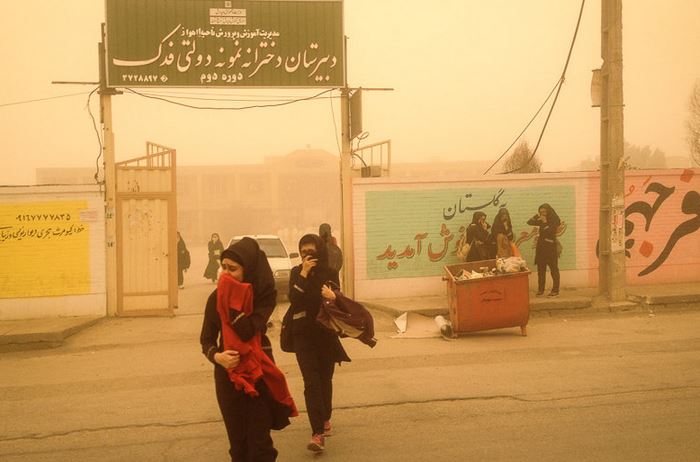
The gradual death of Khuzestan and its citizens/ Hesam Behrani
The natural level of suspended particles in the air is about 150 micrograms per cubic meter. However, in recent days and weeks, the province of Khuzestan has experienced a 70-fold increase in the permissible limit of dust and pollution, reaching a critical situation.
Shahriar Askari, the Public Relations Manager of the Environmental Protection Agency of Khuzestan, announced on Monday, February 8th of this year in an interview with IRNA that the concentration of dust in Mahshahr city has exceeded 10,000 micrograms per cubic meter, Ahvaz 8,110 micrograms, Abadan 486 micrograms, Shadegan 226 micrograms, Andimeshk 114 micrograms, Behbahan 286 micrograms, and Shush 260 micrograms per cubic meter. Two weeks prior to this date, Ahvaz experienced a concentration of at least 70 times the legal limit for the first time. In addition, visibility in Ahvaz has decreased to 150 meters or less. The closure of all schools and offices, as well as the cancellation of many flights in this province, may give others a glimpse into the situation of the people of Khuzestan.
Hashem Baldi, the director of the Khuzestan Province Meteorological Organization, said in an interview with the Mehr News Agency, “Inhaling air polluted with dust particles can cause these particles to enter the air sacs of the lungs, which can disrupt the oxygen supply to the tissues, especially the heart. This irregularity can lead to irregular heartbeats and heart attacks in individuals with heart diseases. In the long term, these fine dust particles can enter the bloodstream and deposit on the walls of blood vessels, leading to atherosclerosis and narrowing of the arteries. Other consequences of dust storms include exacerbation of respiratory allergies in patients with underlying conditions.” He advises the elderly, children under 8 years old, patients with heart and respiratory diseases, and pregnant women to stay indoors and avoid any physical activity, as exercise can increase heart rate and cause shortness of breath, leading to more polluted air entering the lungs.
Despite numerous statements and discussions, according to many experts, the reason for the creation of 10 out of 12 crises caused by dust storms in Khuzestan has been internal sources. It seems that the main source of dust storms is the drying up of internal wetlands, especially the Hoor Al-Azim wetland, which is one of the largest wetlands in Iran. About one third of this wetland is located in Iran and the rest in Iraq, and the main cause of its dryness is attributed to the Ministry of Oil. Some experts believe that spraying water can be a partial solution to this problem, but even in regards to this solution, Ismail Kahrman, an advisor to the Environmental Organization, tells Mehr News Agency: “Spraying water is not a simple task and it cannot miraculously solve all environmental problems overnight.”
But this is not a problem that happened suddenly or overnight. This is not the first time that the southern province of the country has experienced crisis conditions. Apart from the fact that the air pollution in Khuzestan has been unnatural for about 10 years, according to the ISNA news agency, only last year and only during 2 nights, on November 14th and 15th, and only a few days after the Quartz Institute declared Ahvaz as the most polluted city in the world based on data from the World Health Organization, 6,000 citizens of Ahvaz were admitted to hospitals due to these same pollutants.
With these characteristics, it must be known that how long this situation will continue and more than 4 and a half million citizens living in this province, when it is possible that with the decrease of humidity and the blowing of surface winds, the city will be covered in dust, for how long will they have to be deprived of their daily simple tasks such as going out of the house, going to school, and exercising? Sometimes it comes to mind that such a phenomenon is even more terrifying than natural disasters such as hurricanes, floods, and even earthquakes. These events happen suddenly, will last for a few days at most, and will eventually end, and their effects on the lives, health, and environment of citizens, although significant and irreparable, have a limited and specific time frame; when a major earthquake occurs, its damages, both in terms of lives and property, will eventually come to an end, but when will this situation end? How long will the silent death of citizens continue?
These days, among the citizens of the south, the discussion of migration from their homeland or place of residence is also heard, but how many percent of people will have the possibility of such migration, which will have very destructive effects on their lives, such as losing their educational and job opportunities!?
Note:
1- The Khorasan newspaper quoted one of the experts from the National Iranian Oil Company, who did not want his name to be revealed, as saying: “Since the oil field is completely located inside the marsh and the water depth in the deepest points does not exceed four meters, it is not financially feasible to install an oil rig for extraction. The most economical solution is to dry out the marsh, which we can do by spraying the surrounding land after obtaining permission from the Environmental Protection Organization. And we will have to cover the costs ourselves!”
 Created By: Admin
 February 24, 2015
Tags
"Pollen in Khuzestan" Air pollution Magazine number 46 Monthly Peace Line Magazine