


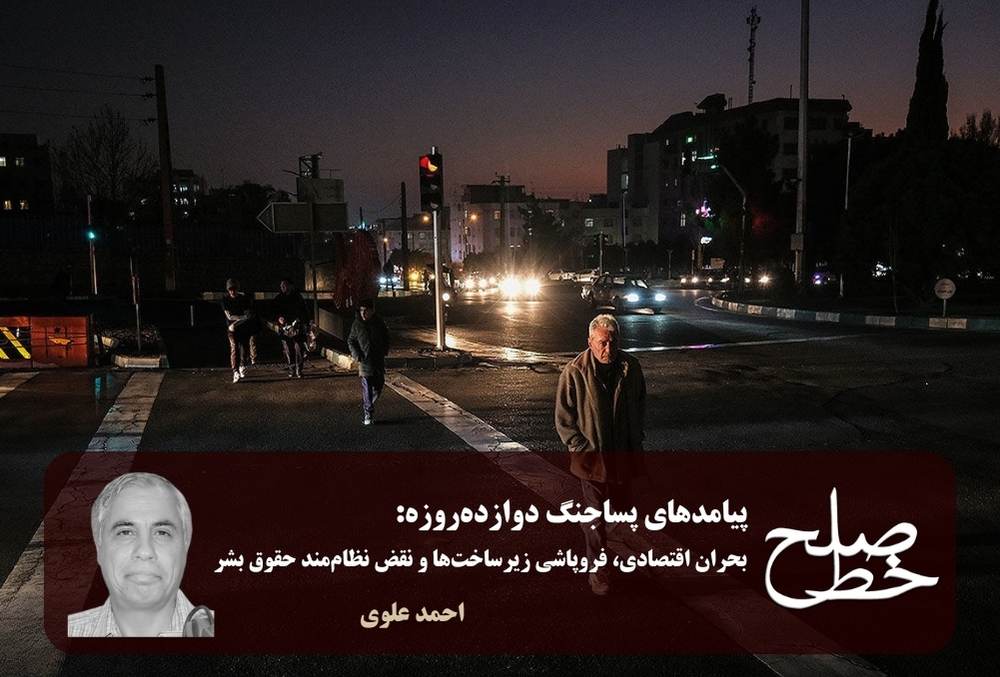
The consequences of the twelve-day post-war period: economic crisis, infrastructure collapse, and systematic violation of human rights / Ahmad Alavi
After the 12-day war between Iran and Israel, a destructive ceasefire was established. However, contrary to expectations of reconstruction and tension reduction, the structure of the Islamic Republic’s government intensified political and economic pressures, deepening existing crises. This note, with an analytical approach based on human rights indicators, examines the economic, social, and legal consequences of this conflict. In this context, the role of ineffective governance, structural corruption, and obstruction of accountable institutions are emphasized as fundamental obstacles to sustainable development.
1- Economic changes, under the shadow of destructive fire.
The fire resulting from the short-term war between Iran and Israel not only did not bring peace or economic revival, but also paved the way for a new wave of economic, social, and infrastructural instability. The already fragile economic structure of Iran, which had been damaged by institutional corruption and security-oriented institutionalism before the widespread sanctions, entered a more severe stage of chronic recession, widespread unemployment, capital flight, and collapse of public services. In this context, analyzing the human rights dimensions of this crisis and its relationship with the structure of governance in the Islamic Republic is essential.
2- Escalation of economic and infrastructure crises.
1-2- Sanctions and Economic Blockade.
Targeted and extensive sanctions on the oil, banking, and trade sectors intensified after the war. Foreign investors withdrew and capital flow stopped. The country’s credit risk fell to the lowest possible levels in international rankings.
2-2- Structural corruption and rent-seeking economy-military system.
The key sectors of Iran’s economy are under the control of military and security institutions. Lack of financial transparency, conflict of interests, and the removal of democratic oversight have resulted in the absence of an effective mechanism to combat corruption and ensure financial accountability.
2-3- Crisis in the job market.
Civil projects have been suspended and the official unemployment rate has increased. The job market is witnessing two simultaneous phenomena: “skilled labor force leaving” and “increase in informal and insecure employment”. Workers of these projects, unemployed youth, and working families are at the center of these damages.
3- Collapse of investment and human resource outflow.
1-3- The fall of startups.
Domestic and foreign investors have withdrawn from investing in new businesses due to the increase in political risk. Inflation of over 40% and the devaluation of the rial have greatly reduced demand for digital services and many startups have been forced to shut down.
2-3- Capital flight and financial fluctuations.
The Tehran Stock Exchange index has fallen and small investors have turned towards the currency and gold market. Capital flight is not just a financial phenomenon, but also a sign of widespread distrust towards the economic governance structure.
4- Crisis of vital infrastructures: Energy and water.
1-4- Power Crisis.
Daily nationwide power outages of 3 to 4 hours have shut down approximately half of the country’s industrial capacity. Estimates indicate a loss of over $20 billion for the production and service sector.
2-4- Water Crisis and Migration.
With a severe decrease in water reserves (more than 57%), more than 70% of villages in Iran are at risk of population displacement. This crisis has led to an increase in internal migration, a decrease in agricultural production, and social dissatisfaction.
3-4- Mandatory closures due to heat.
Temperatures above 40 to 50 degrees Celsius, along with energy shortages, have led to the closure of schools, factories, and medical centers. These closures have had irreparable impacts on education, production, and public health.
5- Systematic violation of human rights in the shadow of economic constraints and unjust governance.
1-5- Violation of the right to a decent standard of living (Article 25 of the Universal Declaration of Human Rights).
The unprecedented increase in the prices of food, housing, and medicine has put the food security of lower classes at risk. Limited access to healthcare services, the spread of malnutrition, and the elimination of support services are clear violations of Article 25 of the Universal Declaration of Human Rights.
2-5- Child labor and dropping out of school (violation of Article 26 of the Universal Declaration of Human Rights).
The economic crisis has increased the number of child laborers and in many areas, it has led to the closure or disruption of public education. Free and compulsory education at the elementary level – a right guaranteed in the constitution – has been violated in practice.
3-5- Deprivation of public services (violation of Articles 22 and 25 of the Universal Declaration of Human Rights).
Widespread closure of health and education centers due to the energy crisis has paralyzed public services. Citizens, especially in rural areas, are practically deprived of primary medical care and general education.
6- Inefficiency of governance structure: The root of crises.
1-6- Concentration of power and elimination of independent institutions.
One of the prominent features of the structure of governance in the Islamic Republic is the excessive concentration of power in the hands of non-accountable institutions – military and security institutions. The removal or weakening of institutions such as the independent parliament, oversight institutions, and free media has resulted in a highly opaque and closed decision-making process. This has led to a lack of accountability in the face of failures, which is considered one of the most fundamental indicators of ineffective governance.
2-6- Structural corruption and conflict of interests between security, military, and economic elites.
The dominance of military institutions such as the Revolutionary Guards over the country’s economy has created a severe conflict between political, security, and economic interests among powerful factions and regime-affiliated elites. This issue has hindered fair economic competition and resulted in unfair distribution of resources and diversion of investments towards non-productive projects. In such a structure, economic policies are not based on development, but rather on specific security interests.
3-6- Obstruction of civil institutions.
With the restriction or suppression of non-governmental organizations (NGOs), trade unions, and independent civil institutions, channels of social participation and public feedback have been blocked. This obstruction, especially in times of crisis, has strengthened a severe distrust towards the government and has led to a wave of migration among intellectuals and social activists.
4-6- Elimination of planning and implementation of transparent and scientific governance and the rule of theocratic discourse – rent-seeking on management.
The loss of data-driven planning, with the ability to test and validate, in social sciences has led to reactive and non-systematic decision making. Crises such as power outages or shortages of water and medicine are not only the result of natural factors, but also the product of delayed and disjointed management reactions that suffer from corruption and rent-seeking. The costs of this inefficiency are not only economic, but also human and social.
Table 1: Components of Ineffective Governance and Structural Consequences.
Ineffective governance is the cause. | Structural consequences. |
Concentration of power and elimination of independent institutions of civil society. | Removal of supervision and accountability. |
Corruption and conflict of interests in the military-economic system among ruling elites. | Inefficiency in policy-making and waste of resources. |
Obstruction of civil institutions. | Public trust and human capital flight. |
Transparent and scientific program planning. | Delayed and costly reactions to crises. |
7- Consequences of Inefficient Governance in the Era of Inflation.
1-7- Job market.
As a result of the shutdown of construction projects and economic crisis, the job market has been severely affected. The increase in unemployment and informal employment has led to a weakening of job security and a decrease in household income. The migration of skilled workers, especially among professionals and university graduates, has become a common phenomenon that limits the country’s reconstruction capacity.
2-7- Escape of capital and investors.
Investment is facing internal and external capital flight due to lack of legal security and severe economic fluctuations. The decline in stock value has not only eroded trust, but also made retirees and small investors vulnerable. This crisis of trust is paralyzing long-term productive investment.
3-7- Livelihood and Food Security.
The increase in prices and decrease in subsidies has greatly reduced the purchasing power of households. Poor families and working class have been most affected by inflation and shortages of essential goods. Chronic poverty and malnutrition also threaten the health of future generations.
4-7- Education and dropping out of school.
The closure of schools in many areas – especially due to heat and energy crisis – has deprived children of their right to education. In the absence of remote learning infrastructure and heavy educational expenses, many children – especially girls – are unable to continue their education. This is a clear violation of Article 26 of the Universal Declaration of Human Rights.
5-7- Health and access to treatment.
Disruption in drug supply, power outages in healthcare facilities, and reduction in public health budget have had serious consequences on public health. The elderly, individuals with chronic diseases, and low-income children are at the forefront of this damage. This is a violation of Article 25 of the Universal Declaration of Human Rights, which guarantees the right to access medical care.
6-7- Water, Energy, and Internal Migration.
The aging of the electricity and water network and inefficient management of resources have led to widespread power outages. Villages are being evacuated and people are migrating to cities, causing an increase in urban slums and dissatisfaction. Small industries are also at risk of bankruptcy due to unstable energy supply.
Table No. 2: Direct and Indirect Consequences of Inefficient Governance in Various Economic Sectors.
Impact area. | Direct consequences. | Indirect consequences. | More vulnerable groups. |
Job market. | Project shutdown, workers laid off. | Informal employment, migration of elites. | Workers, youth. |
Capital. | Stock market crash, capital flight. | Decrease in foreign investment. | Retirees, entrepreneurs. |
Livelihood. | Price hike, decrease in services. | Chronic poverty, malnutrition. | Layers of descent. |
Education. | Dropping out of school, school closure. | Illiteracy, educational poverty. | Children, girls. |
Hello. | Disruption in treatment centers. | Increase in disease and mortality. | Elderly, chronically ill patients. |
Water and energy. | Repeated disruptions, network fatigue. | Migration, social dissatisfaction. | Villagers, industries. |
Backside.
The 12-day war and its consequences have exacerbated the chronic structural crises of Iran’s economy and highlighted the inefficiency of governance on a larger scale. Capital flight, unemployment, collapse of vital infrastructure, and violation of fundamental human rights – including the right to education, health, food, and human security – occur in a situation where the possibility of structural reform is almost non-existent due to a lack of political will. The only way to revive sustainable development is to transition from ineffective governance to accountable, transparent, independent institutions with a focus on civil society organizations, a path that is unimaginable without changes in the existing political-economic legal structure.
 Created By: Ahmad Alavi
 August 23, 2025
Tags
Fire extinguisher Peace Line 172 Twelve-day war