


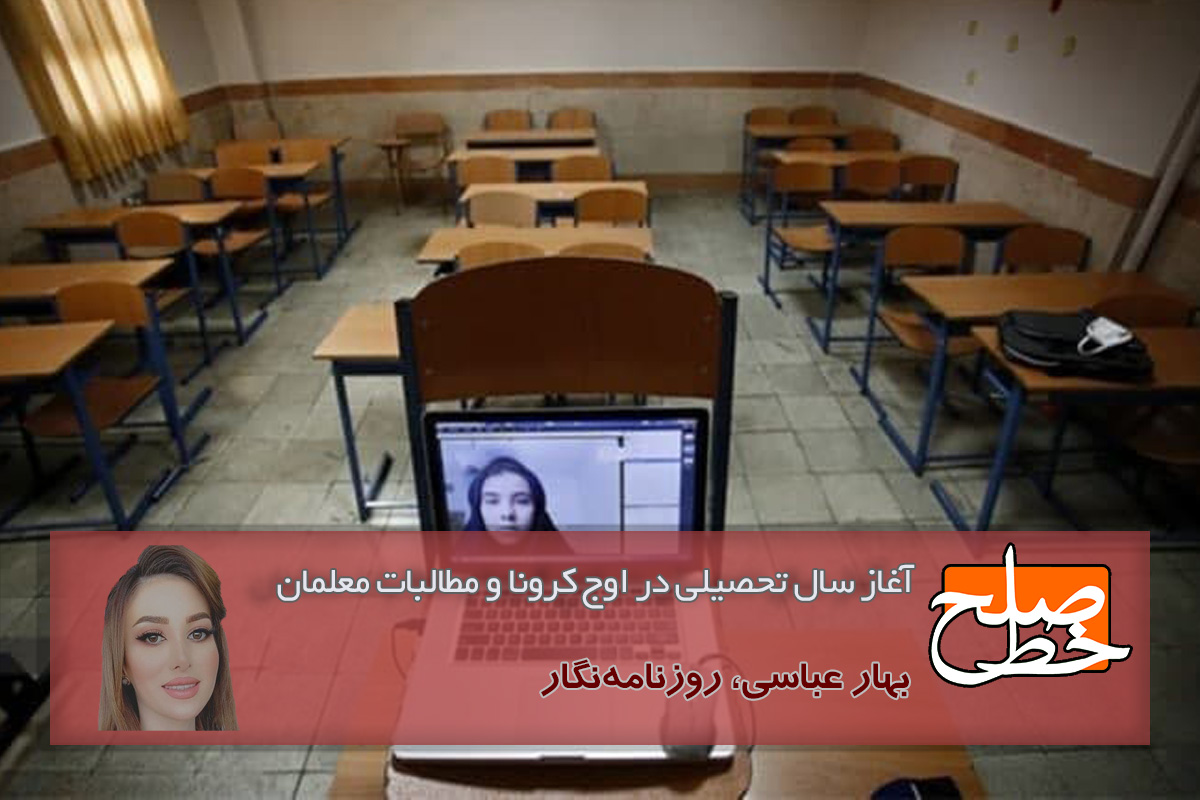
The beginning of the academic year at the peak of COVID-19 and the demands of teachers/ Bahar Abbasi
The Peace Line Monthly held a discussion session on September 8, 1400 at the Club House to address the demands of teachers at the beginning of the new academic year, which has been accompanied by a surge in coronavirus cases in the country. In this meeting, the experience of school reopening in other countries was compared to Iran and teachers expressed their demands and concerns regarding the current state of education in Iran. The teachers were divided into two groups: some saw online education as the only opportunity and possibility for students in the current circumstances, while others were not optimistic about online education and described it as a complementary form of education at best. Teachers also raised other demands such as the ranking system for teachers and the special extraordinary plan, which have been surrounded by ambiguity due to the government’s lack of budget allocation, and many teachers believe that these plans are not feasible. Some teachers were also protesting against the lack of vaccination among the population and stated that in Iran, there is no attention given to the health of
In this session, Mohammad Habibi, a member of the board of directors of the Teachers’ Guild of Tehran Province, spoke about the reopening of schools and in-person education: “Coronavirus has greatly affected the lower class and increased the economic pressure on them due to international sanctions. Coronavirus has also caused many ups and downs for teachers. The happy software designed for online education has failed and many colleagues are using other applications such as WhatsApp for virtual teaching.”
He continued, “Reopening schools is not a rational decision, and until the vaccination of target groups and students over the age of twelve is not carried out, any unmeasured action can impose more victims on society.” He also spoke about the ranking plan for teachers, saying, “The government is facing a budget shortage and the conditions are such that we will face even more inflation by the end of the year. A plan for ranking teachers is currently under review in the parliament. The parliament’s presiding board has used the excuse of lack of resources from the twelfth government to prevent the plan from being presented in the open session. This issue has faced many negative reactions from teachers. The living conditions of teachers are so bad that in the new year, we will likely see more protests and gatherings. In the discussion of the Supreme Leader’s opposition to the entry of the coronavirus vaccine into Iran in December 2020, teacher, worker, and retiree unions wrote a protest statement, but no
Rasoul Badaghi, a member of the board of directors of the Islamic City Teachers’ Association, stated in this meeting: “Unfortunately, we cannot trust the government when it comes to vaccination. There were people who wanted to get the Chinese vaccine, but they were given a placebo instead. On the other hand, if I’m not mistaken, the World Health Organization has only approved one of the Chinese vaccines, but in Iran there are several Chinese vaccines available. Basically, the authorities have lied to the people so much over the years that nothing they say is believable; therefore, vaccination in Iran has very little credibility. Another issue is that classes in Iran are sometimes forty students per class. There is no alcohol for disinfection in schools; as a result, with the reopening of schools in Iran, we will be faced with a huge explosion; a mass murder will occur. The only solution is to keep schools closed. Unfortunately, there are people in Iran who are against vaccination and this puts
Hossein Raeesi, a lawyer and university professor, was also present in this Clubhouse room and mentioned the comparison between the reopening of schools in Iran and Canada, saying: “In the crisis of COVID-19, the rights of teachers and students must be ensured. In online education in Iran, poverty has become evident. Special facilities were needed for online education, which students and teachers did not have access to. Students needed a smartphone and internet, but they were not provided with the necessary facilities and software. In addition, in Iran, the privacy of teachers and students is not guaranteed, and both teachers and students are involved in teaching throughout the night. In Canada, all facilities were provided for teaching, and students and teachers were quickly vaccinated and schools have reopened with social distancing measures, but in Iran, they have not even received a single dose of the COVID-19 vaccine.”
Ahmad Madadi, an international education expert, said in this session: “UNICEF and the World Bank have considered the coronavirus crisis as a major crisis in the past hundred years. UNESCO has requested that all countries reopen schools and pay attention to children’s educational programs and help address the academic backlog of students and provide digital education for teachers. Online education has increased discrimination and gaps. Schools must be reopened and teachers and students must be vaccinated. The emphasis of this statement is that we should not wait for a vaccine and social distancing must be more strictly observed. Teachers should demand more from the government. The main priority is the issue of coronavirus. Closing schools is the last resort. Reopening schools and vaccinating teachers is important, but politicizing demands from the government has taken away the opportunity to solve problems from us. We must look for alternative solutions.”
Mohammad Davari, a member of the central council of the Teachers’ Organization, was another speaker at this session. He stated: “For cultural, economic, and digital literacy reasons, as well as various social and political dimensions, virtual education is at best a complementary form of education. Prolonged online education has deepened the educational justice gap and caused social and psychological damage. I am in favor of holding classes in person. Continuing online education has even more detrimental effects. The education system has been ineffective for years, and changing ministers does not change the root of the problem. Administrators and teachers must be creative, and schools should be given more autonomy in order to reform the education system. The curriculum, teacher system, and grading system in Iran are far behind an efficient system.”
Bahrami Najat, a journalist and former deputy of the Ministry of Education’s Information Center, was also among the other speakers present at this session. He stated: “The problems in Iran are systemic issues. Education has always been marginalized. I do not believe in selective vaccination. Vaccination should be universal.”
Bahrami continued, “Officials have stated that nearly three million people have been deprived of education. Even in big cities where the internet is available and people have more access to facilities, many still faced difficulties and were deprived of education. The Ministry of Education monopolized software because they were making money from it. The government software for education was full of flaws and caused trouble for teachers, with no proper facilities. A teacher had to work three times longer than they did in the classroom, without any virtual teaching, while most of the educational content was sent through WhatsApp and the Shad app was not very useful. Additionally, teachers were forced to use their personal devices and those who did not have smartphones were forced to buy them in these economic conditions. In my opinion, there is no bright future for the demands of teachers and students.”
Sara Siyahpoor, another teacher present in this club house room, said: “No education can replace in-person teaching. Virtual education is a supplement, but due to the lack of sanitary facilities, reopening schools is scary. Schools are unable to provide even the smallest hygiene items. Teachers are more at risk and receive no financial or emotional support. After a year and a half, we are not mentally prepared because we have not been given any training. Consider that the responsibility of creating content has been placed on teachers, while it is the responsibility of the Ministry of Education. Another problem is that virtual education takes up more of our time and affects our personal lives. We are constantly expected to respond to students’ messages, questions, and concerns, as well as their parents’, day and night.”
Rada Mardani was another teacher who spoke at this session. She said, “The purpose of education is to learn how to live. This has never happened in Iran. Education in Iran is a barrier to real life for students. If the current formal education system in Iran were to be shut down, it would be better than the current situation. The coronavirus did not necessarily have a negative impact on children and actually had a positive effect on their lifestyle. Students have had more connection with life in these two years. The focus of active teachers should be more towards nurturing teachers who can establish more connection through virtual education.”
Mohsen Emrani, a teacher and activist, also expressed his concerns: “Reopening schools is a negative decision, as children are carriers and the learning environment is limited, and there is a shortage of human resources. Teachers and students must be vaccinated and educational materials must be provided for them. We teachers have demands. Vaccination and education should be free. The principle of the Constitution states that the government is obligated to provide free and quality educational materials for all until the end of secondary school. The issue of students’ health is important and they must be vaccinated. Our demands are within the law and we must request them with the help of the people to improve the educational conditions.”
Furthermore, Elaheh Amani, the women’s rights activist in this club house, said: “In America, 500,000 students returned to schools on August 16, 2021 and the state of California made wearing masks mandatory for students in enclosed spaces. Masks are mandatory in enclosed spaces, but not in public or outdoor spaces. All students, teachers, and staff must undergo weekly COVID testing. Unfortunately, not everyone in America has equal access to digital tools.”
At the end, Mr. Jamal Musavi mentioned: “In the seventh parliament, we requested for an increase in the budget for educators from Mr. Haddad, but they dissolved the budget. The plan for standardizing teachers has been brought to the parliament for about three months, but in the final stage, they divided the budget and dissolved it. Transparency and clarity are necessary for the demands of teachers’ employment status. We must pursue more advocacy through civil organizations, teachers, and lawyers. Teachers should receive free legal advice in order to advance their demands in a more principled manner.”
 Created By: Bahar Abbasi
 September 23, 2021
Tags
Bahar Abbasi Club House Extraordinary special Monthly Peace Line Magazine Peace Line 125 Ranking Teacher's demands Virtual education