


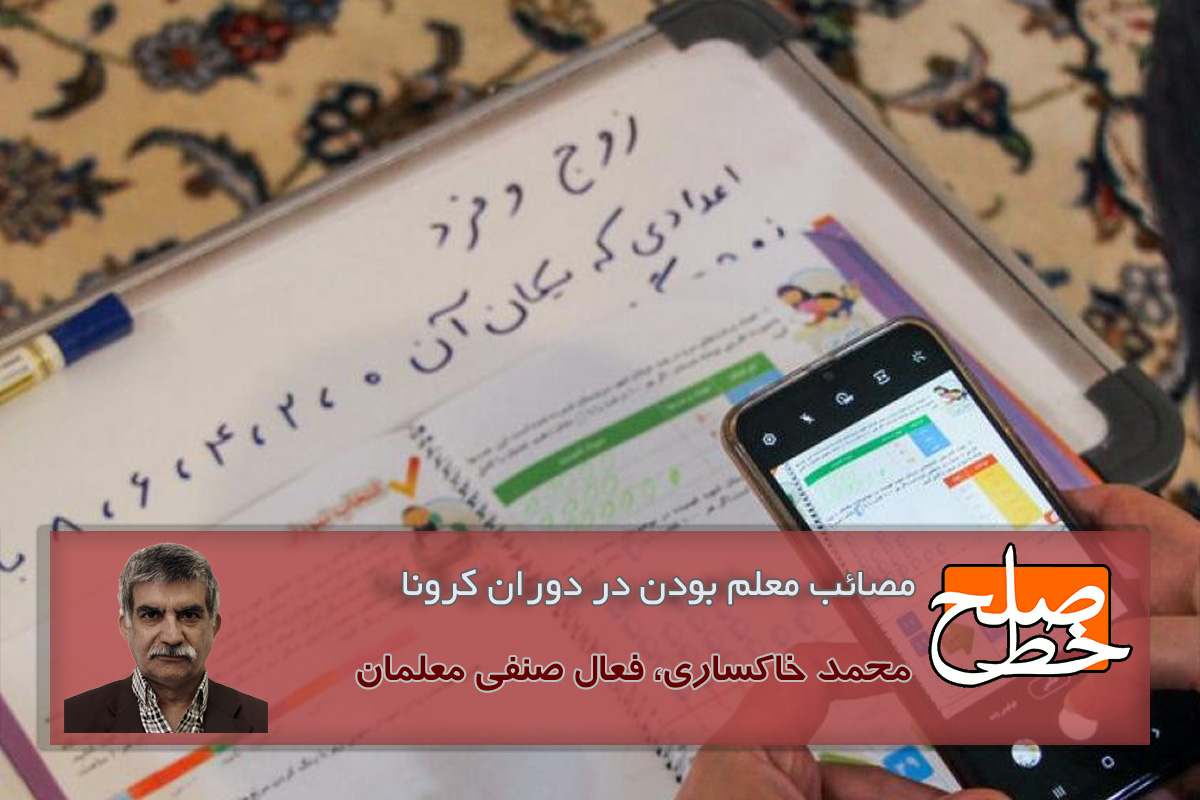
The hardships of being a teacher during the coronavirus era / Mohammad Khaksari
With the outbreak of the coronavirus, the world has taken on a different shape and many jobs have been affected by the changes caused by the virus. The virus, like a tsunami, has engulfed all countries, social classes, professions, and businesses. The spread of the coronavirus has revealed the hidden and untold layers and corners of the hard work and efforts of the teachers in the country.
Teaching is one of the professions that has entered a new realm with the spread of the coronavirus. This means that teachers have been faced with a new way of teaching; a teaching that is challenging for students and teachers alike, as teachers are constantly addressing the academic situation of their students. During the pandemic, families have come to realize how essential and important the role of a teacher is. When they ask them to talk to their child and convince them about a certain subject, they understand the significance of their role.
During this time, most teachers have used all their power and effort to prevent the education system of the country from being stopped. But unfortunately, due to the inefficiency of the government in managing the coronavirus, after more than a year and a half since the spread of this virus, it has prevented the resumption of in-person education for students, while in advanced countries, the necessary medical equipment and supplies for schools, students, and teachers have been provided and classes are now being held in person with special methods (such as having half the number of students and only one day in between).
On the other hand, the teacher pays for all the expenses of the mobile phone, accessories, and internet; even though paying for such expenses is the responsibility of the Ministry of Education; a ministry that unfortunately does not have the ability to listen to the problems and issues of teachers. In the meantime, elementary school teachers have faced more difficulties, as their students are children who do not have access to a personal mobile phone and do not fully understand how to use it. These playful students have no concept of virtual classes, and teachers who must teach and answer students’ and parents’ questions 24/7 through their mobile phones.
Virtual education reduces the speed of learning. In online teaching, students and teachers are physically apart and only see each other indirectly; therefore, they do not feel each other and do not establish a good connection, which also decreases the speed of learning. When the student and teacher are face to face, the power of learning increases, and there is no emotional connection between students in online classes. This constant connection, which sometimes becomes 24/7, makes families aware of another aspect of the relationship between the teacher and the student. In face-to-face classes, there is more control over time and teaching methods, but in online classes, you cannot encourage students to study and can only follow up on the student’s situation through phone calls and parents, which does not have much effect.
It has been a while since virtual teaching started, but some students still do not have access to online education due to poverty and not being able to afford smartphones and tablets. In some areas, there is no access to the internet or educational programs for students. In some regions of the country, even when there is internet available, the speed is so slow that it is not possible to send videos or audio. Not having a smartphone, lack of access to high-speed internet, students not being accompanied, and lack of effective communication between teachers and students are among the most important problems during this difficult and exhausting time of the coronavirus. According to a report published by Hamshahri newspaper, about 3 million students have been deprived of education due to lack of access to smartphones, tablets, and internet. The responsibility for the deprivation of education of these 3 million students lies directly with the government. As the executive branch of the constitution, the government has a duty to provide educational facilities for the students of
From the beginning of online education, it was expected that education officials would take steps to solve these problems. However, not only have these problems not been solved, but it should be noted that in situations where the government wants to control the internet, teachers and students’ access to first-hand scientific information decreases. The increasing role and impact of modern technologies, especially the use of virtual space as one of the emerging phenomena in various dimensions of human life, is an undeniable reality of today’s society. Undoubtedly, virtual space, like other imported technologies, creates many opportunities to accelerate the pace of scientific progress in human societies. However, the government has a security-oriented approach to education. This security-oriented approach not only prevents proper implementation of education and job security for teachers, but also stifles creativity in both teachers and students. Many teachers and students complain about the slow internet speed during virtual learning. Even in the middle of teaching, the internet suddenly cuts off. While in advanced societies, high-speed internet is
The origin of this ruling is not the global standard education. Witness, the United Nations’ Sustainable Development Program, which was outlined in the UNESCO document 2030, and the government opposed it. This document aimed to use international experiences to develop and modernize education in countries. This document, which was developed in collaboration with international expert groups, listed 17 action plans for “sustainable development” of member countries of the United Nations. According to this document, by 2030, all 192 member countries of this organization are required to provide “equal, high-quality and lifelong education” for all residents of the country, regardless of gender, ethnicity, tribe, age, and social status. However, this globally recognized document was removed from the country’s education program by a government decree. One of the reasons for removing the 2030 document was the “Western” concept of gender equality and justice for women.
With this dominant mindset, it is not expected that controlling the coronavirus would be a priority before reopening schools. There is money for building atomic bombs and for foreign countries, but our students in some provinces study in overcrowded schools. Unfortunately, the government does not have a proper understanding of the situation. It has been announced multiple times that schools will reopen in the new year. The Health Unit of the Ministry of Education is against reopening schools. The Coronavirus Task Force claims that schools can be reopened. The reality is that, based on the experience of advanced countries, schools can only be reopened when all employed teachers and students over the age of 12 are vaccinated. However, the government has announced that we will only vaccinate employed teachers and that substitute teachers are not a priority for vaccination.
The delay in the arrival of the vaccine has led to an increase in deaths from COVID-19. According to unofficial reports, around 200,000 people have died from the virus. Apparently, human life is not valued much in this government. The extremist thinking and mindset of the government has its own interpretation of religion. They claim that preserving the system is the most important duty, meaning that human life, human dignity, and the position of teachers are not a priority. Management is a science and the existing imbalances in all economic, social, and cultural fields show that the government lacks the science of management and only uses slogans to solve people’s problems. Education is not separate from society. In developed countries, education is a priority and the training of human resources is valued. Meanwhile, our government believes that by admitting 12,000 students to education, they can train them according to their own desires. They have forgotten that previous educational programs have failed and students have become disillusioned. The most
In addition to the mentioned disasters, the coronavirus has also affected the livelihood of teachers. Teachers are daily witnessing price increases, while their salaries are not in line with annual inflation. When a teacher is struggling with their daily life, education cannot be properly carried out. The government also lacks a proper understanding of human resource development. The focus of the government is on weapons, or as they say, “the battlefield”. The former Minister of Foreign Affairs, Mr. Zarif, declared in his audio file: “The main principle of foreign policy is the battlefield, everything else is on the sidelines.” The global community cries out for peace, while the current government cries out for war. When the main principle of foreign policy is the “battlefield” for the government, the country’s budget also goes in that direction. The entry of the coronavirus vaccine and the health of the people are not only not a priority, but also with political games and rent-seeking, wrong addresses of medicines are given to the people
Education officials should provide cultural and promotional measures, as well as welfare and livelihood services, through sincere and heartfelt communication with the “Council of Coordination of Cultural Teachers’ Organizations of Iran” to elevate the status of teachers and increase their motivation to serve the country. Iranian teachers have repeatedly proven their love for their people and their country. Their selflessness has been a unique example for the future builders of the country. Many teachers went to the front lines during the war and defended our beloved homeland, sacrificing their lives. Others filled the empty positions of their fallen colleagues by accepting extra teaching hours without receiving any compensation. Even after the war, teachers remained loyal to their love and commitment to Iran and its children by participating in the country’s reconstruction efforts. Teachers like “Yazdan Keshvari”, a teacher at the school in the village of Safilan, who sacrificed himself trying to save his 13 students from the flames, were among those selfless teachers. The sacrifices of teachers cannot be measured by
Scientific growth areas, through changes in scientific structures and changes in scientific priorities, can drive young people towards the peak that is the ultimate educational standard. Based on this guideline, the structure of the education system needs to change in order to support and promote the scientific and social status of teachers as one of the pillars of the country’s scientific structure, in order to raise worthy and constructive young people. The current education system, which is under the influence of political-security considerations, cannot teach students life skills. This structure is sick. The political-security perspective does not allow for change and transformation in education. With this structure, even if a proper professor were to come to life, they would not be able to bring about any change. In order to create change in the current education system, teacher unions must be formed in all cities of the country, and the number of these unions should be equal to the number of cities in the country, so that the “Council of Coordination of Cultural Teacher Unions
Without fundamental changes in education, students will not be trained with life skills. The educational structure must be such that from the elementary level, students are taught peace, human rights, and peaceful living so that human values are ingrained in them. Unfortunately, our current education system is not responsive to the needs of students with this structure. It is a factory that produces the mafia of entrance exams, non-profit universities, and open universities; universities that lack educational quality and only give young people a degree without skills.
Mohammad Khaksari is the editor-in-chief and owner of the weekly magazine “Qalam-e-Moallem”.
 Created By: Mohammad Khaksari
 September 23, 2021
Tags
Extraordinary special Mohammad Khaksari Monthly Peace Line Magazine Online education Peace Line 125 Ranking Teacher's demands