


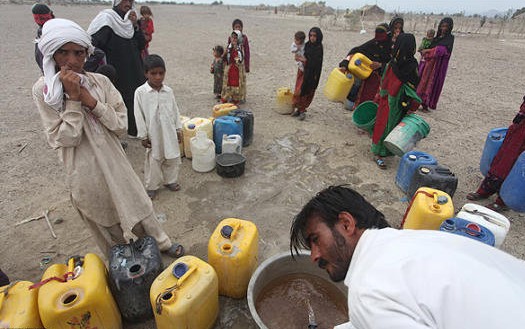
The people of Sistan and Baluchestan want water.

More than half of the population of Sistan and Baluchestan province lives in the villages of this province and the lack of drinking water in rural areas of Sistan and Baluchestan has been a problem for years, especially in the summer season and due to the negligence of officials, it has become one of the unresolved issues for the people of this region and seems to have no end in sight.
Carrying 20-liter jugs with hand carts and struggling to place large metal pots on their heads, standing in long lines in front of water tankers – this is a repetitive and endless story in the villages of Sistan and Baluchestan. Many young people and women in the villages of this province are considered the “water bearers” of their families, and whether they like it or not, they have been managing their families by receiving approximately 15 liters of water per day for years. This amount of water is not enough to even properly wash their hands and faces, let alone meet their basic hygiene needs.
Water resources of Sistan and Baluchestan province.
Given the climate of Sistan and Baluchestan province and the high rate of water evaporation, the water in this region is mostly supplied through springs, deep and semi-deep wells, permanent and seasonal rivers, and floods. The main source of water, which is obtained through rainfall, is estimated to be around 20 billion cubic meters per year, of which 85% is lost due to dry climate, wind, and evaporation. The remaining 15%, equivalent to 1.6 billion cubic meters, is surface water that flows through long paths in the rivers of this province, such as Bam, Kajoo, Sarbaz, Kheir, Mashkel, Rabch, Sianjan, and Hirmand. Unfortunately, without proper and sustainable use, a portion of this water is lost to neighboring countries, with some flowing into the Arabian Sea. Only 7% of this surface water, equivalent to 1.4 billion cubic meters, infiltrates into the
In examining the status of drinking water for the rural population – as we mentioned, the majority of the population in this province are rural residents – it is necessary to have information about the number of villages in this province. According to the estimation of the Sistan and Baluchestan governorate, this province has more than 5,719 villages, of which 2,746 villages have a population of over 20 households. The Rural Water and Wastewater Company is responsible for providing water to villages with more than 20 households; but the question is, is this responsibility being fulfilled properly? To answer this question, we must refer to several reports on the water supply situation for the deprived people in this region.
According to reports from domestic news agencies and official websites, Sarbouk is one of the districts of Nikshahr county where, according to officials, the residents have been suffering from water shortage for years.
According to Mr. Ismail Balideh, the mayor of Sarbouk, in villages with a population of over 500 people, only 2 water tanks are distributed per week. This amount of water distribution throughout the week not only does not meet the needs of the people, but also has had a negative impact on the hygiene conditions of the region.
In the villages of Qasr-e Qand district, the average water distribution per person among 37 villages in the Talang region with a population of over 9,000, is only 15 liters per day for each household.
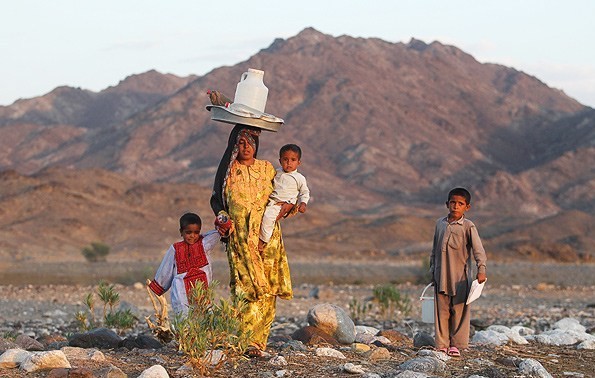
Or Dehk village, a suburb of Saravan city, as stated by Mr. Abdolghayoum Dehvari, the head of the village council, despite accommodating more than 420 households, its residents only have access to half an hour of drinking water during the week. He also mentioned about the efforts made to address this issue: “Numerous correspondences with the rural water and sewage department have not yielded any results, and officials insist that they do not have a budget to solve this problem.”
In addition, we should not forget villages with less than 20 households, where the responsibility of providing water supply has not been assigned to the rural water and sewage company. These villagers are even deprived of 15 liters of insufficient water.
On the other hand, the population growth in the province has been reported to be around 8%. Despite the inclusion of villages with more than 20 households, villages with less than 20 households are still experiencing an increase in population and the phenomenon of ruralization, which has caused problems such as water supply and shortage of drinking water in recent years instead of being resolved, has worsened.
These instances of inactivity are simply a “sample fist” to quench the thirst of the people, which is a reminder to “read the detailed story yourself from this summary.”
Insufficient budget is a worse excuse than sin.
Nasrullah Chari, the head of the Rural Water and Wastewater Company in Sistan and Baluchestan, has spoken about the water conditions in the region, saying: “More than 4,000 villages in Sistan and Baluchestan, with an approximate population of 400,000, do not have access to a drinking water and sanitation network. As a result, the main source of nourishment for the people is springs and canals, which have also been affected by recent droughts.”
Despite acknowledging the issue of water supply and resolving this crisis, he has stated: “Due to limited financial resources, only 50% of the water supply costs (such as purchasing water, purchasing purification materials, driver salaries, government tanker fuel costs, purchasing parts and repairs, etc.) are allocated to this company by the governorate each year.”
Undoubtedly, this budget will not meet the needs of the villagers in this region and it seems that if national funds are not attracted and allocated and there is no serious determination and “special attention” created, the main concern of the people will still remain unresolved and will lead to problems in health, disease, and increased mortality (with the explanation that Balochistan has the highest rate of child mortality under 5 years old),…
 Created By: Admin
 July 24, 2014
Tags
Issue number 39