


Censorship and the creation of imperfect beings.
 ”
”
“Censored publications remain bad even when they produce good products, because these products are only as good as the representative of the censored media and do not have the characteristic of being bad media products.”
“Even when free publications produce bad products, they are still good because their bad products deviate from the inherent nature of free publications. A bad ruler is bad even if he has a good voice. Nature is good even if it gives birth to monstrous creatures without horns or tails.”
The essence of free press is one with personality, rationality, and ethical freedom. Censored media personality is the same as a soulless monster of servitude, a civilized but perfumed abortion.
If we remove “media” from the above sentences and replace it with “film”, “television series”, “news report”, or any other thing that is subject to censorship and removal, we can see the true state of Iranian society. Even a situation like the coverage of women in Iran, which is censored, restricted, and limited by the government, brings about the same results.
Comparing TV series in the neighboring countries of Iran and Turkey clearly shows how censorship can produce both good and bad products. Even when producing a bad product, “freedom” is still considered good. Censored series within the country create characters that are all similar; the “good” ones are all the same and the “bad” ones are all alike, both unrealistic. The ceiling and floor of good and bad in these series is very narrow. However, in Turkish series that are dubbed through the Jem network and are popular in Iran, we are faced with very bad series, and also very good ones. The good or bad of these series is evident because they have not been shaped under the blade of censorship. They are like natural fields that produce diverse and sometimes crooked products, but in industrial fields, products are all uniform and shaped; an organic and natural crooked cucumber has a much higher value than a straight and uniform but unnatural and genetically modified one.
Censorship in programming news and stories in the Islamic Republic’s radio and television has created such a monotony that it has become extremely difficult to create complex characters and put them in difficult situations, especially when it comes to portraying positive characters. These characters cannot be tempted, cannot betray, and cannot be “bad”, and a character that cannot be “bad” is not a good character, it is not a real character. This is especially true for religious and legal characters; a clergyman cannot be bad, cannot be tempted, cannot betray, and must be absolutely good, or if not good, must be absolutely bad and it becomes clear that they were not truly a clergyman, but rather an atheist trying to destroy the clergy. This also applies to government officials and law enforcement, and they have conditioned the taste of the people to expect only superficial characters, regardless of their profession, accent, language, or ethnicity. These characters have no profession, no accent, their last name should not indicate
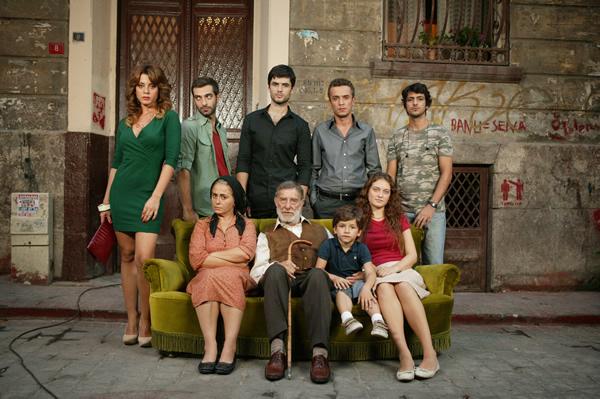
In most Turkish series, even in their villains, characters have ups and downs and are multidimensional; the best of them do bad things and the worst of them sometimes have positive aspects. For example, in the series “Lost City” (Kayıp Şehir) which is dubbed in Persian as “Under the Skin of the City” and airs on Gem TV, among the main characters there is no one who can be called good and no one who can be called bad. When you get used to the idea that a character is very good, suddenly they do something “bad” in a human way; just like real humans! And a character that you think has no positive aspects, suddenly shows their human and “good” side in a critical moment. On the other hand, racism is criticized, traditional anti-women actions are condemned, the police are seen as guilty and even protests against the police are shown, anarchist youth who have a picture of Che Guevara on the wall
In the realm of thought, the situation is also like this. Censorship in Iran has shaped ideas and confines them within a specific framework, causing them to fluctuate. The gap between the most radical opinions and the most conservative ones has become so narrow that it is sometimes indistinguishable.
In other areas such as news reports, the activities of news agencies are also more or less the same, and even the smallest initiative in a headline can lead to the closure of a newspaper and send the editor to court.
Censorship and restrictions have no beauty, and the idea that restrictions bring creativity is a fabricated rumor by censors or a justification for escaping the humiliation of being censored. Censorship does not create anything, it only turns beautiful or ugly beings into imperfect creatures; even a beautiful imperfect being is still ugly.
1- Marx, Karl. Censorship and Freedom of the Press, Hassan Mortazavi, Akhtaran Publishing, p. 92.
 Created By: Admin
 May 25, 2014
Tags
Magazine number 37