


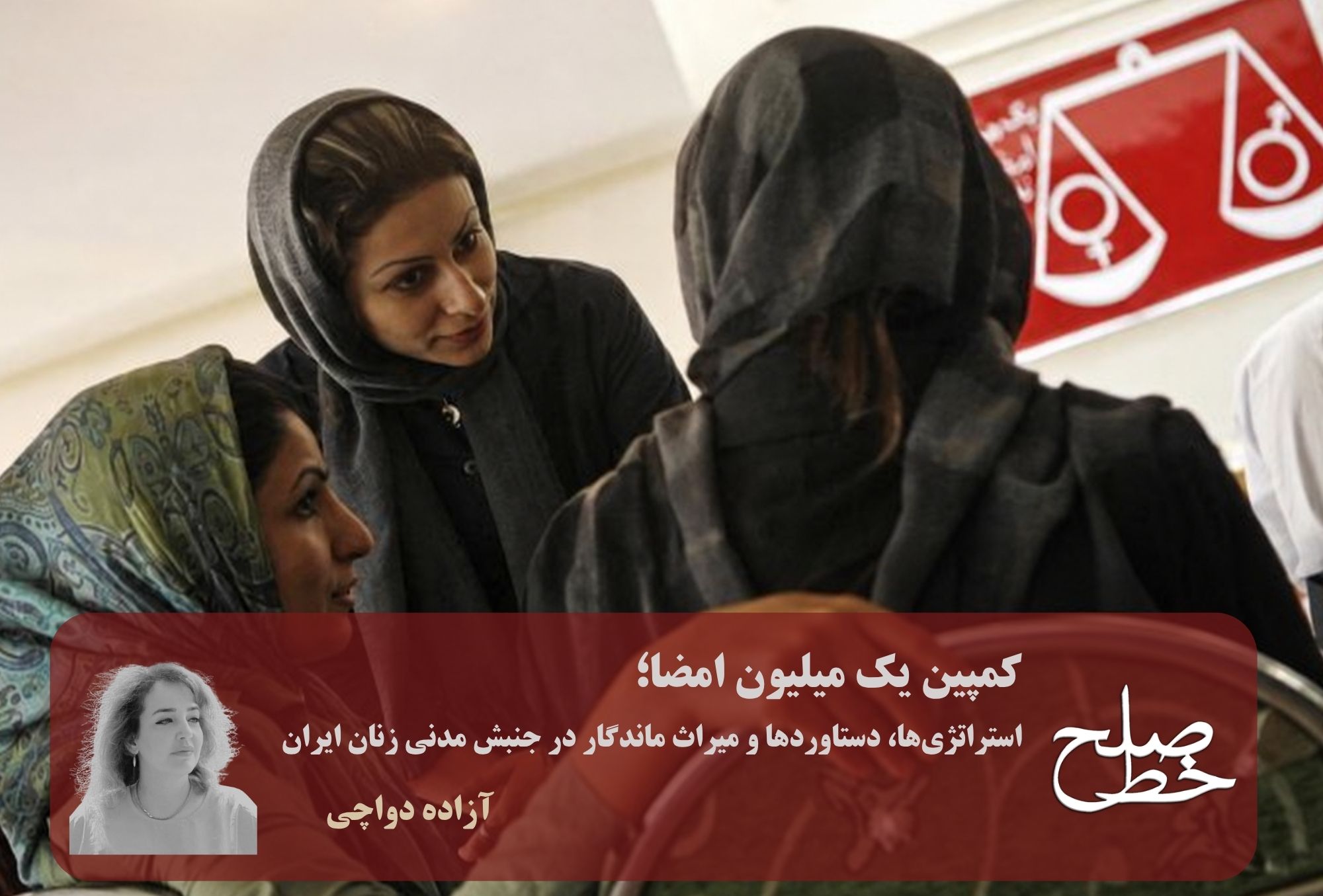
The One Million Signatures Campaign: Strategies, Achievements, and an Enduring Legacy in Iran’s Women’s Civil Movement/ Azadeh Davachi
The “One Million Signatures Campaign to Change Discriminatory Laws” (Change for Equality), launched in August 2006 (Mordad 1385) through the efforts of a group of women’s rights activists, is regarded as one of the most prominent, cohesive, and influential collective actions in Iran’s contemporary history. By adopting an issue-oriented approach and making use of social and legal tools, this civil movement was able to challenge legal inequalities in the public sphere and compel official centers of power and decision-making to respond and reconsider. As explicitly stated in the text of the campaign’s original plan, the primary objective of this civil movement went beyond collecting signatures: it was defined as creating an opportunity for public dialogue about women’s rights throughout society and training one million civil activists.
The campaign emerged at a time when Iranian civil society needed a new model for advocacy. Although in subsequent years the movement faced structural limitations due to intensified political pressure, widespread arrests of activists, and the developments following the 2009 elections, and consequently lost its initial operational effectiveness, the discourse it created, the model it established, and the intellectual foundation it built within society left deep and lasting achievements in Iran’s civil sphere, the effects of which continue to this day.
Key Strategies and Operational Innovations
The campaign’s progress and impact resulted from the adoption of a set of intelligent, flexible strategies adapted to the social conditions of Iranian society. The first prominent strategy was gender inclusivity and the creation of collective agency. The campaign did not remain an exclusively women’s process or one confined to a women-only space; rather, by bringing women and men together, it transformed the struggle for equality into a public concern that transcended gender. Men’s active participation in the movement refuted the assumption that gender equality was solely a women’s concern. Noushin Ahmadi Khorasani writes in this regard: “For the first time, men of the new generation became active in the women’s movement not merely out of sympathy, but as equal comrades, and the belief took shape that discriminatory laws, just as they place pressure on women, also damage human relationships and the health of society.” This synergy meant that, in addition to the broader public, nearly fifty associations, unions, and non-governmental organizations also aligned themselves with the campaign’s objectives in 2006, creating an unprecedented coalition.
The second and most important strategy was moving the struggle from enclosed spaces into the public sphere through face-to-face dialogue and practical education. Before then, women’s rights activities had often been confined to seminars, private meetings, specialized magazines, and limited workshops; the campaign, however, moved beyond these elite frameworks and brought activism into streets, parks, buses, the metro, and even people’s homes. One volunteer activist, describing this field-based approach, writes: “Perhaps this was the most appropriate way to begin, because one of the main objectives was to reach ordinary people in the streets, public spaces, the metro, buses, and parks—wherever they could be found.” This face-to-face communication was accompanied by the distribution of educational booklets titled The Impact of Laws on Women’s Lives, which explained complex legal rights in simple language. The text of these booklets used a tangible analogy: “Law is like clothing; when society grows and changes, the garment of law must also change to fit society’s body, rather than forcing society into a tight and outdated garment.”
In addition, adopting an issue-oriented and non-ideological approach, together with a horizontal and network-based structure, constituted the two principal pillars of the campaign’s resilience against repression. Directly focusing on reforming tangible laws concerning such matters as marriage rights, divorce, inheritance, diya, the age of criminal responsibility, and child custody, while avoiding partisan or ideological controversies, enabled different currents—including secular, religious, leftist, and liberal groups—to find common ground for cooperation around specific legal demands. In their initial statement, activists emphasized that “women’s rights and democracy are inseparably linked, and without legal equality, genuine democracy cannot be realized.”
In other words, the absence of hierarchical leadership and the creation of a multicentered network made the movement extraordinarily flexible in the face of waves of security repression, so that the arrest of one or several members did not paralyze the campaign as a whole. Describing the campaign’s movement, Shirin Ebadi says: “Even if we ourselves had wanted to, we could no longer have stopped the One Million Signatures Campaign, because this movement had become a living, multicentered network throughout the country.” This non-hierarchical structure and geographical dispersion paved the way for the participation of inexperienced but concerned young people who had no previous history of political activism. This process led to extensive cadre-building and the training of a new generation of women activists who reproduced legal awareness throughout society.
Tangible Achievements, Legal Reforms, and Historical Legacy
The achievements of the One Million Signatures Campaign were not limited to the realm of ideas and discourse; rather, they produced tangible effects and consequences across various legal, social, behavioral, and transnational dimensions. In the legal sphere, although the ultimate goal of collecting one million signatures was not fully achieved because of security pressures and arrests, the social pressure generated by the campaign’s discourse-building compelled the government and decision-making institutions to retreat on certain issues and undertake important legal reforms:
— Pushing Back the 2008 (1387) Family Protection Bill: One of the most prominent achievements was resistance to the government’s proposed bill, which sought to make the registration of temporary marriages easier and expand men’s ability to practice polygamy without the first wife’s permission. The campaign’s sustained pressure, public awareness-raising, and allied coalitions led to widespread opposition to these discriminatory provisions, resulting in their removal from the bill or suspension.
— Adoption of Equal Diya in Traffic Accidents: Scholarly, religious, and public criticism of the unequal valuation of women’s and men’s lives ultimately persuaded lawmakers to require the Bodily Injury Compensation Fund to pay the difference between women’s diya and men’s diya in traffic accidents, up to the amount of a man’s diya—a law that represented an important step in changing traditional approaches toward diya.
— Civil Promotion of Conditions within Marriage Contracts: Through public education about overlooked rights, the campaign transformed the use of conditions stipulated within marriage contracts—such as the right to divorce, the right to employment, the right to determine one’s place of residence, and the right to leave the country—from a neglected issue into a common, conscious practice and norm among a new generation, enabling women to mitigate structural inequalities at the individual level.
Regarding the philosophy behind these achievements, Parvin Ardalan notes: “Our goal was not merely to change the law from above; we wanted to demonstrate that no law can possess legitimacy and stability without the will and consent of society. Raising public awareness also transformed the issue of legal discrimination from a personal, private, or family matter into a public and national demand.” Sussan Tahmasebi says of the reach of this awareness: “Our interrogators sometimes found themselves at a loss in the face of our demands, because they realized that these demands were so simple, tangible, and consistent with society’s everyday needs that opposing them was impossible.”
At the transnational level as well, the campaign for the first time created an indigenous and organized connection between activists inside Iran and Iranians abroad, bringing domestic civil demands directly into international arenas without intermediaries. Perhaps the campaign’s most enduring and vital legacy, however, was laying the groundwork for and providing a nonviolent model for subsequent social movements. The campaign demonstrated how advocacy could be connected to the public sphere and how the street could be used as a space for peaceful protest. The concepts, civil courage, and network of activists that developed within the campaign and through its educational activities continued to nourish society in subsequent years. This approach established a direct intellectual and analytical line of connection with later social movements—including the “Woman, Life, Freedom” movement—a movement with deep roots in the same equality-seeking discourse-building and pioneering civil courage of the campaign.
Afterword
Ultimately, although the One Million Signatures Campaign was prevented from continuing in its original operational form because of widespread arrests, heavy judicial sentences, the political pressures of the government of the time, and the shocks following the 2009 elections, it never reached an endpoint, nor did its discursive structure cease to function. This movement succeeded in demonstrating that the path toward lasting social change does not run through top-down directives, but through raising awareness within society. Tangible legal achievements, increased public legal understanding, cadre-building and the training of a new generation of activists, and the presentation of an indigenous model of struggle all helped ensure that the One Million Signatures Campaign would remain a turning point in contemporary history and one of the richest experiences of civil activism in the historical memory of Iranian society, paving the way for subsequent equality-seeking movements.
Footnotes:
Ahmadi Khorasani, Noushin (2009 [1388]), The Inside Story of the One Million Signatures Campaign for Equality, translated by Women’s Learning Partnership (WLP).
Document archives, declaration of establishment, text of the campaign’s original plan, and the educational booklet The Impact of Laws on Women’s Lives, Change for Equality website, 2006–2009 (1385–1388).
Ebadi, Shirin; Ardalan, Parvin; Tahmasebi, Sussan (2006–2009 [1385–1388]). Interviews, volunteer accounts, and notes published on the Feminist School and Change for Equality websites.
Review of the social context, the June 12, 2006 (22 Khordad 1385) demonstrations, and the face-to-face approach of the One Million Signatures Campaign, Exterminating Angel online magazine, 2007.
Documents concerning the Family Protection Bill and enactments related to amendments to the Compulsory Civil Liability Insurance Law (equal diya payments in traffic accidents), Statistical Center of Iran and reports of the Islamic Consultative Assembly, 2008–2009 (1387–1388).
 Created By: Azadeh Davachi
 September 23, 2026
Tags
Civil society Peace Line 185 Women's movement Women's rights Women's rights activists