


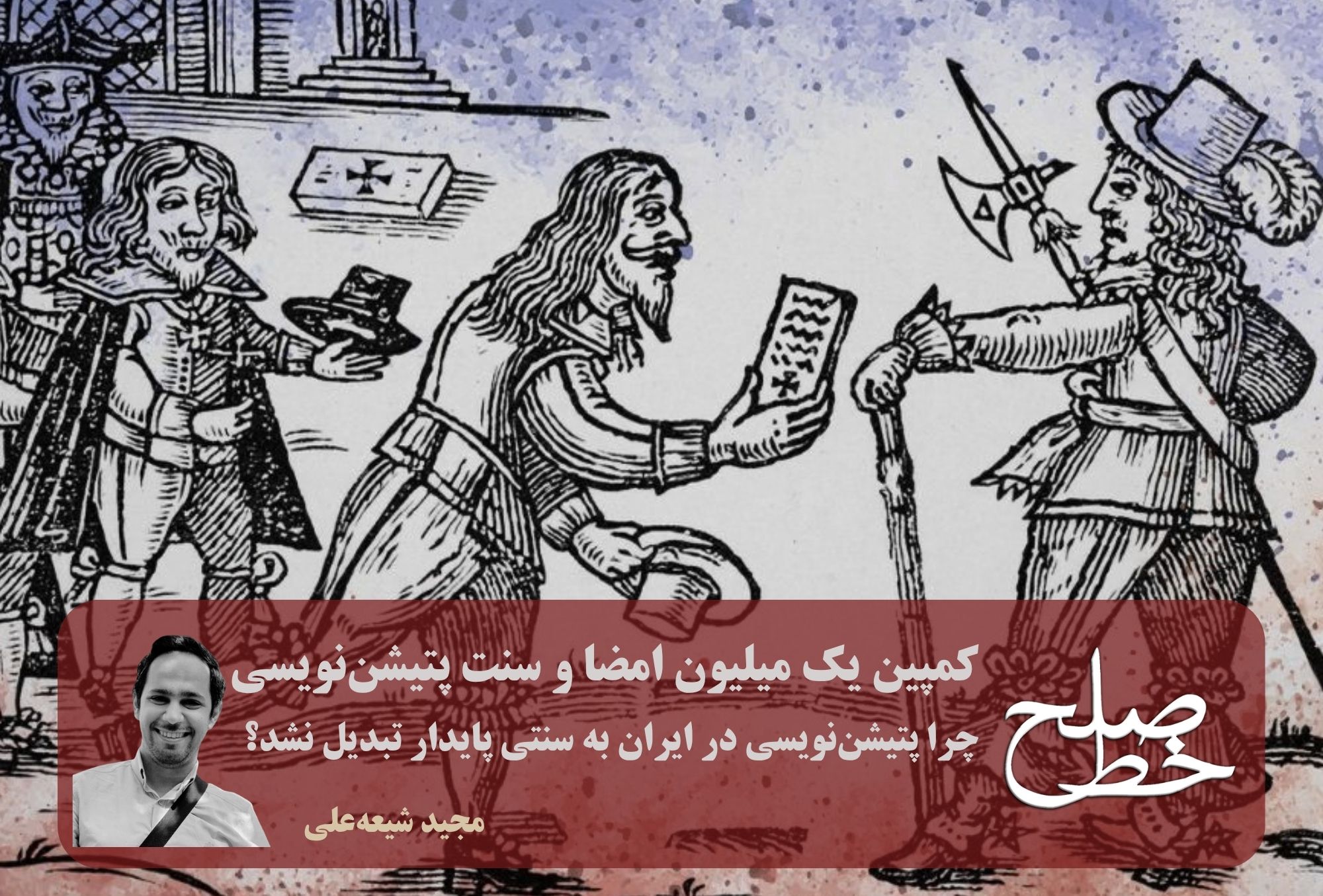
The One Million Signatures Campaign and the Tradition of Petitioning/ Majid Shia’Ali
Twenty years have passed since an experience that was never repeated either before or after it. It was a campaign made unique by the convergence of several characteristics: the formation of a formal feminist movement, political and religious moderation with an emphasis on legality and non-conflict with religious foundations, an emphasis on collective action and civil struggle with a bottom-up approach, efforts at organization, networking, and awareness-raising, and finally and most importantly, the use of a political petition to advance a social movement. Even if we set aside the campaign’s other distinctive characteristics, this was the only experience on such a broad scale involving petitions around citizenship rights. For this reason, the experience of signing petitions in our country’s political and civil sphere needs to be re-examined so that its achievements and failures can inform future experiences. To that end, it is first necessary to look at the emergence of this method of political struggle.
What developed in the political traditions of Western societies as the signing of political petitions as a tool of activism has roots in a historical evolution. Today, this method can be distinguished through several elements. First, it is a request. Second, the request is made not individually but collectively. Third, the addressee is the government or other public institutions. Fourth, making this request entails creating power within society to exert pressure for its implementation. More than anywhere else, the formation of this model of activism can be traced to medieval England. Although in all societies there has historically been some form of petitioning or submission of pleas to rulers, the petition possessing the characteristics described above is a modern phenomenon that gradually developed out of England’s civic traditions.
Petitioning developed side by side with Parliament in England. In 1066, the island was conquered for the last time, and William the Conqueror accepted the traditions of the defeated people and incorporated the existing consultative assembly into his system of governance. Recognition of this institution laid a foundation that gradually helped create the conditions for democracy, industrialization, and other social transformations. The Crusades then provided the next stage of development. In order to finance military expenditures, the English king needed more taxes, and the historic increase in taxation heightened tensions between the nobles represented in the assembly and the king. This escalation eventually led to conflicts that produced a charter that can be regarded as the first major turning point in the history of Parliament as an institution.
The Magna Carta, or Great Charter, concluded in 1215 between the king and the nobles, on the one hand recognized the rights of free men and, on the other, strengthened the position of Parliament and added new functions to it. Among these new functions was the review of petitions submitted by individuals. At this stage, however, Parliament was still a weak institution. Its sessions were convened by order of the king and had no fixed schedule. The lower classes were still absent, the composition of the assembly was fluid, and membership in it was less a right or form of social representation than a status granted by the king. Only at a later stage were the two houses of Parliament separated from one another.
With the religious, political, social, and economic transformations of the sixteenth and seventeenth centuries and the changes they produced, the country became the site of continuous conflict among social classes, followers of different religions, and competing visions of a new centralized state. On the one hand, in the process of changing religion and confronting the Catholic Church, and on the other, amid the enclosure movement, the monarchy turned Parliament into a fundamental pillar of power. It was in the midst of this turbulent environment that, as Parliament became more powerful, petitioning evolved from an individual and local action into a collective form of action.
At the next stage, Parliament itself, amid the conflict among Parliament, the king, and the Church, played a special role in changing the status of petitioning. When conflict between the Protestant Church and a Catholic king was added to the struggle between a king seeking more taxes and a Parliament opposing them, Parliament presented the Petition of Right to the king in 1628. At this stage, petitioning acquired two new characteristics. First, the petition had moved beyond merely expressing a grievance or making a humble request. The text created a form of power against the king’s power, and refusal to accept it was not without consequences. Second, it concerned the securing of rights. Members of Parliament now imposed restrictions on actions such as taxation without parliamentary consent and on arrest and trial. Although the petition was unable to prevent the coming civil war, it moved England toward transformations that culminated in a nonviolent revolution and an agreement with a new monarchy—an agreement that further restricted royal power and affirmed and guaranteed petitioning as a public right of citizens.
After the Glorious Revolution of 1688, at the height of industrial growth, alongside the Enlightenment, and amid history-making revolutions such as the French Revolution, the American Revolution of Independence, the Revolutions of 1848, and others, petitioning reached its peak in the eighteenth and nineteenth centuries. By then, this modern political instrument possessed the characteristics mentioned in the initial definition. One of the prominent features that came to occupy the center of petitions during this period was an emphasis on securing citizenship rights. At the high point of this process, the Chartists, who in the mid-nineteenth century demanded political reforms and expansion of the right to vote, succeeded in producing petitions with more than one million and even more than three million signatures. Later, other movements seeking the expansion of citizenship rights, including those focused on the rights of women, people of African descent, and other discriminated groups, also used this instrument. Looking back over the history of developments in England raises a question: why, then, was our society unable to transform its existing tradition of petition-writing into such a significant instrument, and how did this path develop in our society such that the One Million Signatures Campaign, even at its peak, was unable to reach the number it had set for itself?
Before the Constitutional Revolution, this process had begun in our country as well. During the Tobacco Movement, petitions with large numbers of signatures were prepared by various social groups. This process was further strengthened during the Constitutional era, but with the rise of the Pahlavi dynasty and the decline of institutions strengthened during the Constitutional period, petition-writing also declined. The interruption of this tradition of struggle and the halt in its development fundamentally altered the historical trajectory of using this important instrument.
The abandonment of this tradition and its lack of success—both in recent years before and after the One Million Signatures Campaign—can be attributed to three fundamental reasons. First, unaccountable authoritarianism. Although during much of the historical development and maturation of petitioning in the modern world governments were undemocratic, the existence of some degree of accountability gave meaning to raising demands before authoritarian rulers. The repression of the One Million Signatures Campaign, compared with the guarantee of the right to petition in the Bill of Rights of 1689, clearly illustrates this difference.
Second, the prevalence of a form of political radicalism and distance from moderate political tendencies throughout much of modern history among Iranian political activists. Raising demands through petitioning is associated with a reformist understanding of political activism. This is because, on the one hand, a request is made for the provision of greater rights, while, on the other hand, the government that has violated the petitioners’ rights is nevertheless recognized by them as the party to whom the request is addressed. In conditions where society has become polarized and reformist activism is condemned, campaigns that place the government—albeit under pressure generated by social power—in the position of a negotiating party are unlikely to gain broad support. In the experience of the One Million Signatures Campaign, it should also be noted that this campaign, which placed legality and religious moderation on its agenda, emerged after nine years of pursuing reformist demands and at the height of that movement’s influence.
Third, the success of a petition depends on the creation of power generated through social mobilization around it and the growth in the number of signatures. But this, too, depends on the existence of social networks and a certain degree of organization within society. The presence of strong civil, political, professional, and other organizations increases the likelihood that a petition will succeed. Yet in conditions such as ours, where political and civil organizations lacked significant influence, limited public participation in the campaign was hardly surprising.
Today, however, we live in a world in which social media and the internet have had a profound impact on this political instrument. Websites and social media have created the possibility of a major transformation in petitioning. This transformation is the product of several social dynamics. First, social pressure, meaning that the size of participation in a petition affects whether an individual participates. Second, conditional participation: in many campaigns, people participate when they know others are participating as well. Third, the tipping point: people are willing to participate once they are confident that participation has reached a level sufficient to ensure the campaign’s survival. Fourth, the bandwagon effect: the participation of a majority of those around an individual places pressure on that person to join or at least refrain from opposing. Because people’s actions on social media are now visible, these dynamics, together with broad and continuous communication, make exponential growth of petition campaigns possible.
Margetts and her colleagues, in research conducted on this subject, concluded that the rules of social science and the effects of social media have placed us in a condition of “political turbulence.” In their work bearing that title, they argue that today any campaign, regardless of its capabilities, social networks, or supporting organizations, can randomly come to dominate the political space on social media. Yet this fundamental transformation has not strengthened petitioning in today’s world; rather, it has weakened it.
Ultimately, our society’s political sphere has long suffered from a weak tradition of petitioning. In addition, three issues—authoritarian unaccountability, opposition radicalism, and the weakness of civil society—have structurally obstructed the strengthening of petitioning. Third, although social media have made petitioning easier, they have also generated turbulence and reduced the significance and impact of petitioning. To these factors must be added another: in recent years, political activists in our country have preferred collectively signed statements that do not raise demands and merely declare positions, keeping the number of signatories to dozens, hundreds, or at most a few thousand, over petitions. This is a method that undoubtedly lacks serious political impact. Therefore, after two decades, we must once again seek to return to petitioning and strengthen this tradition by reinforcing moderation and civil society and by striving to make the government more accountable.
 Created By: Majid Shia’ali
 September 23, 2026
Tags
"Million Signature Campaign" Civil society Democracy Democratization Feminist Peace Line 185 Petition Women's rights