


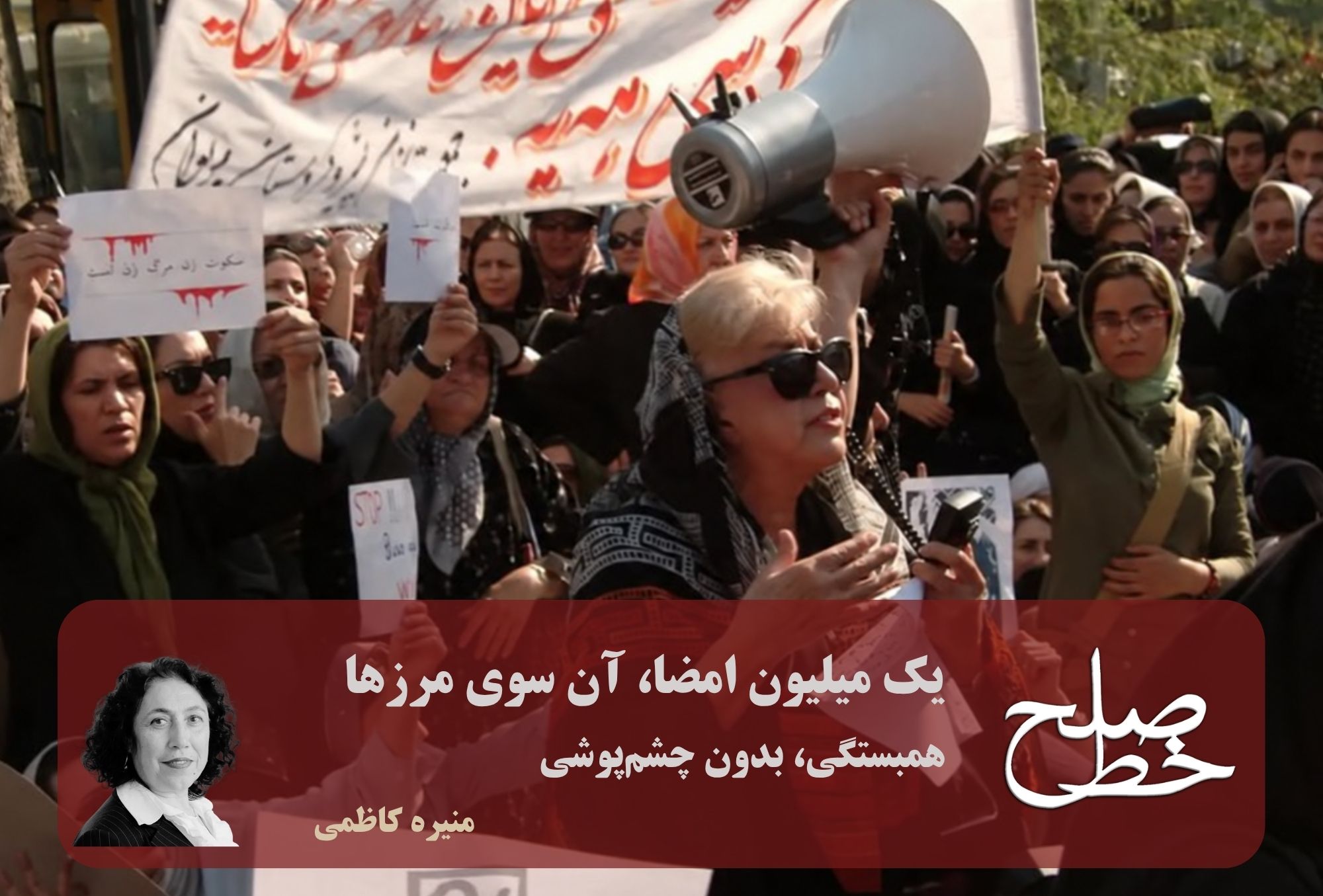
One Million Signatures, Beyond the Borders/ Monireh Kazemi
Throughout different periods of history, there have always been Iranian migrants and exiles. What distinguishes this era from previous ones, however, is, first, their large numbers and widespread dispersal across different parts of the world and, second, their constant exploration of their personal pasts and Iran’s recent history—an exploration accompanied by a sense of longing and tinged with disillusionment.
In response to these feelings, some take refuge in nostalgia—even an invented, unreal, and glorious nostalgia—while others turn to study, research, and the production of ideas in search of answers to their questions. Yet there is also a group that seeks, in the process of finding answers, to create change in the world around them. At the time, from my perspective, the activists of the “One Million Signatures Campaign to Change Discriminatory Laws” belonged to this third group. For this reason, I began working as a supporter of the campaign from the very beginning.
History of the Campaign
Following the June 12, 2006 (22 Khordad 1385) gathering held in Haft-e Tir Square, groups of activists from the women’s movement decided, in pursuit of the objectives set out in the resolution issued at that gathering, to launch a collective and purposeful movement aimed at changing unjust and misogynistic laws in Iran. The One Million Signatures Campaign to Change Discriminatory Laws began on August 27, 2006 (5 Shahrivar 1385), in the street, outside the closed doors of the Raad Institute, with a new promise of building a better world.
The campaign in Iran was launched with inspiration from the “One Million Signatures Campaign to Reform the Mudawana,” meaning Morocco’s family law. This pioneering campaign was launched on March 3, 1992 (12 Esfand 1370), by the Union de l’Action Féminine (UAF), through the feminist publication 8 March in Morocco.
Similarities and the Iranian Campaign’s Adoption of the Moroccan Model
Both campaigns sought to reform discriminatory family and personal-status laws, including those concerning divorce, polygamy, the age of marriage, and child custody. Both campaigns adopted signature collection as a means of documenting their demands and demonstrating to the authorities that women’s demands were not confined to a small segment of society—intellectuals—but represented the demands of broad sections of the population.
The Moroccan Campaign’s Intra-Religious Approach
Moroccan activists did not define their movement as being in conflict with Islam. Rather, relying on the dynamism of Islamic jurisprudence and offering contemporary interpretations, they called for legal reform—an approach that was adopted in precisely the same way by campaign activists in Iran. Accordingly, campaign activists sought religious authorities who could help them change Islamic laws. Some women in the diaspora regarded this as a weakness of the campaign, which resulted in a lack of support for the campaign among them.
The Moroccan campaign ultimately succeeded in collecting more signatures than its original target and, by generating a major public debate, compelled Sultan Hassan II, the king at the time, and his successor, King Mohammed VI, to yield—a process that led to effective and fundamental reforms of Morocco’s family law in 1993 and 2004. The success of this model persuaded Iranian activists, following the suppression of the Haft-e Tir Square gathering, to pursue the Moroccan campaign’s face-to-face approach.
Differences
The striking difference separating these two campaigns was the difference between the governments established in Morocco and Iran. In Iran, an Islamic government was in power, based on laws derived directly from Sharia and Shi’a hadith. It was a government that had taken control of the country following a revolution—a revolution supported not only by secular Iranians educated in the West, but also by Western intellectuals such as Michel Foucault and Richard Falk, as well as a segment of Western feminists. Most left-wing and liberal-left Western observers, along with groups supporting minorities such as Germany’s Green Party (progressives), regarded the holding of “elections” as evidence of popular acceptance of the government and of its proximity to Western “democracy.” In some instances, they even associated the existence of reformists in opposition to fundamentalist hardliners with a dynamic society (Berlin Conference, April 2000).
Another important point was that hijab was not compulsory in Morocco, whereas in Iran it was one of the written and unwritten principles of the Islamic government. And who does not know that Iranian women took to the streets against compulsory hijab from the very day after the Islamists came to power, that they were humiliated every day, beaten, dragged across the asphalt of the streets, arrested and sent to prison, and subjected to torture and abuse? This very issue made some women in the diaspora hesitant to support the campaign. They accused the campaign of ignoring those women whose priority was the struggle against compulsory hijab. Thus, from the outset, the campaign’s failure to address hijab constituted a serious challenge for it in the diaspora.
Nevertheless, for me, the campaign was a breeze of change in public attitudes inside Iran and a means of laying the groundwork for cultural change. Even today, as I write this text, I consider it one of the influential movements in the social transformations following the events of February 1979 (Bahman 1357). In other words, in this relay race among women dating back to the Constitutional Revolution, those members of my generation who took to the streets against compulsory hijab on March 8, 1979 (17 Esfand 1357) and never returned home passed the baton to the next generation: the activists of the “One Million Signatures Campaign to Change Discriminatory Laws.” For this reason, I supported it with everything within my power. I introduced the campaign at women’s associations in several cities, student groups, and German institutions such as the Heinrich Böll Foundation, and collected signatures at gatherings and, on several occasions, in the streets. I created a German-language blog for the campaign and published related material there. At the annual seminar of Iranian women in Germany, with the support of Chahla Chafiq, I was able to bring together a group in support of the campaign activists, which subsequently led to the creation of both an Iranian women’s email list and a website called the “International Network of Solidarity with the Struggles of Iranian Women.”
Negative Experiences
The regrettable aspect of my experiences while promoting the campaign was that, after events ended, Iranian women who had attended would approach me privately and object to what I had said about discriminatory laws, accusing me of portraying Iran in a negative light. They said I was embarrassing them in front of Germans and that, after hearing me speak, Germans would now look at Iran as a backward country like Afghanistan. They would ask questions such as: Why did I talk about polygamy in the law? What percentage of Iranian men actually live in polygamous marriages? Why did I speak about child marriage in the law? What percentage of girls below the legal age are actually forced into marriage? Even if child marriage exists, it happens only in remote villages. Why did I mention the existence of stoning in the law? Is stoning even carried out at all? I found many of these reactions very strange, particularly because a high percentage of these women had undoubtedly succeeded in obtaining residency in Germany precisely because of the existence of these same Stone Age discriminatory laws.
The saddest incident of this kind occurred one evening when, after an event introducing the campaign, I went to a restaurant for dinner with several participants—including three Iranians and several Germans, most of whom were affiliated with Germany’s Green Party. Amid conversations taking place around different parts of the table, I suddenly heard: “No, hijab is a protective shield for Iranian women against men’s lustful gazes and sexual harassment.” These words were being said to a German woman who held a position in the municipal government by an Iranian woman whom I knew personally and knew to consider herself a feminist supporter of the campaign. At that moment, something inside me collapsed. Is change possible?
An Unanswered Question
Given that some Iranian refugee, exiled, and migrant women, despite having lived in Germany for many years and having experienced secularism—albeit an imperfect form of it—have still been unable to free themselves from the residue of traditional upbringing and government propaganda, can activities of this kind—peaceful civil campaigns—be effective in a society such as Iran following the establishment of the Islamic government?
One of the campaign’s statements read: “The foundation of this campaign is a belief in raising awareness, creating dialogue among citizens, and learning collective and democratic forms of activity—that is, reform from below, from within civil society, rather than from above. Therefore, the foundation of this collective action is a belief in the necessity of strengthening the public sphere, a belief in empowering women, the conviction that only those changes that emerge from within society and result from direct familiarity with suffering and from experiencing problems, directly or indirectly, by each individual are lasting and deeply rooted, as well as an awareness that legal problems are not individual and private problems, and that large numbers of women struggle with their bitter consequences.”
Now that many years have passed since that period, I still do not have a precise “yes” or “no” answer to the question above. But I am certain that the campaign was effective in changing attitudes and, in particular, in promoting “agency” among the next generation of women. In fact, the teenage girls and young women who participated in the My Stealthy Freedom and White Wednesdays campaigns, women such as “Vida Movahed,” and the girls and women who later courageously took to the streets during the “Woman, Life, Freedom” movement and set their headscarves on fire, grew up in the embrace of mothers—and grandmothers—who, from March 8, 1979 (17 Esfand 1357) through the “One Million Signatures Campaign to Change Discriminatory Laws,” nurtured and promoted agency despite repression.
But can civil activities of this kind be expected to bring about changes in the laws of a government armed to the teeth, sitting atop oil fields, possessing an economic mafia, money-laundering networks, proxy guerrilla groups, all manner of lobbies, international media and propaganda support, and the potential to acquire nuclear weapons—a government that imprisons, tortures, and executes people on any pretext and engages in killing and massacres on a large scale without any fear or concern regarding politicians or global public opinion?
An Experience in Stockholm
During the same period when I was actively promoting the campaign, Iranian women’s rights activists in Stockholm invited me to participate in a meeting to discuss the campaign. At the same time, one of the campaign activists, who was also a blogger and had received Deutsche Welle’s Best of the Blogs award, came to Europe. I saw this as a good opportunity for her to attend the meeting, first, so that as an activist working on the ground she could share firsthand accounts and personal experiences with the participants at the Stockholm meeting, and second, so that I could meet her as well. This became possible, and I participated in the discussion together with her. The first question raised after the campaign was introduced concerned compulsory hijab and the campaign’s failure to address it. I left the answer to my friend who had come directly from the campaign’s field of activity. As she responded, I looked at the faces in the room and sensed their dissatisfaction with what my young friend was saying. Maria Rashidi, herself a victim of honor-based culture—whose former husband had arranged for acid to be thrown in her face—interrupted the campaign activist before she had finished speaking as a sign of protest. Once she began expressing her criticisms of the campaign, the meeting lost its calm course for the remainder of the session.
Hijab: A Persistent Challenge
One of the arguments made by my campaign activist friend was that the chador—or hijab—was not an issue for working and laboring women. Whenever I hear this statement, I am transported back to 1976–1977 (1355–1356). During the summer holidays of my final years of high school, I worked as a day laborer at a pharmaceutical factory to save spending money for the school year. I would wake up early in the morning so that I could arrive on time at the designated pickup point for the factory shuttle. We lived in a working-class neighborhood. I walked the ten-minute distance from our home to the municipal bus stop and then traveled by bus for half an hour to the designated location where the workers were picked up. Along these routes, I witnessed a number of girls my age and young women wearing hijab quickly pull off their chadors or headscarves, after glancing behind and around themselves, and hide them in their bags. I knew several of them. One was named “Shahnaz.” I knew that her religious and traditional father regularly beat her over the issue of the chador. Shahnaz had passed an examination to enter nursing-assistant training, and for days we could hear arguments, shouting, and sometimes physical violence from their home over whether she would be allowed to attend nursing school. Eventually, her father agreed to let Shahnaz receive nursing training on the condition that she remain veiled. At the factory, too, many female workers came to work without hijab. Those who did wear hijab either wore headscarves or dull, patterned chadors. A small number would enter the changing room, remove their chadors, and put on headscarves. Most of them—whether veiled or unveiled—had photographs of singers and actors, Iranian and foreign, wearing what might be called “semi-nude” clothing pasted on both sides of their locker doors in the changing room. In September 1977 (Shahrivar 1356), three young women wearing black chadors began working there, and it was apparent from the way they dressed and spoke that they were not from the working class. One of them rode the same shuttle as I did. Some time passed before, one day on the way home, she told me that she and her friends were university students and that, in addition to earning money, they had chosen to work at the factory in order to educate workers about their rights. To make the workers feel closer to them, they came to work wearing chadors. She went on to say that in the mornings, they secretly took their chadors out of their bags in quiet alleys and put them on. This bitter irony remained lodged in my mind: the women workers either did not wear chadors at all, or those who did never wore thick black chadors and did not cover themselves so tightly. I imagined the quiet alleys in the early mornings, with some women pulling off their chadors and immediately hiding them in their bags, while those who wanted to educate workers about their rights took black chadors out of their bags and arrived at the factory wearing hijab.
Neoliberalism, Postcolonialism
After the Stockholm meeting ended, the campaign activist and blogger and I headed toward the home of a mutual friend. On the way, we talked about books we had recently read. At one point, I enthusiastically asked: By the way, have you read Reading Lolita in Tehran by Azar Nafisi? To my surprise, I discovered that she had a negative opinion of it. In describing the book, she repeated verbatim the same arguments made by Iranian and Western friends influenced by postcolonial theory: “This book serves the neoliberal narrative of Iranian society,” and “Azar Nafisi wrote it to ingratiate herself with the dominant current in the West.” I was deeply upset by what she said. Until then, this book had been, for me, the best and most comprehensive book portraying the Islamic totalitarian government through a female perspective.
When Malala Yousafzai received the 2014 Nobel Peace Prize, together with Kailash Satyarthi, for her efforts concerning children’s right to education, I heard that one former campaign activist had said that the prize had been awarded to Malala in order to humiliate Muslim men.
A number of campaign activists also attended the 30th conference of the “Iranian Women’s Studies Foundation” in June 2019. One of the campaign’s male activists was a speaker on one of the conference panels. During a discussion of the influence of postcolonialism on Eastern societies, he referred to Women with Mustaches and Men without Beards, by Afsaneh Najmabadi, and quoted the work as saying: “In order to escape the label of backwardness and modernize society, Iran moved its sexual structure toward Western normative heterosexuality and erased or concealed manifestations of same-sex desire from its literature and official history.” In other words, in his view, homophobia had not existed in Iran but had been exported to Iran—and to Eastern societies—from the West.
Positive Experiences
Finally, I cannot bring this text to an end without mentioning the good and valuable experiences I had during the period in which I worked in support of the campaign. Throughout those years, I formed friendships and acquaintances and gained personal and collective experiences that would have been entirely impossible for me without my work supporting the campaign. Among hundreds of such experiences were becoming acquainted and forming friendships with Chahla Chafiq and Sabri Najafi, as well as the delightful conversations and unforgettable laughter I shared with Simin Behbahani, who had come to Paris as a representative of the campaign activists to receive the Simone de Beauvoir Prize.
 Created By: Monireh Kazemi
 September 23, 2026
Tags
"Million Signature Campaign" Hijab Peace Line 185 Unveiling Women's rights