


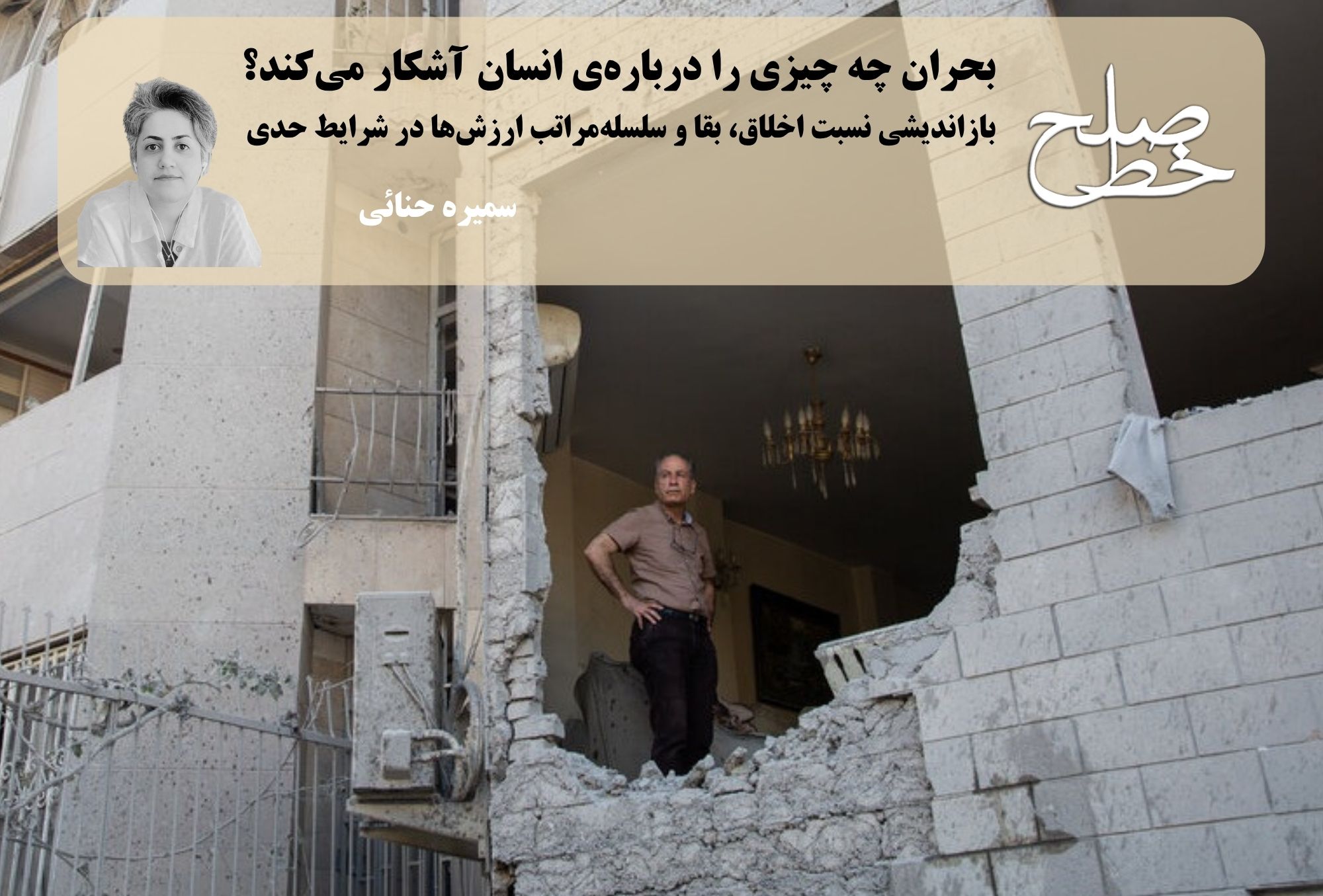
What Does Crisis Reveal About Human Beings? / Samireh Hanaei
War does not only destroy cities. Crisis does not only unravel political or economic order. Perhaps the deepest effect of crisis lies where it is less visible: the moment when a person realizes that they can no longer preserve everything that is valuable to them at the same time.
In ordinary life, many moral choices do not seem particularly difficult. Helping a neighbor, telling the truth, observing fairness, or sharing resources usually does not come at a cost that threatens a person’s existence. But crisis disrupts this balance. Suddenly, circumstances emerge in which every choice may come at the cost of losing another value. Should the last food in the house be shared with a neighbor or kept for the family? Should one risk one’s own life to save another? Is lying to preserve human lives still immoral?
These questions are not new. Moral philosophy has tried for centuries to answer them. But perhaps the more important question lies elsewhere. Why do people respond so differently to the same crisis? Why do some think only of their own survival, some go no further than their family, while others, even at the height of danger, preserve their sense of responsibility toward others?
The first answer can be found in the thought of Immanuel Kant. In his view, the validity of morality does not depend on circumstances. If an action is morally right, changing circumstances do not turn it into a wrong action, and if it is wrong, the difficulty of circumstances cannot justify it. The moral value of an action depends on its motive, not on the result it produces. For this reason, crisis cannot change moral principles; it can only make acting according to them more difficult.
This answer defends morality against relativism, but leaves one question unanswered. If moral principles are the same for everyone, why do people make different decisions in similar situations? Have all those who make difficult choices in a crisis simply moved away from morality?
Thomas Hobbes sees the issue from another angle. He believes that human beings, above all else, seek to preserve their own lives. From Hobbes’s perspective, morality and law take shape when people realize that without cooperation with others, even their own survival will not be possible. In this view, cooperation, trust, and adherence to rules are not merely moral virtues, but rational strategies for preserving life.
Hobbes’s view explains part of the reality of crisis. During war, earthquakes, or famine, if everyone thinks only of their short-term interests, society rapidly moves toward collapse. Even survival requires a minimum level of trust and cooperation. Yet this view also encounters examples that are not easy to explain. How are we to understand a doctor who, despite having the opportunity to leave a war zone, remains there? Or a person who risks their life to save a stranger, with no benefit awaiting them?
At this point, the issue is no longer merely the relationship between morality and survival. It seems that human beings, even under the harshest conditions, sometimes make decisions based on something beyond preserving life. But what is that “something”? Pursuing this question leads us toward an answer that neither Kant alone nor Hobbes can fully explain. Perhaps, in order to understand human behavior in crisis, we must ask whether the central issue is morality itself, or the way people choose among values that are all important to them.
Viktor Frankl, the psychiatrist who spent years of his life in Nazi concentration camps, raises a point that takes the discussion in another direction. He believed that even under conditions in which nearly all external freedoms are taken away from a person, one freedom still remains: the freedom to choose one’s attitude toward what has happened to them. For this reason, in Frankl’s view, human beings cannot be explained solely by the instinct for survival. If survival were the only driving force behind human behavior, sacrifice, empathy, and responsibility under conditions in which life itself is under threat would make no sense.
Yet this answer, too, creates a new question. If all human beings have the possibility of choice, why are their choices so different? Why, on the same street, does one person keep the last loaf of bread for themselves while another shares that same bread with a neighbor? Why does one doctor refuse to leave the city in the midst of war, while another seizes the first opportunity to leave? If none of these behaviors can be explained simply by “being good” or “being bad,” then where does the difference lie?
Perhaps the issue was somewhere else from the very beginning. We usually regard crisis as the moment when morality collapses, as though with the onset of war or famine, moral rules are also suspended. But is that really the case? Or is what changes not morality itself, but the conditions under which human beings are forced to choose?
At this point, the thought of Isaiah Berlin opens another horizon in this discussion. Berlin believed that human values, contrary to what many moral theories assume, are not always compatible with one another. Freedom, justice, security, loyalty, truth, or compassion may all be valuable, but in particular situations, the full realization of one may come at the cost of limiting another. In his view, the tragedy of moral life begins precisely here: not with choosing between good and evil, but with choosing between goods that cannot all be preserved at the same time.
If we accept this perspective, crisis takes on a different meaning. Crisis does not necessarily create new values, nor does it suddenly turn a person into a different being; rather, it creates a situation that reveals the conflict among values. What remains hidden in ordinary life becomes an unavoidable problem under extreme conditions: a person is forced to decide which value to prioritize over another.
In ordinary life, many values do not come into conflict with one another. One can be loyal to one’s family, help a neighbor, tell the truth, and preserve one’s own safety all at once. Crisis disrupts this balance. Suddenly, a person is placed in a situation where it is no longer possible to preserve all of these values simultaneously. Every choice means relinquishing another choice.
Perhaps for this reason, dividing people into “moral” and “immoral” under extreme conditions simplifies reality more than it helps us understand it. A person who stores all available food for their family during wartime may be the same person who is generous and giving under ordinary circumstances. Conversely, someone who appears entirely ordinary in everyday life may risk their own life to save another in the midst of a crisis. If people’s characters do not transform so completely over such a short period of time, perhaps what has changed is not the person, but the situation that has forced them to choose among values that are all important to them.
From this perspective, crisis does not destroy morality so much as increase the cost of living morally. Helping, telling the truth, remaining loyal, or acting justly are no longer low-cost choices when one’s life is in danger. This is precisely why moral actions appear more striking during crisis; not because morality does not exist in times of peace, but because adherence to it carries a much heavier price in times of crisis.
Perhaps the right question is not whether crisis makes human beings more moral or less moral. The question is how crisis forces people to reveal which value they are unwilling to lose when preserving all values is no longer possible.
Crisis is not a mirror that directly reveals the “true nature” of a human being. A person is not a static creature who, at the first shock, exposes some hidden face. What crisis reveals is the quality of a person’s choices at a moment when no choice is without cost. For this reason, a person should not be understood only by what they choose, but also by which value they have relinquished in order to make that choice. Perhaps extreme circumstances do not so much test morality as they test human beings; because only when preserving all values becomes impossible does it become clear which value a person is willing to preserve at the cost of losing others.
 Created By: Samireh Hanai
 August 23, 2026
Tags
Crisis Ethics Natural disasters Relativism