


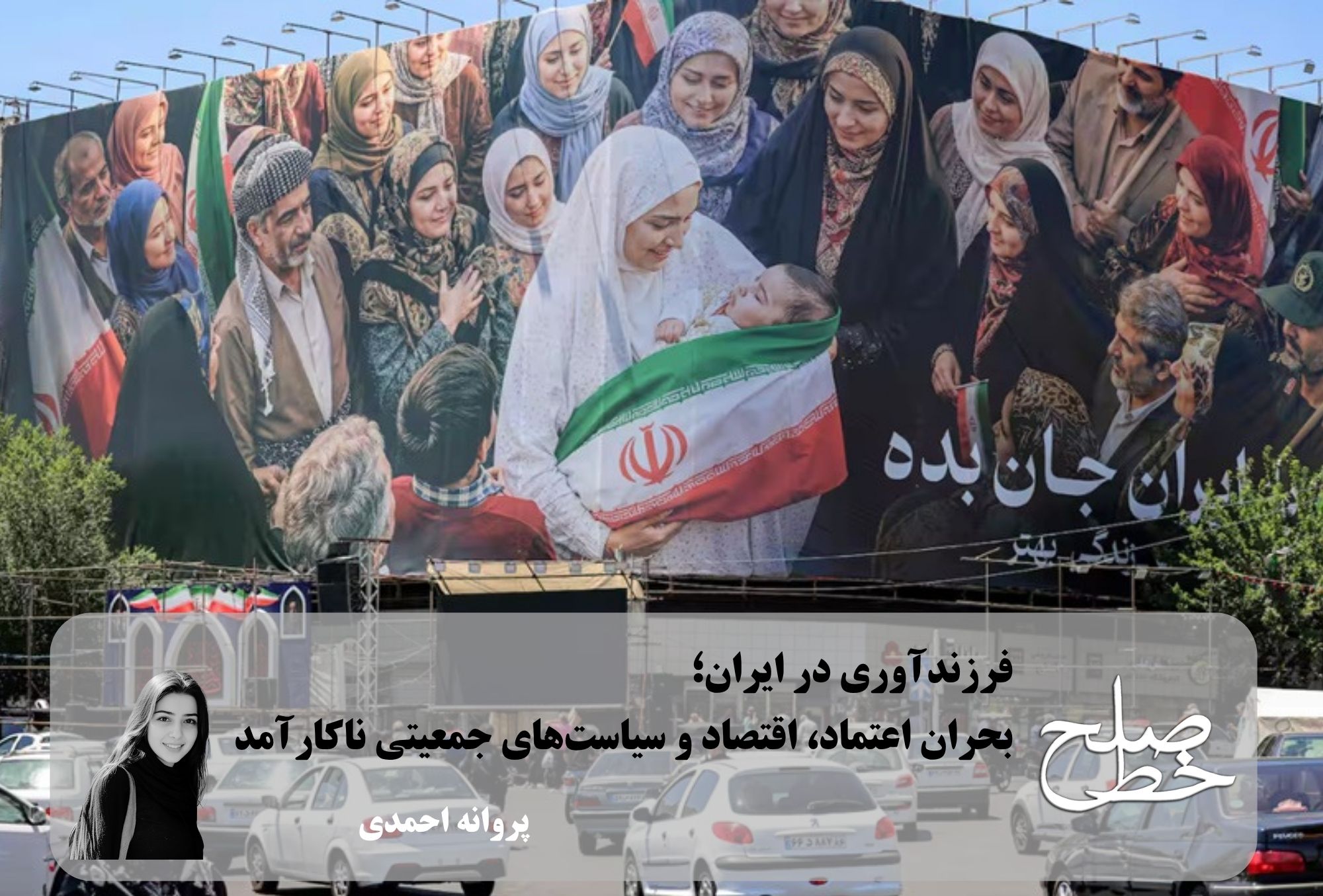
Childbearing in Iran: A Crisis of Trust, Economy, and Ineffective Population Policies/ Parvaneh Ahmadi
The decline in childbearing in Iran is no longer merely a statistical indicator or a demographic concern; it has become a sign of a deeper crisis in social trust, economic security, and the outlook for the future. In recent years, the government has repeatedly warned about the “aging of the population” and, through the adoption of laws and the implementation of extensive propaganda, has encouraged people to marry, have children, and even have a third and fourth child. Yet the daily experience of many families shows that the gap between official slogans and the realities of people’s lives grows wider every day.
According to World Bank data, Iran’s total fertility rate in 2024 was around 1.7 children per woman; a figure far below the population replacement level, which is about 2.1 children. The United Nations Population Fund has also estimated Iran’s fertility rate for 2025 at 1.7 and the share of the population aged 65 and over at around 9 percent. These figures show that Iran has entered a phase in which declining births and increasing life expectancy are gradually pushing the country’s age structure toward aging.
This trend is, of course, not unique to Iran. Many countries are facing declining fertility; but the important difference in Iran is that the childbearing crisis is taking place against a backdrop of chronic inflation, job insecurity, economic instability, rising housing costs, declining purchasing power, and widespread distrust of the future. When a family is under pressure even to pay rent, provide food, healthcare, education, and the basic needs of life, the decision to have another child is not seen as a simple family choice, but as a major economic and psychological risk.
The Iranian government views the issue of population decline mainly from the angle of “increasing the number of births,” not from the perspective of the child’s quality of life, the mother’s health, the family’s economic security, and women’s right to make decisions. This numerical outlook has caused many people to feel that policymakers are more concerned about population statistics than about the real lives of families. If the real goal were to support families, one would expect the state first to address stable employment, housing, health insurance, education, childcare, and financial support for mothers, and only then expect people to have more children.
One of the most important obstacles to childbearing is the cost of pregnancy and childbirth. From the very first weeks of pregnancy, families face the costs of tests, ultrasounds, periodic care, medication, maternal nutrition, and visits to doctors. Although services at health centers exist in some cases, many families, in order to ensure the health of the mother and fetus, are forced to visit gynecologists, private laboratories, and imaging centers; costs that are heavy and at times deterrent for the lower middle class and low-income families.
Meanwhile, restricted access to prenatal screening has been one of the most controversial consequences of the government’s population policies. The “Family Protection and Youthful Population” law, adopted in 2021 (1400), with the official aim of increasing the population, created restrictions in the areas of screening, abortion, and family planning services. Studies published in the field of public health show that these policies can lead to an increase in unwanted pregnancies, unsafe abortions, and reduced access for women to reproductive health services.
From the perspective of many families, limiting free or accessible screening means that the state is willing to impose the risk of the birth of children with physical or mental problems on families, without providing adequate support for their care, treatment, education, and rehabilitation. The main concern is not only the cost of screening; the more important issue is that families feel their right to make informed decisions about pregnancy has been taken away from them. When even in cases of severe fetal abnormalities, obtaining permission for abortion becomes difficult or impossible, the social message of these policies is clear to people: birth statistics have been prioritized over the health and dignity of families.
The crisis becomes deeper when the government, on the one hand, encourages families to have more children, and on the other hand, fails to provide even the simplest needs of infants. In recent years, numerous reports have been published about shortages or high prices of infant formula, rationing of its sale, the need for a national ID card to purchase it, and a sharp increase in diaper prices. For a family that must search several pharmacies to find infant formula, official propaganda about “more children” looks more like disregard for the realities of people’s lives than a supportive policy.
Individual accounts also confirm this picture. A 34-year-old woman with two children explains that an unwanted pregnancy brought her fear and anxiety instead of joy; because she and her husband, despite working, are unable to cover the costs of living, school, food, clothing, and medical care for their children. A 30-year-old man, despite three years of married life, still does not dare to have a child; because every day he worries about losing his job, rising rent, and an unstable future. A 40-year-old mother of three also tells Peace Mark Monthly Magazine that today’s conditions are not comparable to previous years, and that even providing basic items for a child has become a serious concern.
These accounts show that the decline in childbearing cannot be explained merely with phrases such as “change in lifestyle,” “weakening of family culture,” or “promotion of individualism.” In many cases, families do not have children not because they consider family worthless, but because they do not want to bring a child into a cycle of poverty, anxiety, insecurity, and lack of a future. Contrary to official propaganda, this decision often stems from responsibility, not irresponsibility.
The consequences of the continuation of this trend for Iran will be serious. In the short term, declining births may perhaps be seen only in the form of smaller families, but in the medium and long term, it will lead to a decrease in the young population, a smaller labor force, an increased financial burden on pension funds, greater pressure on the healthcare system, and higher costs of caring for older persons. The United Nations Population Fund has predicted that by 2050, around 27.9 percent of Iran’s population will be over the age of 60; a figure that indicates the rapid pace at which Iranian society is aging.
However, the solution to the population crisis lies not in coercion, restriction, ideological propaganda, or ignoring women’s rights, but in rebuilding public trust and creating real conditions for forming families. Global experience shows that population policies are effective when they are accompanied by tangible support: accessible housing, stable employment, effective health insurance, maternity and paternity leave, affordable childcare, quality education, support for working mothers, and respect for families’ right to choose. Without these infrastructures, promoting childbearing is not only ineffective, but can also create greater anger and distrust.
Ultimately, the childbearing crisis in Iran is less a crisis of “people’s desire to have children” than a crisis of hope, security, and trust. People think about their child’s future when they themselves have a future they can imagine. As long as inflation, unemployment, high housing costs, job insecurity, weak healthcare support, restrictions on reproductive health, and distrust of policymakers continue, many families will not be willing to sacrifice the lives of their future children for population slogans. The main issue is not that people do not want to have children; the issue is that the government has created conditions in which childbearing has become a costly, risky, and sometimes impossible decision for many families.
Footnotes
World Bank. (n.d.). Fertility rate, total (births per woman) – Iran, Islamic Rep. World Bank Open Data. Retrieved August 4, 2025.
United Nations Population Fund. (n.d.). Population ageing and disabilities. UNFPA Iran. Retrieved August 4, 2025.
Mousavi, S. A., & Zahedi, R. (2025). Population law, reproductive health, and public health implications in Iran. Medical Journal of the Islamic Republic of Iran, 39, 24.
 Created By: Parvaneh Ahmadi
 June 22, 2026
Tags
Demographics Increase in population Miscarriage Population aging Population decline Population policies Pregnancy Procreation